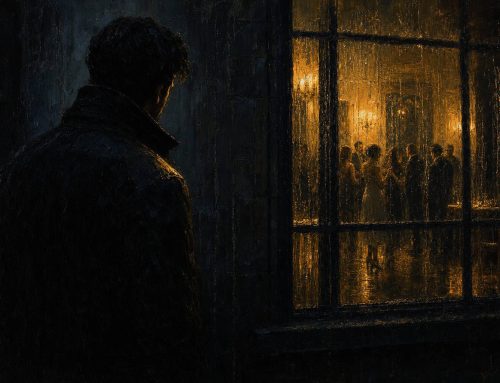
The moment when all accounts come due, and the body itself becomes the witness stand.
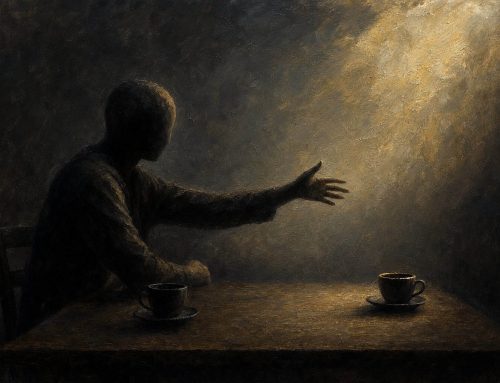
You know it first through the tremor in your hands as you reach for the morning coffee, the cup suddenly too heavy, as if gravity itself has shifted to press your accumulated history down through your bones. The ledger you’ve kept—that careful tallying of acts justified and omissions explained—begins to blur at the edges. Not because the entries fade, but because they multiply, each rationalization spawning its shadow, each defense revealing what it was built to hide.
The mirror this morning holds a different quality of light. Not harsh, not merciful—simply flat, like heaven’s own silence. You see the face you’ve worn to different audiences, the slight adjustments of expression you’ve mastered for each context, and for the first time, they all appear simultaneously. The competent professional, the devoted believer, the careful friend—each mask transparent now, overlapping like multiple exposures on old film. “She is both the person standing in front and behind the mirror, herself and her replicant, and her shadow and its source.”
The Arithmetic of Fragments
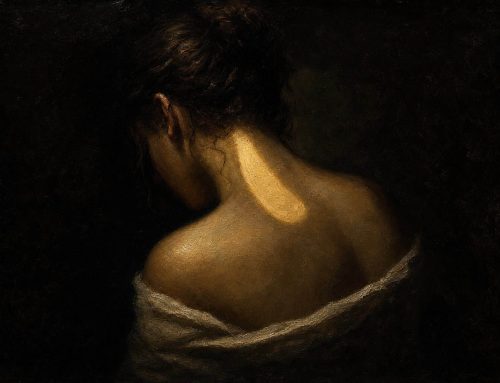
Your body knows before your mind admits. The tension you’ve carried for years in your shoulders—that weight you attributed to stress, to circumstance, to anything but its true source—announces itself as testimony. Each knot of muscle holds a choice unmade, a truth unspoken, a harm unacknowledged. The body has been keeping its own books all along, recording every moment you chose the comfortable lie over the difficult truth, every time you “made a clean, practical calculation that served all parties” except the part of you that knew better.
You’ve distributed yourself so carefully across different contexts. At work, you are efficiency itself, your competence a shield against deeper questions. At home, you perform a different dance, the steps memorized so thoroughly you barely notice you’re dancing. In moments of prayer—if you still pray—you offer up the version of yourself you think heaven wants to see, though you suspect heaven sees through it all. “Rather than perform a lie before God and ask for performative forgiveness, I accepted what I was and, out of a strange respect for the sanctity of the Eucharist, abandoned it completely.”
The fragments have their own logic. Each piece contains enough truth to be believable, enough performance to be safe. You became expert at the subtle calibrations—”word choice, posture, and distance passed through my instinctual awareness”—reading every room, adjusting your presentation like a trader in that marketplace “where worth was appraised quickly, traded often, and lost easily—a place where silence could be both shield and sentence.”
The Column of Evidence
But now the columns begin to merge. The careful compartments you’ve maintained start leaking into each other. The pride you’ve dressed as humility, the greed you’ve called prudence, the wrath you’ve named righteous anger—they all stand revealed in their true forms. The spiritual scalpel you once imagined you were using to excise impurities from your soul turns out to have been cutting away the very parts that might have kept you whole.
He sees the hidden motivations of the heart animating behavior. He values sincerity—appreciating two copper coins as being greater than thirty pieces of silver!
The divine seeing you once feared becomes almost a relief against the weight of your own self-deception. At least that gaze is honest. At least that witness sees what is, not what you’ve crafted for display. “Pride is worship with the mirror for a tabernacle,” and you’ve been both priest and congregation in that hollow liturgy.
Your accumulated acts rise up—not as external accusation but as simple fact. The faces of those you’ve harmed appear not as angry specters but as calm witnesses. They don’t need to accuse; their presence alone is testimony. The gap between who you claimed to be and who you actually were opens like a chasm, and you find yourself stranded on one side, looking across at the life you pretended to live.
The Collapse
The moment arrives without announcement. You’re standing in your kitchen, or sitting at your desk, or walking down a familiar street, and suddenly your knees buckle. Not from external force, but from the simple inability to carry the weight one moment longer. The body that has been your co-conspirator in maintaining appearances finally refuses. Tears arrive without your permission, without even sadness—just the pure release of what can no longer be contained.
The body keeps its own books, recording every moment you chose the comfortable lie over the difficult truth.
Your intellect, that faithful architect of justifications, drags now like a broken sword. The frameworks you built to explain yourself to yourself reveal themselves as prisons. Every carefully constructed argument for why you had to do what you did, why you couldn’t have chosen differently, collapses into rubble. “Resigning ownership over personal freedom, choice, and responsibility to others, ignoring death and finitude”—this was the real betrayal, not of others but of your own capacity to choose.
The silence that meets your collapse is neither condemning nor absolving. It simply is. Heaven offers no verdict because the verdict is already written in your bones, in your tears, in the fragments of self scattered across all those careful performances. “Faith is something that cannot be proven; it is something that either one has or one does not have,” and in this moment, even faith becomes irrelevant next to the simple fact of what you’ve done and left undone.
The Witness Stand
Your body becomes the courtroom. Each muscle holds memory, each gesture testifies. The hands that signed documents, that reached out or held back, that built walls or bridges—they all speak their truth now. The mouth that formed so many carefully chosen words, that swallowed so many others, opens now only to release sounds that aren’t quite words, aren’t quite sobs, but something more primal—the voice of recognition itself.
“Unlike angels, we are now born into ignorance and must climb toward wisdom through years of pain and discovery. That makes us weaker—but also forgivable.” But forgiveness isn’t what arrives in this moment. What comes is simpler and more terrible: the plain truth of what is. No interpretation, no framework, no meaning-making system to soften the edges. Just the raw fact of your choices and their consequences, “the consequences or results that manifest in their wake.”
Consent is not a courtesy; it is how heaven moves. Hold this truth; weigh your own bonds against it.
You realize that every choice was yours, even the choice to pretend you had no choice. Every fragment you created was an attempt to avoid this moment of total accounting, this collapse of all defenses into simple acknowledgment. The arithmetic of self-protection reveals itself as the very structure of your imprisonment—each calculation adding another bar, each rationalization tightening the lock.
The Undeniable Sum
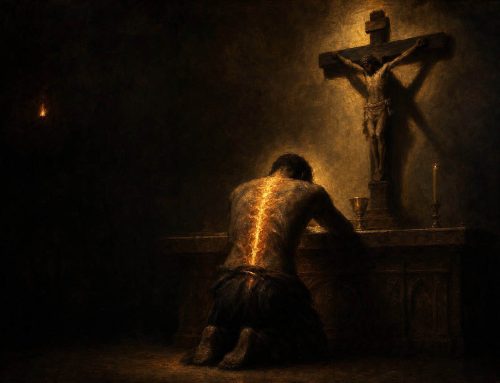
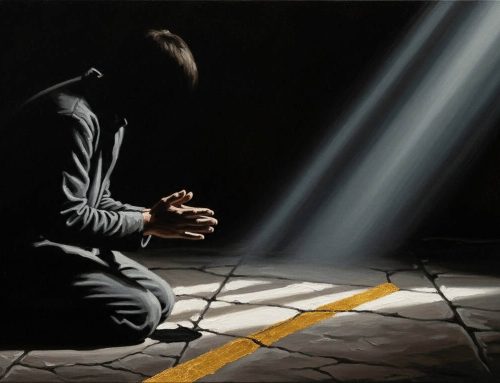
What remains when all strategies fail? When the performances end, when the fragments can no longer maintain their separation, when the body itself refuses to carry the divided self any longer? You find yourself on your knees—literally or figuratively—facing the sum of what you’ve been. Not what you intended to be, not what you told yourself you were becoming, but the actual accumulation of choices made and unmade.
“Had I not written these words… my Master would have held me accountable for wasting His investment. And a good servant wants to please his Master.” But which master have you been serving? The internalized expectations of others? The image you’ve cultivated? The fear of being seen as you actually are? The reckoning reveals that you’ve been your own harshest master, demanding performances that no divine authority ever required.
The tears continue, but they’re different now. Not the tears of self-pity or even remorse, but the tears of recognition. The body knowing what the mind still struggles to accept. The flesh testifying to truths the spirit has been avoiding. “All that remains is for the man to acknowledge her absence and walk away from the altar she refuses to tend”—except the absence is your own, the altar is the false self you’ve been tending, and the walking away is really a walking toward what you’ve always been beneath the performances.
The Horizon of Truth
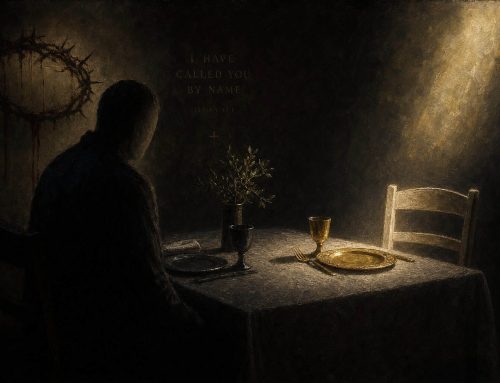
“So, I leave these confessions in the chair, not as a closed account, but as witness to a process that continues. The ascent moves forward by consent.” The reckoning doesn’t end with collapse; it opens onto something else. Not redemption—that would be too easy, too much like another performance. Not absolution—that would require an authority you’re not ready to acknowledge. Just the simple, terrible freedom of having nothing left to hide.
The intentional horizon of reckoning stretches toward a place where “concepts such as fact, truth, honor, loyalty, love… appear within the horizon of limitation.” Where the finite self, stripped of its elaborate defenses, might finally consent to being what it is: limited, mortal, capable of both harm and healing, carrying the full weight of its choices yet no longer crushed by the need to justify them. The ledger remains, but it’s no longer secret. The mirror still reflects, but you’re no longer performing for it. The silence continues, but it’s no longer empty—it’s full of the possibility that comes only after the last defense has fallen, the last calculation has failed, and the truth stands naked in its own light, neither condemned nor absolved, simply and terribly free.