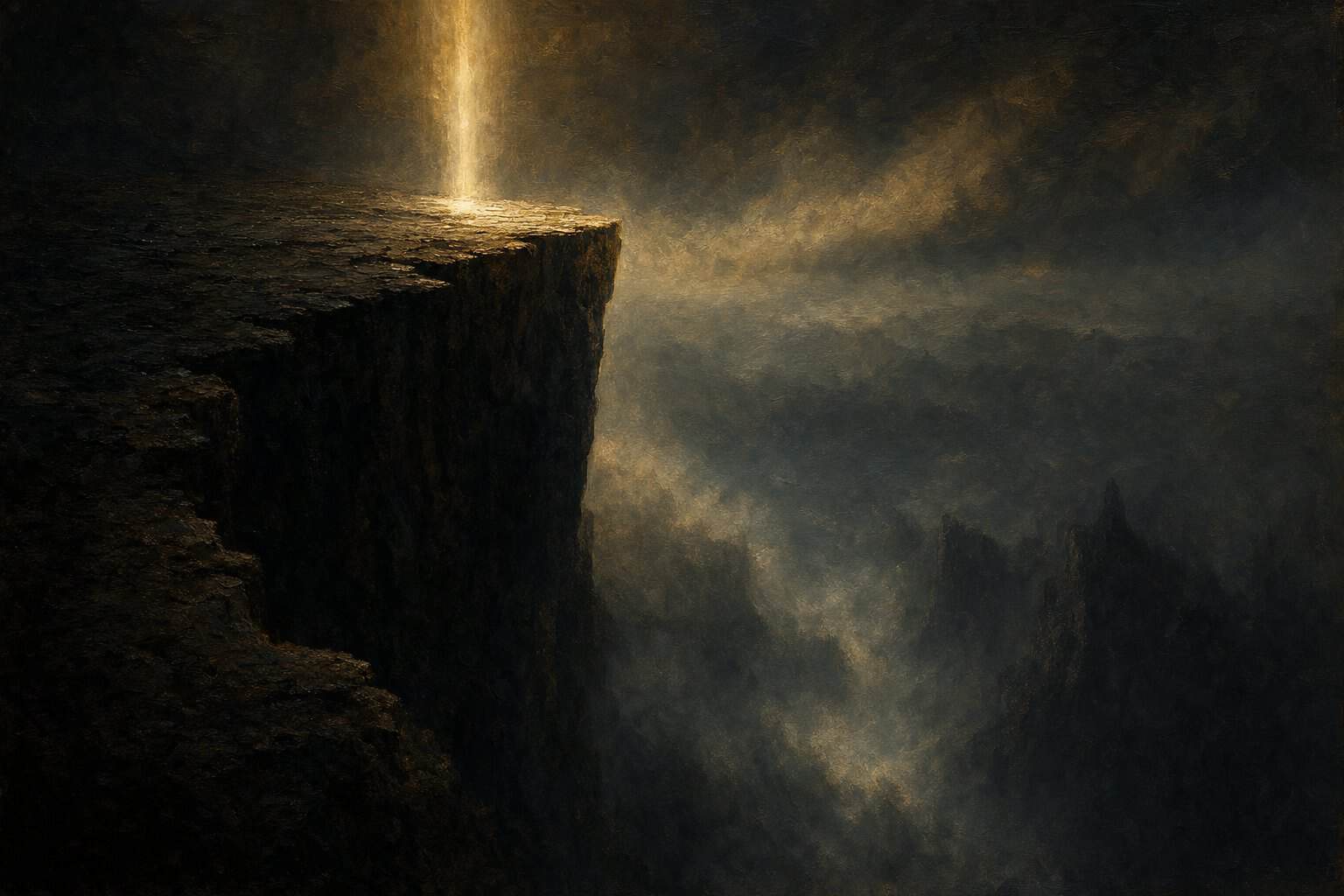
Before the will can choose, something has already trembled in it – the dizziness of a freedom we inherited, and inherited already wounded.
The Vertigo Before the Fall
Kierkegaard offers, in The Concept of Anxiety, an image that has never been improved upon: anxiety is the dizziness of freedom. When the eye peers down into an abyss, he writes, it grows dizzy – but the dizziness lies as much in the eye as in the depth. So it is with the soul before its own possibility. Anxiety is not fear, for fear has an object; the beast in the road, the fire on the stair. Anxiety has no object, or rather it has for its object the whole open field of what one might become. It is the mood that arises not from any particular threat but from the sheer fact of being a creature who can. Through the lens of the site’s grounded scholarship, John MacQuarrie clarifies precisely this: Angst is ‘the basic way one finds oneself,’ a primordial mood that discloses being-in-the-world itself rather than any specific danger. It is not an empirical emotion to be studied and cured. It is a disclosure. It shows you, before you have done anything at all, that you are the kind of being for whom everything is at stake.
The Primal Mark
In Confessions to the Empty Chair there is what the memoir names the primal mark – the wounds that crossed thresholds we never opened. This is the crucial phrase. Not thresholds we opened rashly, not doors we flung wide in appetite; thresholds we never opened, and yet the wound came through them anyway. Here Kierkegaard’s genius becomes indispensable, because he refuses two easy accounts of such a wound. The first would make the child simply a victim, purely acted upon, a passive surface on which harm was written. The second would make the child guilty, complicit, somehow deserving. Kierkegaard’s third way is stranger and truer: he speaks of anxiety as the state in which innocence and its own undoing are already intertwined – the child dreams of freedom before it possesses it, and that dreaming is itself a kind of trembling. The primal mark is not chosen. But it inscribes into the not-yet-choosing self the whole vocabulary of dread. You learn the shape of the abyss before you have ever stood at its edge deliberately, and thereafter the edge is where you live.
The Inheritance of Sin
The memoirs speak of the inheritance of sin – the child’s inherited poison crystallizing into adult choice. Kierkegaard is the philosopher who thought most carefully about exactly this crystallization, and he did so precisely to break the machinery of blame. He distinguished the inherited condition from the qualitative leap of the individual act. Adam does not transmit sin as a bloodline transmits a disease, mechanically, so that we are guilty for what another did. Rather, each person enters a world in which sinfulness is already the atmosphere, the presupposition, the very air – and then each person makes the leap themselves, freshly, incomprehensibly, into their own transgression. Anxiety is the hinge between the inherited and the enacted. The poison is given; the crystallization is done. This is very close to what Anthony calls post-edenic ontology, the self as always-already fallen. We do not begin at zero and fall. We begin fallen, thrown – MacQuarrie’s development of Heideggerian thrownness is exact here – into a condition we did not author, and only then are we asked to answer for what we make of it. Grace does not undo the inheritance. It meets us in the leap.
You did not choose the wound at the edge of the abyss – but the vertigo you feel there is not yet your fall; it is your freedom, and your invitation.
Where Dread and Desire Are Indistinguishable
This is the vertiginous truth the corpus circles again and again: at the edge of one’s own possibility, dread and desire cannot be told apart. Kierkegaard names this with unnerving precision – anxiety is ‘a sympathetic antipathy and an antipathetic sympathy.’ We flinch from the abyss and we lean toward it in the same motion. The recovering man before the temptation knows this in his body: the very thing he most dreads is charged with a pull he cannot honestly deny. MacQuarrie’s reading helps us keep this from collapsing into mere pathology. He shows how this mood opens ‘the possibility of both falling into inauthenticity and awakening to authentic existence’ – the same trembling is the gate to both. The vertigo is not itself the sin. It is the condition of being free, and freedom, borrowing Berdyaev through MacQuarrie, is meontic, rooted in nothingness rather than in being. It contains, at once, creative possibility and the seed of its own destruction. To feel the dread of your own desire is not yet to have fallen. It is to have arrived, fully, at the place where a self is decided.
The Empty Chair and the Courage to Tremble
What, then, does one do with the dizziness? The temptation is to numb it – to flee into das Man, the anonymous ‘they,’ where no one trembles because no one is anyone in particular; or into the bad faith that pretends the wound was destiny and the leap was never a leap. But the confessional posture of the memoirs refuses both anaesthesias. To confess before the empty chair – the seat of the unseen listener – is to hold oneself open at the very edge, neither denying the inheritance nor disowning the choice. This is Kierkegaard’s astonishing reversal, the one MacQuarrie draws out: anxiety is not only the precondition for sin but the propaedeutic to faith. The same dizziness that could pitch you into the abyss is the dizziness that, borne rightly, teaches you. He who has learned to be anxious in the right way, Kierkegaard says, has learned the ultimate. You do not seek a life without vertigo; that would be a life without freedom, without a self. You seek instead to stand at the edge with the whole truth of your thrownness confessed and your possibility still open – and to let the trembling become, at last, prayer. The chair is empty only to the eye. Anxiety was always the mark of a listener already there.