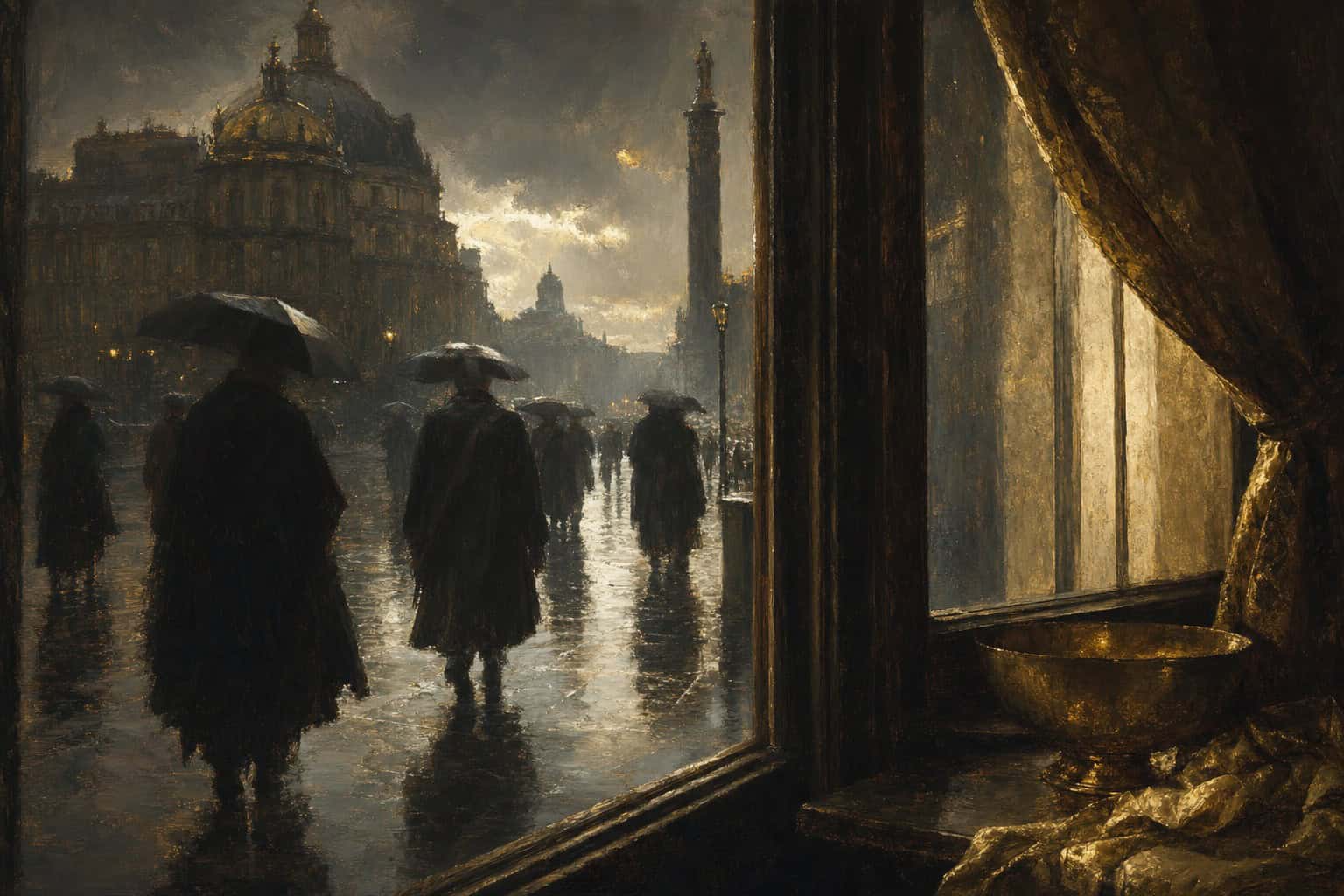
Rain smears the sidewalk into one gray blur and he walks fast inside it, brushed by strangers, half in love with how easy it would be to dissolve into the current and simply be no one.
Footsteps Blurred on the Wet Pavement
Rain streaks the sidewalk into one long gray smear, and every passing body becomes part of that same moving blur. The narrator walks fast, shoulders brushed by strangers’ coats, shoes striking the pavement in a rhythm that doesn’t belong to him alone anymore. No one here knows his name, his losses, the vows he’s broken or the ones he still pretends to keep. In this narrow stretch of city, bordered by storefront glass and the rattle of buses, he discovers a brutal kindness: the crowd unhooks him from his own story. He is reduced to weight, heat, motion, another set of footsteps on wet concrete. That reduction feels like air after drowning and like treason in the same breath. This is not sightseeing; it is hiding in plain view, letting the city scrub his features until even he has trouble recognizing the man whose life used to feel so specific, so inescapably his.
The Body That Turns Before the Thought Arrives
At a crosswalk, before the signal shifts, his torso has already angled toward music leaking from an open bar door, hips hitching almost imperceptibly. The decision happens below the neck: a tilt of the head, a pause in his stride, knees softening toward the bass line pulsing through brick. His mind, still trained to calculate and forbid, starts its usual litany of reasons to keep walking—vows, failures, theories about self-control and purity. But the flesh has already voted. Shoulders square themselves to the sound, feet find a slower cadence, and his whole frame leans toward warmth and noise like a plant toward sun. In this tiny, almost invisible turn, the tidy world of arguments and systems loses jurisdiction. Desire acts as its own magistrate, issuing a quiet command the intellect can only chase after, breathing hard and late.
Bass Vibrations Against a Hollow Chest
Inside, the speakers send low frequencies straight through his sternum, the bass thrumming against a chest that has felt hollow for months. Lights smear across sweat-slick faces, and the air is thick with perfume, beer, and human heat. He doesn’t dance so much as sway at first, muscles stiff from long obedience to stillness, from years of treating the body as a problem to be solved rather than a creature to be trusted. Each beat is a small assault on that frozen discipline, a steady pounding on the sealed vault of his grief and his carefully defended holiness. This movement is not noble. It is hungry, awkward, tinged with panic—the flailing of a spirit that both fears and craves being touched by anything stronger than its own control. Nothing is resolved here. The music only keeps pressing, and his body keeps answering, however clumsily, to a call he never gave it permission to hear.
When the weight of being yourself grows unbearable, disappearing feels like mercy, and that is the most dangerous gift the city offers.
Smuggled Joy in the Lining of an Ordinary Coat
Later, when the night cools and the street empties a little, he carries something the way a child might pocket a stolen sweet. No one around him knows what happened inside that humid room, what small resurrection took place when his shoulders finally dropped and his lungs filled to the bottom with loud, smoky air. There is no plan to confess it, to analyze it, to hold it up for correction or approval. Instead he tucks the memory deep, like a note folded into the lining of his coat, close to the warmth of his ribs. In a life ruled by scrutiny—his own and others’—this unshared fragment becomes a hidden ration. Not because it is filthy, but because it is his, and being allowed to own one hour of unaccounted-for aliveness makes the rest of his examined, argued days slightly more survivable. The church will not see this moment. Neither will his enemies. It moves forward with him, silent, pressed flat against his skin.
A Heartbeat Heard Under City Sirens
As sirens flare and fade somewhere beyond the next block, he becomes aware of another sound beneath them: his own pulse, steady again after months of erratic panic and practiced numbness. The awareness does not feel pious. It feels incriminating, as if being alive with this much intensity must mean he has betrayed someone, or something sacred, that asked him to stay broken as proof of his love. Yet the stubborn tapping in his chest refuses to apologize. The city does not offer theology, only traffic and neon, yet in that raw mix he has stumbled into a question prayer has never quite let him ask: whether God can tolerate a man who is not only sorrowful, but vividly, dangerously alive. No answer rises up from the pavement. There is only the aftertaste of sweat and music, the cool night air on his flushed face, and the unignorable thud of blood insisting on its route through his veins like a drum someone else keeps playing.