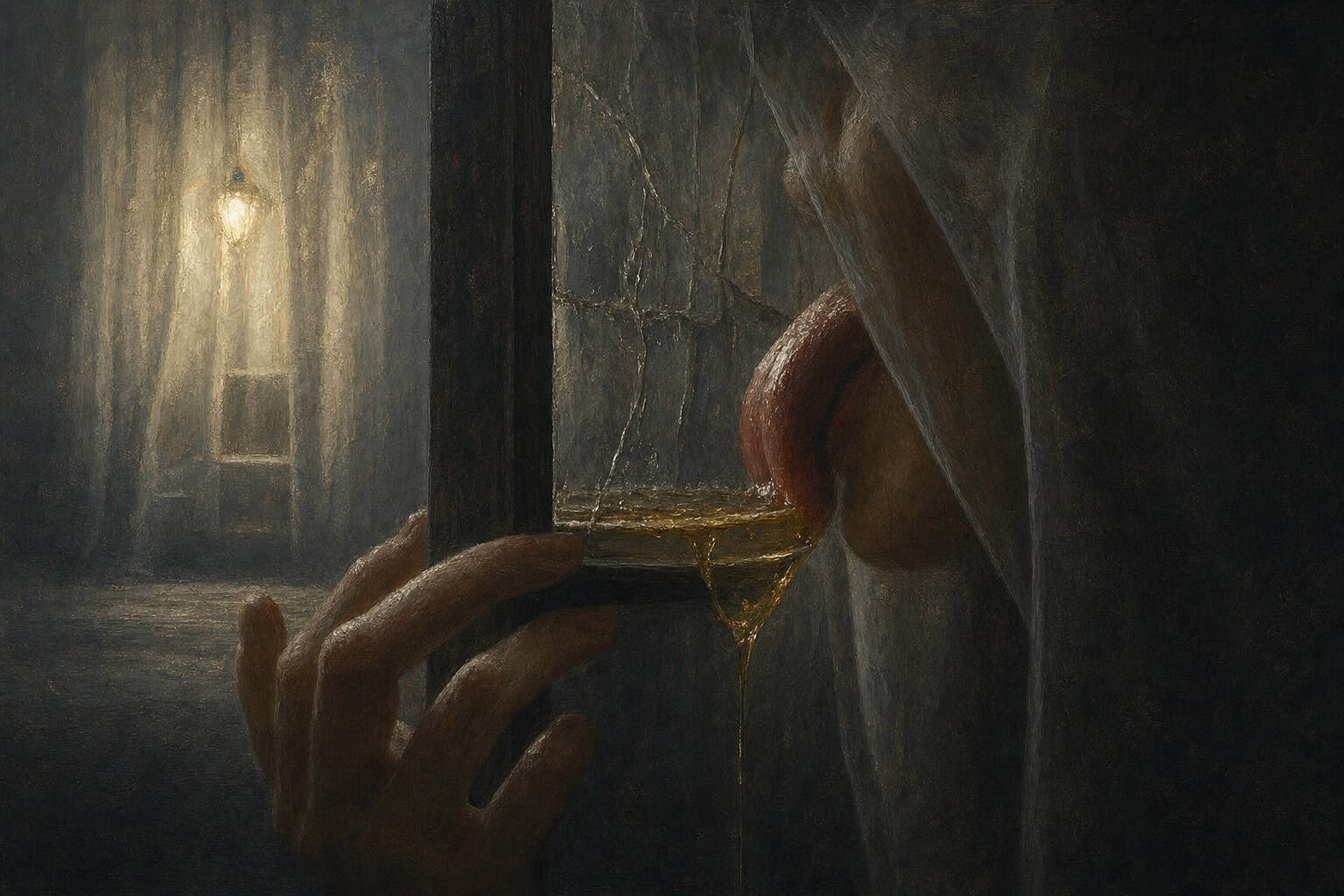
Someone offers him care in small human ways — a question that lingers, a gaze that stays — and it reaches a mouth that has only known rust, so that even honey arrives faintly poisoned.
Honey On A Tongue That Only Knows Rust
He is not alone, yet his body behaves as if the room were already empty. Across from him, care is offered in small, human ways—a question that lingers, a voice that does not rush, a gaze that neither devours nor looks away. It should be simple: receive, answer, soften. Instead, he tastes a familiar metal rising from the back of his throat, as if every past abandonment had dissolved into his saliva and now coats this moment. The sweetness in front of him touches that bitter film and changes flavor before it can be known. He notices this in real time, like watching clear water cloud as it passes through a dirty glass. Those born into neglect, he realizes, never got the practice of tasting love clean between servings. Every new gesture arrives pre-mixed with the memory of hands that once let go too soon. What looks from the outside like intimacy becomes, inside his chest, the slow tightening of a trap.
When Care Slides Across A Scratched Glass
As he sits in this exchange—part therapy, part confession, part charged encounter—another realization presses in: it is not only his tongue that has learned this bitterness, but his sight. The person before him leans forward with what appears, by all ordinary measures, to be concern. Yet his mind, trained by earlier deficits, parses each gesture like a hostile text, reading double meanings where there may be none. A question about his pain becomes a strategy to mine him. A pause meant to hold space becomes proof of boredom. He senses how a tiny, original scratch on his trust has spread across the lens until every face is refracted through it. He can describe this mechanism clearly, almost coldly, as though analyzing someone else. Still, the knowledge does not stop his body from flinching. The very clarity that should free him instead exposes the depth of the crack that now governs how every kindness arrives: bent, darkened, suspect.
The Tongue That Craves Salt And Spits Out Honey
Pressure gathers as he recognizes that his interior filter is not neutral; it has chosen a side. His whole organism operates like a reversed gate: it lets in what harms and bars what might mend. A steady, unhurried presence in this moment pricks him like a thorn, while the memory of harsher, more chaotic connections glows with a crooked warmth. He notices an urge to pull back from the one who stays and to lean, in imagination, toward the one who withholds. It feels less like a decision and more like gravity—his body trusting the familiar burn of deprivation over the strange softness of provision. Inside this single conversation, he watches his defenses sort input with ruthless efficiency: tenderness is flagged as danger; subtle exploitation slips through as if coded as home. The scene tightens around that awful recognition: his own guard dog now bites the hand that feeds and nuzzles the thief at the window.
When early wounds teach us to taste love through the residue of abandonment, every new tenderness arrives already faintly poisoned by what came before.
When Your Mouth Waters For What Hurts You
An ordinary reader does not need his exact history to feel the sting of this pattern. You may notice it in smaller, quieter ways: the text from the reliable friend that you delay answering, while you obsess over the one who stays vague. The gentle question from a partner that makes your shoulders clench, even as you chase after those who leave you guessing. Praise feels suspicious; neglect feels like air you already know how to breathe. Your body, like his, may have learned early that love arrives paired with threat, so now even clean affection carries the echo of danger. You can outline the cycle, mock your own taste, even swear you will choose differently next time. Yet when the moment comes, your mouth waters for what has always hurt you, and genuine care tastes strangely flat or cloying. This passage names that misalignment not as mere foolishness, but as a learned survival script that will not loosen itself.
Learning To Name The Bitter Film Without Spitting Out The Honey
By the end of this passage, nothing has been fixed; the tongue has not been washed clean. The man remains someone for whom every new sweetness passes through an old residue, so that love and abandonment arrive fused on his palate. He understands now that his interior membrane, meant to guard life, was trained too young on the wrong substances and has been misfiring ever since. The text does not offer an easy purge, some sudden power to taste rightly. Instead, it lingers in the narrow, almost cruel space where one can see the distortion and still feel ruled by it. The question hanging here is not how to erase the bitter film, but whether a person so marked can learn to name its presence while not dismissing the honey altogether. The scene closes less like a cure and more like a man holding a glass he knows is stained, watching clear water poured again, and choosing—for now—only to keep looking at what shimmers through the clouded sides.