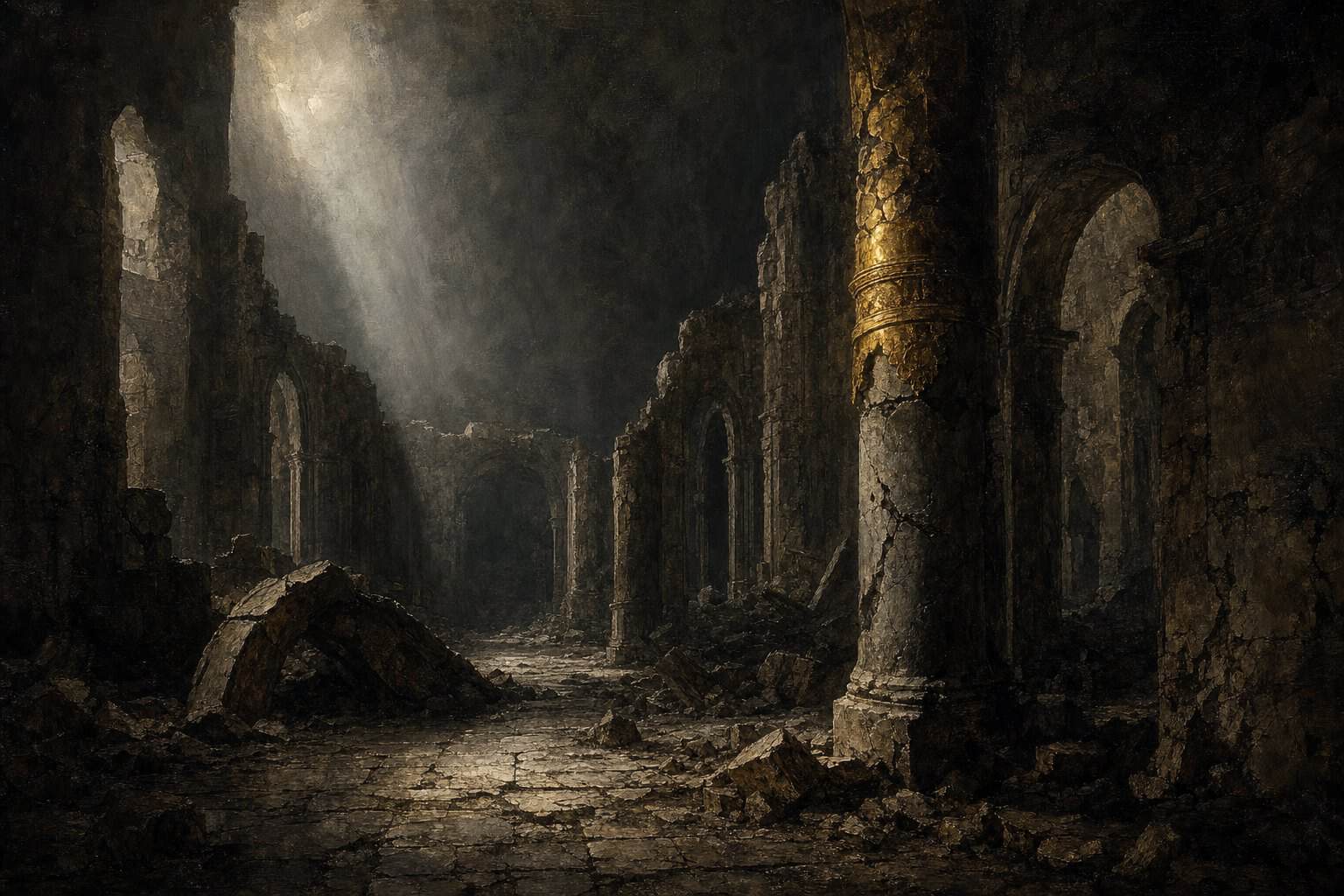
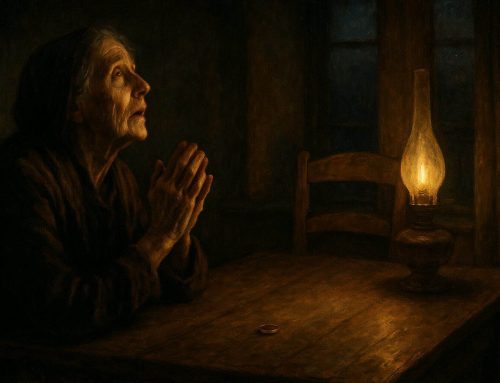
You do not fall once and remember it; you wake each morning already fallen, and the whole of a life is learning to build inside that ruin.
Waking Already Fallen
Consider the difference between falling and having-fallen. To fall is a moment, an event with a before and an after, a crisis you could in principle narrate. But the condition Heidegger names Verfallen is not an event; it is a mood you were already in when you came to. Dasein, he insists, does not choose its situation freely and then descend into distraction — it finds itself already delivered over, already absorbed, already interpreting itself through the borrowed voices of das Man. This is thrownness: not the crime but the finding-oneself-at-the-scene, hands dirty, unable to remember the innocence you are somehow certain you have lost.
This is the quiet, terrible premise beneath Anthony Adoré’s Confessions to the Empty Chair. The confessing self does not report a single transgression. It reports a state. What the empty chair hears is not ‘I did wrong on this date’ but ‘I woke into wrongness, and cannot locate its origin.’ Post-Edenic ontology names precisely this: the fall is not a thing that happened to me; it is the ground on which I first became aware of standing. I did not exit Eden. I opened my eyes east of it.
The Will That Wills and Wills Not
Augustine gives this condition its most unbearable interior. In the Confessions, he does not describe a will that is weak, as if it merely lacked force. He describes a will that is doubled — I willed and I willed not — a single faculty at war with itself, commanding and disobeying in the same breath. This is the disordered will: not the absence of desire but its fragmentation, love pointed at too many finite things, each promising and none satisfying the infinite longing beneath. His theft of the pears is the perfect emblem, because he stole not for the fruit but for the theft itself. The will chose ruin for ruin’s sake, and could give no account of why.
Here Augustine and Heidegger clasp hands across fifteen centuries. What Heidegger describes structurally — a self scattered into the everyday, fleeing its own possibilities — Augustine describes as a wound: our heart is restless, until it repose in Thee. The restlessness is not a failure of the self; it is the self’s constitution after Eden. And the prayer that condemns the whole of it, Grant me chastity, but not yet, is bad faith made devotional — the will bargaining with its own liberation, preferring the familiar architecture of its captivity to the terror of being made whole.
Fallenness Is Not Sin
It is crucial not to moralize this too quickly. Fallenness, in Heidegger’s sense, is not a verdict; it is the everyday texture of being-in-the-world. To be absorbed in one’s concerns, to speak the idle talk that circulates without origin, to interpret oneself through the tradition one inherits — these are not crimes. They are the water we swim in. The danger is not that we are fallen but that fallenness conceals itself, presenting the borrowed life as though it were the chosen one. The They is most powerful precisely where it is invisible, where its interpretations feel like our own most private thoughts.
This is why post-Edenic ontology is an ontology and not merely a confession of guilt. It describes a condition prior to any particular fault — the way Vorhandenheit, the world reduced to mere present things, covers over the living referential whole. The fallen self does not primarily sin against a commandment; it lives at a distance from its own Being, and only later, in fever or grief or the sudden silence before the empty chair, does that distance become audible. Adoré’s memoirs work this seam relentlessly. The sins, when they come, are almost secondary. The scandal is the ground beneath them: a self estranged from itself before it ever raised a hand.
You do not repair the fall by pretending you might return to Eden; you build a life by confessing, each morning, that you woke already east of it.
Building Inside the Ruin
What then does it mean to build a life, a faith, a love upon this foundation? Not to repair Eden — that gate is barred and the seraph does not sleep. The temptation of the fallen self is always restoration, the fantasy of returning to a wholeness one imagines having possessed. But this is another face of bad faith: it treats the fall as reversible, a wrong turn we might retrace. The Fractions of the Soul teaches otherwise. You do not reassemble the fractions into the original coin. You learn to live as fraction, to love as fraction, to build cathedrals with broken stone.
The relational patterns Adoré renders obliquely — the ache one might name after Jeannètte, that hunger to be seen wholly by another and the recoil when the other’s gaze reveals you as you are — these are the Augustinian restless heart mistaking a finite face for the infinite rest. To love inside post-Edenic ontology is to love knowing that the beloved cannot heal the fracture, and to love anyway, without demanding of the finite what only the eternal can give. This is not resignation. It is the beginning of an ordered love: ordo amoris, desire finally aimed at the one object that does not diminish under longing.
The Empty Chair as Clearing
And so we return to the chair, empty and waiting. Read through Heidegger, it is a clearing — a Lichtung, the open space where Being might show itself once the chatter of everyday self-interpretation falls silent. Read through Augustine, it is the intimacy of the God who was within while I was abroad, more inward to me than I am to myself, and therefore recognizable only when I stop fleeing into the world’s noise. The two readings do not compete. The confessing self speaks toward an absence that is also a presence, a silence that listens, a seat kept for the One who was never absent but only unnoticed.
To confess to the empty chair is not to fix the fall. It is to stop pretending it did not happen, to cease the elaborate flight of the They-self, and to let the condition become audible in its own words. You wake having-fallen. You will wake so again tomorrow. But between the waking and the sleeping there is a chair, and a silence that leans forward, and the strange grace of being heard exactly as you are — fractured, thrown, restless, and for the first time honestly present. That honesty is not the end of the fall. It is the only floor solid enough to build on.