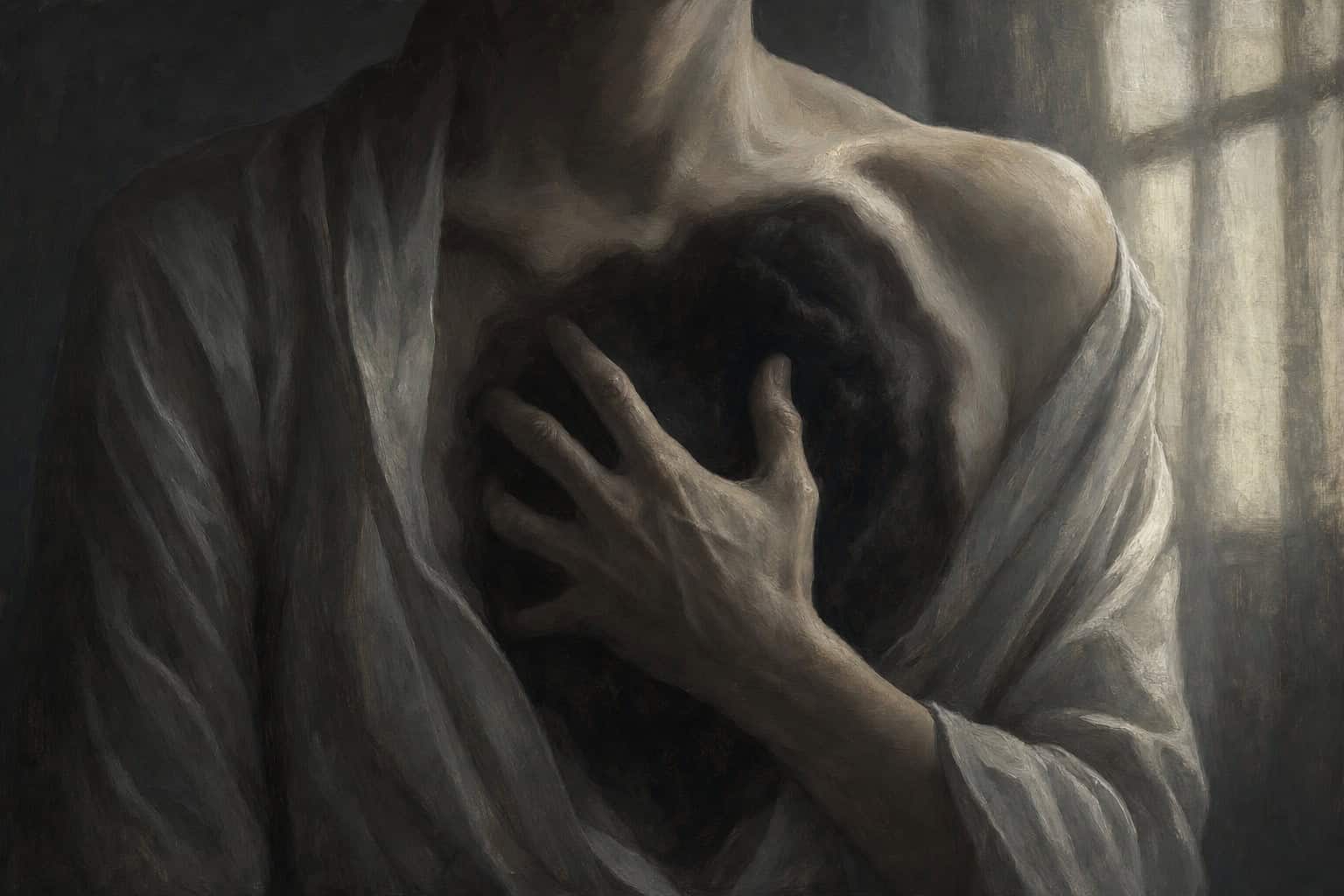
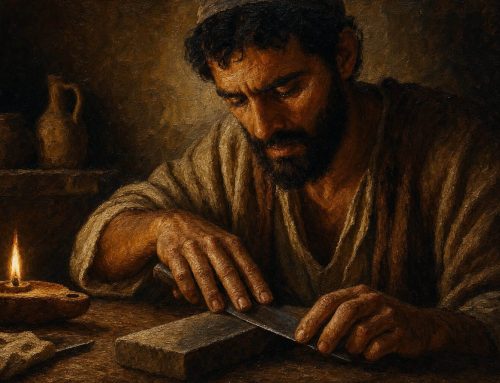
He presses his palm flat over his breastbone as if to pin down a tenant that moved in too early — one that has been cataloguing his weaknesses from inside the walls.
A Hand Pressed Hard Against the Breastbone
Heat gathers under the palm before the mind can name it. A young man stands there, thumb hooked under his collar, fingers spread flat over his chest as if he could pin something down by touch alone. The air is ordinary, the light unremarkable, but behind the ribs there is a pressure that feels like an uninvited guest leaning its back against his heart. He knows the texture of panic, of asthma, of too much coffee; this is none of those. This feels like a presence that has studied the layout of his body and chosen the softest interior wall. In that simple gesture—hand to sternum—he begins to understand that the battlefield is not an abstract sky of ideas but the warm cavity behind his breastbone. What he thought was just his own troubled feeling now shows itself as contact, as if another will has slipped in under the bone and is testing how much space there is to claim.
The Moment Words Turn to Gravel on the Tongue
He tries to pray the way he always has, reaching for the old syllables like a man reaching for a light switch in the dark. The familiar phrase rises, but halfway up the throat it thickens, breaks apart, and falls back down like gravel. His chest tightens—not in fear of punishment but in a kind of internal gag, as though someone presses two fingers against his windpipe from the inside. Sound refuses to cross the line. It is here that the realization lands with weight: if the voice dies, everything else soon follows. This is not a random stutter; it is a deliberate strike at the single bridge between his small life and the God who can gather it. The young man stands with his jaw clenched, tongue heavy, feeling how easy it would be to stop trying altogether and let the silence close over him like water.
Freedom That Already Tastes of Rust
Later, away from the immediate choke of prayer, another grief surfaces. He notices how even his attempts to choose well seem rigged from the start. In a quiet corridor or beside a kitchen sink, he tests his will on some small decision and feels the slant under his feet. The choice is his, but the angle is not. The very faculty by which he decides carries a dull metallic taste, as if the hinges were corroded long before he ever tried to open or close anything. He senses an old damage baked into the machinery, an impurity that arrived with him and did not wait for his first personal failure. The chest pressure and the silenced voice are not isolated events; they expose a deeper fracture in the way his wanting works. He begins to see that he is not just besieged from outside but compromised at the core where consent is born.
The oldest enemy takes up residence early, cataloguing every weakness from within the body’s most intimate chamber, and calling that dark tenancy home.
Temptations Cut to Your Exact Measurements
What he feels in his own body casts a harsh light on the patterns he sees everywhere. The late-night scrolling that always collapses at the same kind of image, the sharp words that slip out only when a certain tone is used, the sudden urge to disappear exactly when someone praises him—none of it looks random anymore. It feels stitched to him, as if someone has been measuring his fears and stitching snares that hug the skin. The thought is sickening: he has been watched like this for years, maybe since the first time his lower lip trembled in a crib. Not a stranger’s glance, but a long study that has learned which memory will buckle his knees, which rejection will send him hunting for false comfort. An intelligence has mapped his weak spots with patient care. Every new pull toward self-betrayal carries the eerie familiarity of clothing that fits too well.
Between the Ribs, a Disputed Piece of Ground
The image will not leave him: that narrow space where lungs rise and fall, now crowded with something that is not content to remain a guest. He can feel his own heartbeat, stubborn and rhythmic, pulsing against whatever presses back. Two claims share one small chamber. There, inside the cage of bone, the question of unity turns concrete—whose rhythm will set the pace, whose will gets to call this flesh home. He has not yet seen how far this contest will go or what it will cost to answer with anything more than a whimper. For now there is only the stubborn weight of a hand on his chest and the knowledge that this ground is not neutral. The story will have to decide what, or who, is allowed to keep breathing in that narrow strip of living muscle that never quite gets to rest.