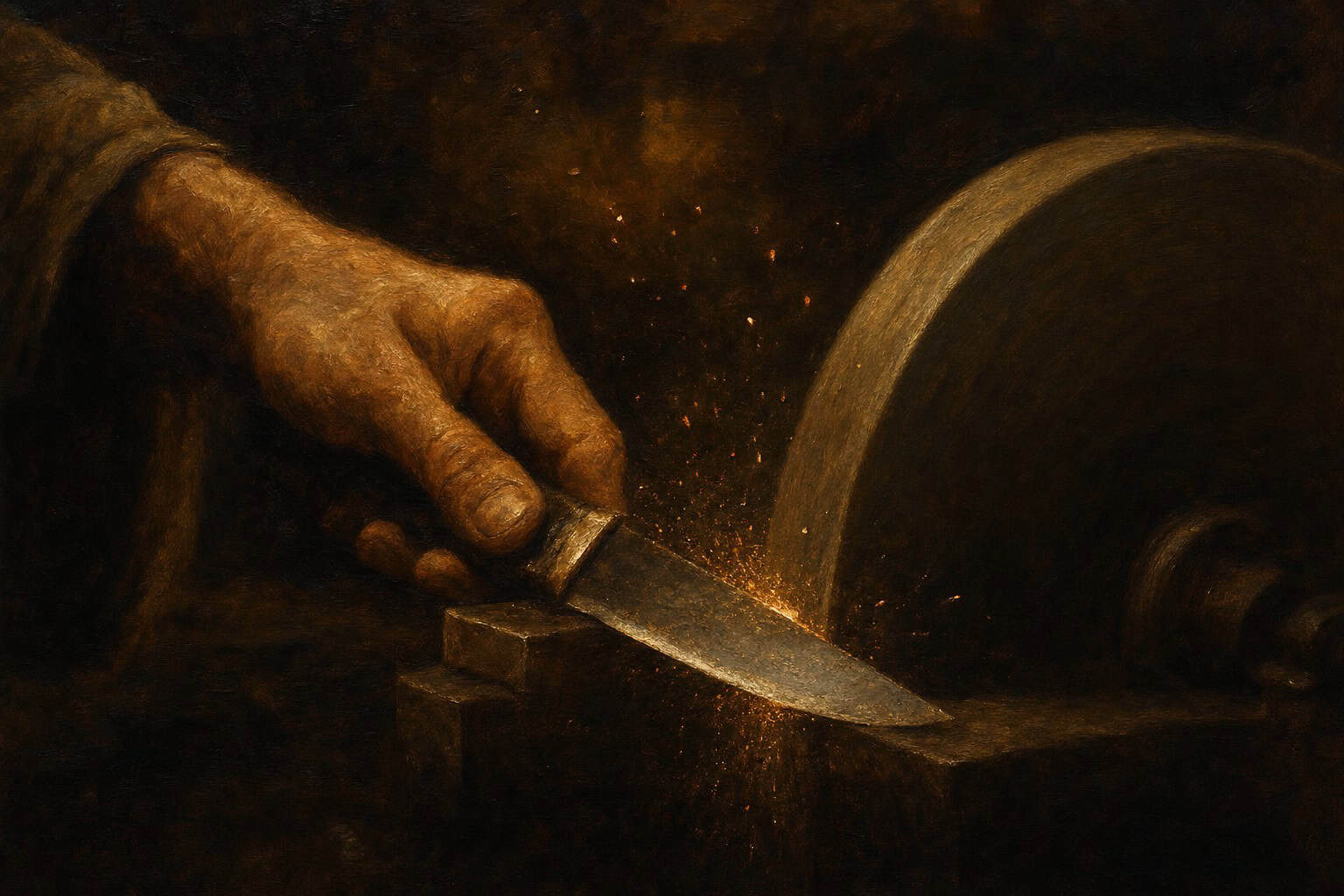
He looks over the litter of his past — every breakup, every conversion, every scrap on the shop floor — and at last sees the single shape they were carving all along.
Shavings on the Shop Floor
Midway through the memoir, the narrator turns his gaze over the whole workshop of his past and finally names what all the scraps mean. He is not recounting one breakup or one conversion but the pattern running through years of ties with women, prayer, and interior struggle. In this chapter, he steps out from behind the pose of detached analyst and admits that love—love of God, love of women, love of truth—is what has been driving his hand across the page. He writes as a man who knows his time is limited, who has watched people vanish between one heartbeat and the next, and who refuses to leave this world with his real words still sealed inside him. The terrain here is big: a life of relationships re-seen as training, a hidden obedience to a master finally declared, and a late naming of himself as a particular kind of instrument inside a war he believes is spiritual long before it is romantic.
The Moment He Learns He Is Not the Blade
At the center of this chapter stands one recognition: he is not the hero weapon he once imagined. He is the stone under the blade. He describes receiving, in prayer, a clear sense that his task is not to build, heal, or predict but to take on the unglamorous work of abrasion. His master does not threaten him into this role; there is no talk of paying off a divine debt or serving out a sentence. Instead, something in him was altered over years of walking with that master, until he could no longer pretend that his particular mix of insight and harm was random. When he says he is meant to prepare axes and arrows, he means that his presence in a woman’s life will almost always involve discomfort that cuts through pretense. The reckoning is that his gift is edged, and using it will sometimes crack what is weak instead of polishing what is strong.
Hands Blackened by the Work
Emotionally, the chapter moves like a man wiping grit from his palms and only then seeing the cuts. He begins with a tender declaration of love for the unseen reader, then pivots into the rough description of how women have pressed against him: some as stubborn mass that scoured him, some as willing metal seeking an edge. As he narrates this, a low ache runs beneath the confident language of vocation. He remembers being used for favors, for attention, for a listening ear, thanked with the same offhand ease as returning a borrowed pencil. He remembers, too, the women who let his hard questions and hard presence change them. The feeling tightens as he confesses that he himself is not simple; he is crowded inside by devotions that do not fit easily together. His love of God and his hunger for women are not lined up in tidy rows but move through his chest like competing currents that leave him both refined and rubbed raw.
A man may spend half a life discovering his vocation was to be a whetstone, worn smooth by love and pain into a surface that sharpens everyone but himself.
Blades That Choose Their Edge
Within the wider book, this chapter marks the point where his private myth of being merely a victim of female fragmentation gives way to a harsher honesty. He has a part in the breaking. Here he insists that nothing in his story was scripted like a play. God’s knowing the shape of his life did not push any hand, just as knowing sunrise is coming does not shove the planet around. Each woman, he says, chose in real time whether to come to him as resistant stone or as metal willing to be honed, and he chose how to read and answer what she brought. That insistence on freedom plugs directly into the book’s central question: how a heart crowded with selves can move toward wholeness without blaming fate or biology for every fracture. The whetstone role becomes one answer: unity will not come through flattery or sedation, but through encounters that expose soft metal to rough, truthful contact.
The Quiet Spark When Steel Catches
What this chapter quietly promises is not an easier life, but an intelligible one. The narrator is offering his own story as a case study in how severe love can be, without dissolving into cruelty or sentimentality. He tells you plainly that some lives are called to soothe and others to unsettle, and that he has learned, late, that he belongs to the latter. There is consolation here, but it is a hard consolation: the idea that heartbreak, manipulation, and disappointment can become the very angles that make a person useful in God’s hands. If the earlier chapters circled around legion hearts and contaminated lenses, this one says: even the grinding has a place in the design. To walk into this chapter is to stand near the stone as it turns, to listen for the faint sound when two surfaces meet and, for an instant, throw off a small, stubborn spark in the dark.