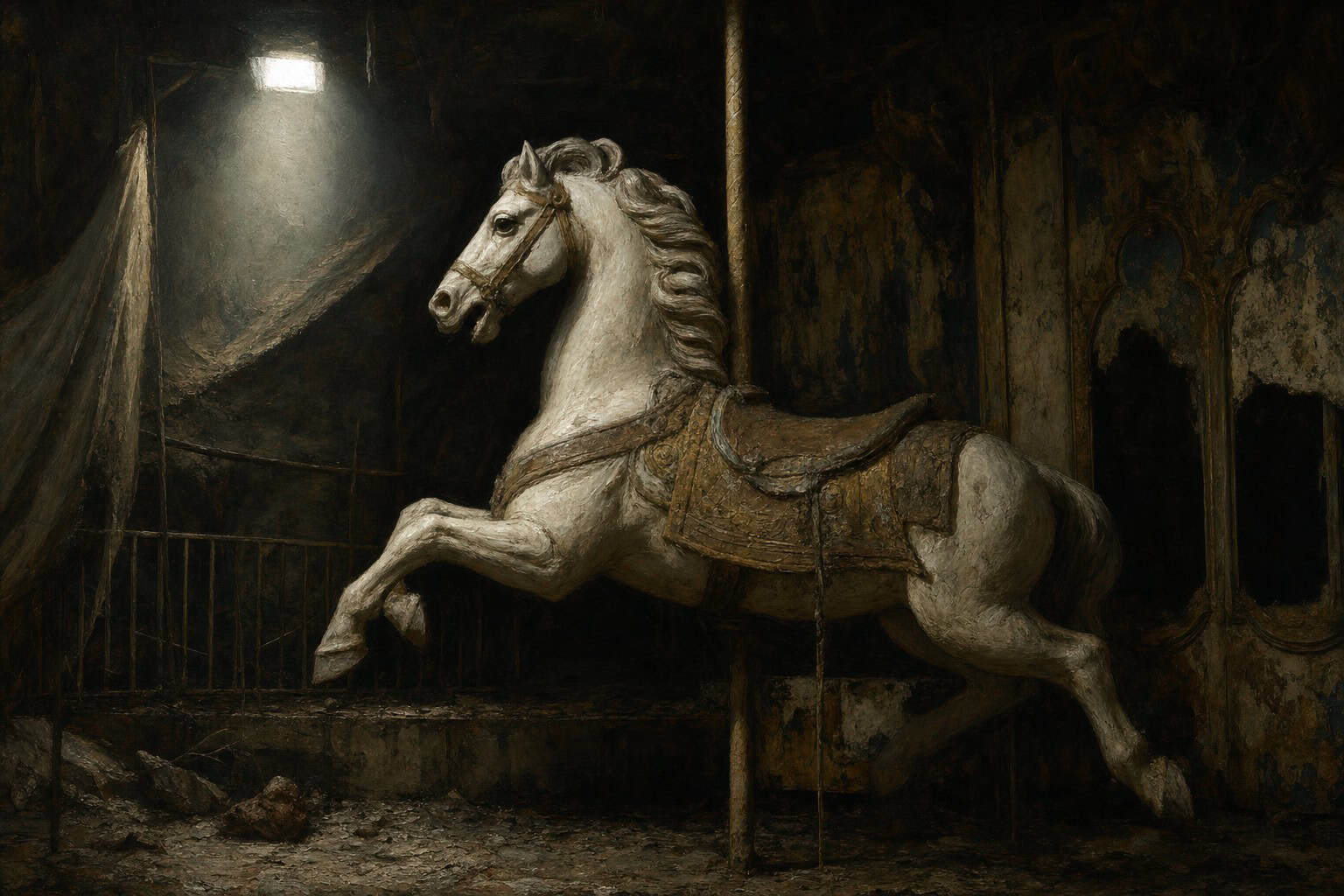
A chipped carousel horse heaves on its brass pole, galloping without ever crossing new ground, its gold paint peeling under feverish light — motion mistaken, again and again, for a journey.
Paint Flaking from the Galloping Horse
A chipped carousel horse heaves up and down on its brass pole, frozen in a wooden gallop that never crosses new ground. The lights throw a feverish glow on its cracked paint, gold peeling at the mane where too many hands have clutched for balance. A figure holds the pole with white-knuckled resolve, feeling the wind press against their face, hearing the bright, relentless music, certain that this blur must count as travel. Each circuit offers the same sequence of colors—cotton candy pink, rusted bolts, the same bored attendant flicking ash into a paper cup. Desire here is not a clean flame but a looping engine: wanting to want, seeking to keep the seeking alive. The horse does not feel the strain because it is not alive; only the rider grows tired. Yet the dizziness is easier to bear than stillness. To step off would mean admitting that all this motion has not moved them an inch closer to the unity they mouth in their prayers.
The Unmoved Attendant by the Gate
Near the carousel gate, an attendant stands with folded arms, close enough to see the rider’s nausea, far enough not to reach out unasked. This is how divine power appears in this passage: not as a hand yanking bodies from the ride, but as a steady presence that refuses to counterfeit consent. The silence here is not neglect. It is the hard mercy of a love that will not drag a person to wholeness while their fingers still cling to the pole. The gate remains unlatched, but it does not swing open on its own; no loudspeaker orders anyone to dismount. The rider circles, glancing toward that still figure between flashes of light, half-hoping for interruption, half-terrified it might come. Meanwhile, the music covers their own groan. The text names this terrible courtesy: an authority that could stop the machinery but waits instead for the smallest, honest reach, accepting the risk that we might ride ourselves sick before we ever extend a hand.
A Distant Melody Beneath the Carnival Music
Under the shrill organ pipes, another sound seems to press against the rider’s chest, not heard so much as remembered. The carousel melody is loud, all surface glitter and easy rhythm, but threaded through the dizziness is a quieter, older tune the mind cannot place. The passage leans into this tension: we cannot seek what is utterly unknown, yet our seeking proves we have known it somehow. Every lap tightens the contradiction. The rider keeps scanning the crowd for a face they could not describe, searching for a home whose shape they have never seen, driven by a homesickness that arrives without a clear address. Each revolution sharpens this ache; the familiar blur of booths and lights feels less like entertainment and more like a screen hiding what once touched them. The heart carries a memory it cannot name, and that buried recollection is both compass and torment, hinting that real union exists while giving no map off the spinning track.
When desire feeds only on itself, we mistake the spinning for a journey, and the search for wholeness becomes the very thing that keeps us fractured.
The Ticket Stub Sweating in Your Palm
Away from the page, the same worn stub sticks to your skin—membership cards, recurring subscriptions, a phone full of notes from the last retreat. You line up for new rides with old patterns: another relationship that repeats the same choreography of need and withdrawal, another book promising to unlock your true self, another round of “working on it” that never quite reaches the hard renunciations you already recognize. The activity soothes because it proves you are trying. Failure becomes a kind of credential, the right to say, “At least I am in motion.” But the text will not flatter this movement. It names the way sexual encounters can become solo acts performed with another body, how “connection” can hide a refusal to actually be seen, how self-improvement can harden into a hobby that guards you from conversion. The carnival thrives on your fear of the quiet beyond the fence. The stub in your palm feels flimsy, but you keep it, just in case you want one more spin.
Letting Go of the Brass Pole
Your hand around the brass pole begins to ache; the metal no longer feels neutral but oddly shaped to your grip, as if both of you have conspired in the illusion. The passage presses here: as long as consciousness clings only to itself, every encounter, even the most intimate, curves back into a closed loop. Lovers become mirrors, not windows; their bodies turn into tools for numbing rather than places of honest belonging. The heart fractures further each time it uses an embrace to avoid the loneliness that could have opened into prayer. At some point, the rider’s knuckles must uncurl, not into thin air, but into a space where nothing moves on their behalf. No music cues the gesture. No applause waits. The horse keeps rising and falling for whoever climbs on next. Somewhere beyond the fencing and neon, there is earth that does not spin and a sky that does not circle, only hangs there, patiently refusing to move first.