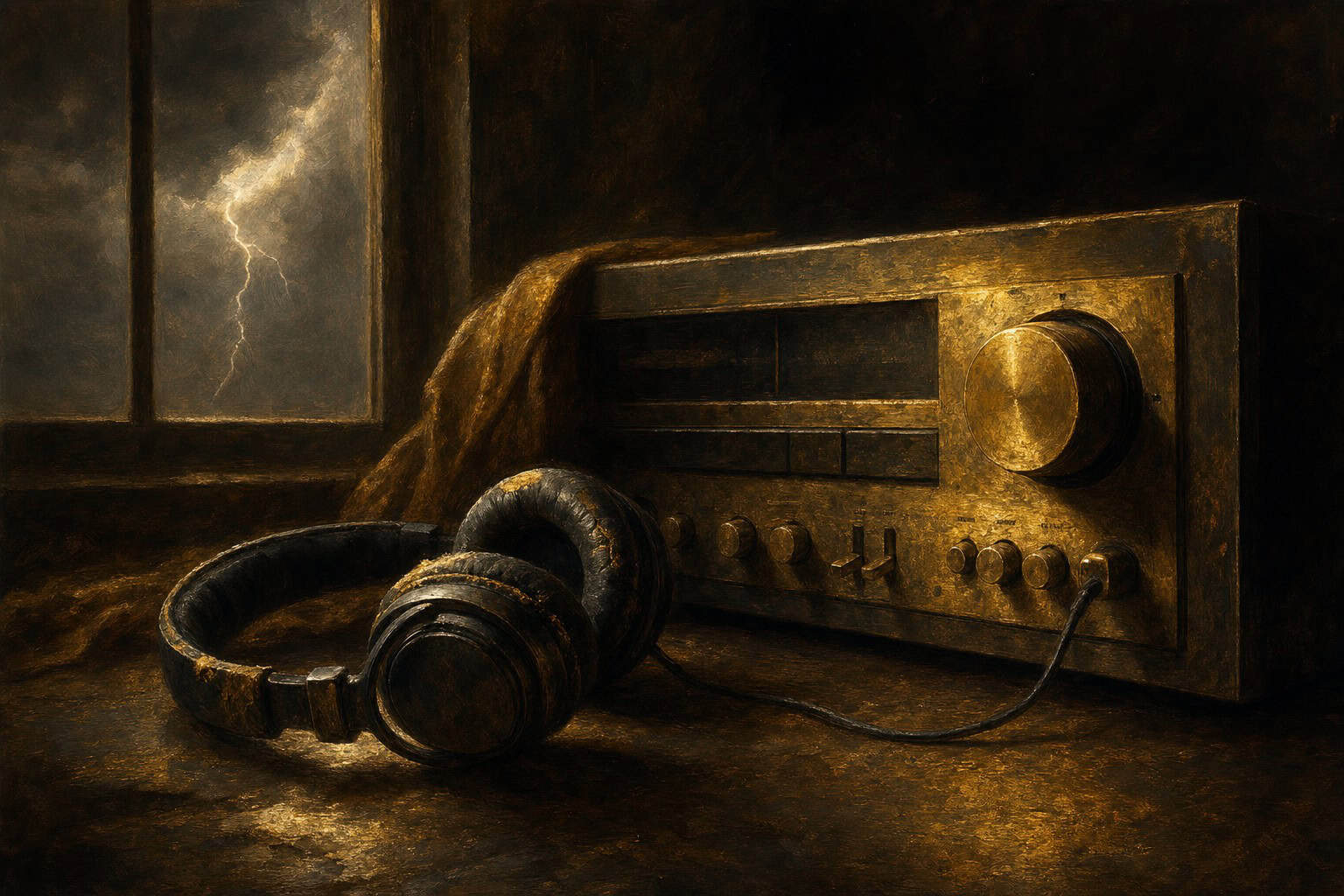
He puts the headphones on not to listen but to dig, and the loudest tracks give up the exact shape of a grief that was never allowed to weep.
Bass Lines Pressed Into Bone
He sits with headphones on, not for pleasure but for excavation. The playlist is already built, decades old, a string of tracks that once shook cheap car doors and apartment walls. Now the same bass notes thud quietly against his skull, but his body remembers the earlier impact: ribs vibrating, teeth buzzing, a chest so tight it needed volume to pry it open. Each song brings back not a scene but a bodily state—the way seventeen felt as a buzzing under the skin, the way twenty-two tasted like metal in the mouth. The older man scrolls, clicks, and waits for the first distorted guitar to drop, then notices how his shoulders tense, how his jaw locks just as it did back then. He is listening to his own fossil record, pain pressed into sound rather than stone, each riff holding a younger body mid-clench, mid-survival.
Turning the Knob Until the Ribs Rattle
The younger self, the one inside these tracks, has no language for what is wrong. What he has is a stereo with a volume knob that keeps going past reasonable, past kind, into a level where the floorboards buzz. In those years, Nine Inch Nails plays like an unofficial liturgy: drums that hit like slammed fists, vocals that sound more like tearing than singing. He stands in front of the speakers and lets the onslaught hit him full in the chest, a self-chosen impact he can finally predict and control. Violence is not allowed to spill from his hands into the world, so it surges instead through wires and cones, a current of rage expressed as decibels. The playlist is less a hobby than a survival mechanism, a way to keep from exploding outward by consenting to be shaken apart from the inside.
When Noise Becomes a Kind of Confession
Listening now, years later, he realizes these tracks were the closest thing that boy had to telling the truth. The lyrics he once screamed along with are half-forgotten, but the emotional contour is exact: the rise that matched his panic, the drop that mirrored his collapse, the relentless beats that refused to let him go numb. The older narrator does not flinch away from this recognition. He allows the songs to do again what they did then—drag the unspeakable into the open, if only as vibration. Yet a tension hums under the listening. Can he let these brutal anthems stand as an honest record of who he was without letting them re-take the house of his heart? If he softens toward the boy who needed such fury, does he risk softening the edges of the harm that formed him? The speakers hum on, carrying both the accusation and the plea.
Rage is often grief that was never allowed a gentler language; the angriest music preserves the exact shape of a pain that could speak no other way.
Your Own Blood Still Hums With Old Choruses
Most people do not catalog their past with dates and neat timelines; they know it by the first bar of a song. A few seconds in and your stomach drops, or your throat tightens, or your hands suddenly remember a steering wheel at 2 a.m. That is the territory this passage names: the strange way sound holds the shape of our younger selves when nothing else could bear it. Maybe your soundtrack was violent, maybe it was sad, maybe it was just loud enough to drown out the house, the school, the job. The question this scene presses is not whether those songs were good or bad art, but whether you can bear to meet the person who needed them without turning away. Because the bass lines may be dated and the production thin, but your body still hums with their imprint, waiting to see if you will curse that younger pulse or finally bless it.
Letting the Last Note Ring Without Muting It
The passage does not end with a tidy act of deletion or a heroic rebrand of the playlist. The older man does not rip out earbuds and renounce this music as childish sin, nor does he baptize every scream as secret prayer and move on. Instead, he lingers in the unresolved space between recoil and reverence. The tracks play on low, like a storm heard from another room, while he sits in the strange middle: grateful that this rage once kept him from disappearing, wary of how easily it could still swallow him whole. Somewhere in the sustained feedback of an old chorus lies a path toward a different kind of love, one that does not demand amnesia as its price. But that path is not yet chosen here. For now there is only the courage to keep listening, letting the final chord fade into air without rushing to switch the song.