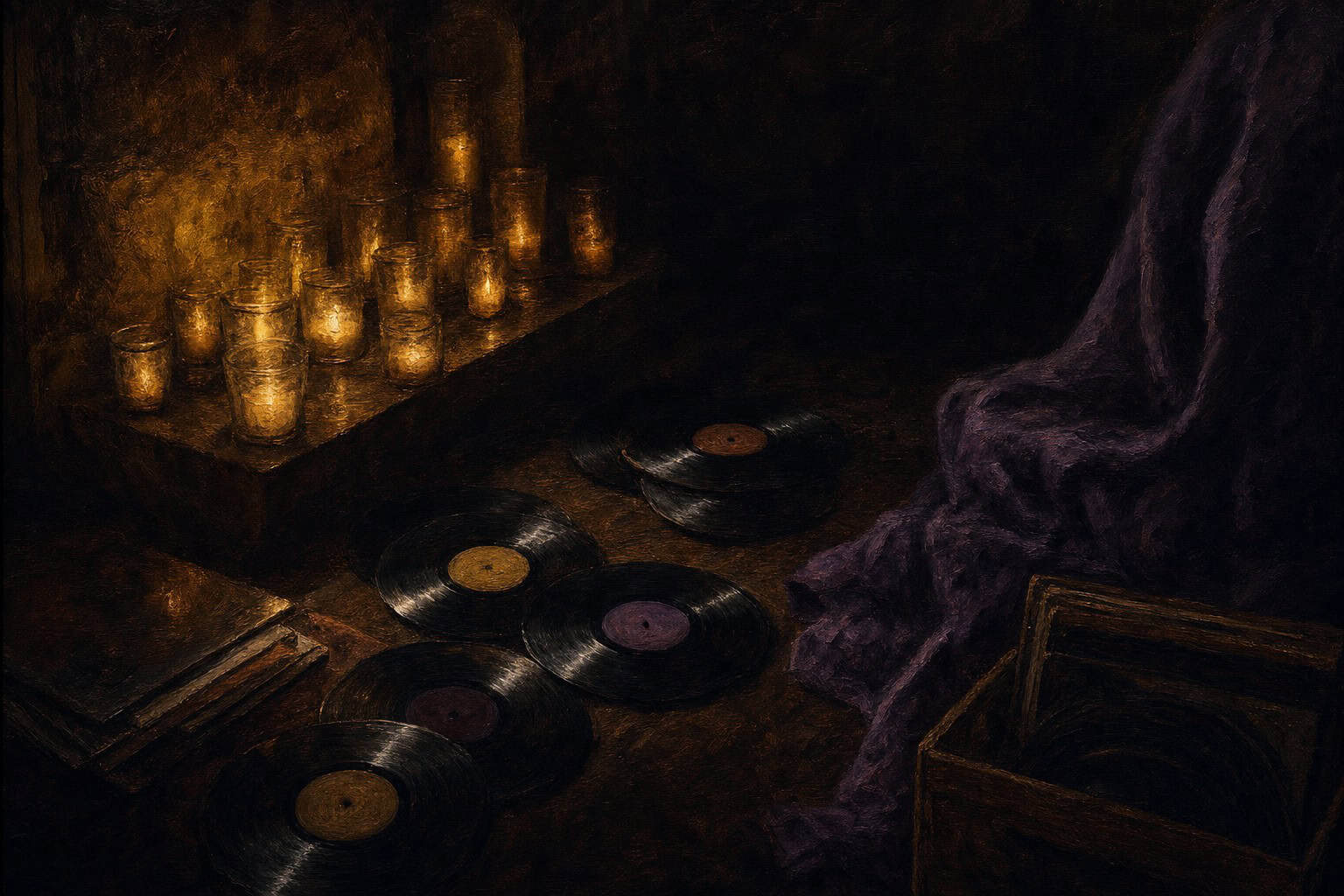
His thumb hovers over one title the way a hand hovers over an old scar, while the whole playlist runs down through him like a spine.
Thumb Hovering Over a Dangerous Track
A man sits with his headphones on and his phone in his hand, staring at a playlist that runs like a spine through his life. The dominant image is simple: thumb hovering above a title that once felt like oxygen. One tap would send him straight back to the sweaty backseat, the half-lit basement, the bus window at night where he first learned to disappear into sound. Each song on this list is less entertainment than preserved tissue, a thin slice of a younger self held in rhythm and distortion. Some tracks he can let play; they sting but they don’t threaten to swallow him. Others are landmines. His stomach tightens before the first chord even hits, his body remembering a pressure in the chest, a rawness in the throat, before his mind can call up names or dates. He scrolls and pauses, scrolls and pauses, caught between the urge to finally face these songs and the instinct to keep them sealed inside their little rectangles of album art.
The Girl Behind the Song, the Myth Behind the Girl
Certain titles drag one figure to the surface, pooled from different years into a single shape: the girl who looked like escape. Her face isn’t clear now, but the feeling is. The guitars from that season still throb with the fantasy that if she said yes, everything ruined at home and in his own head would suddenly make sense. He remembers how he quietly split her in two: the real person in the hallway, and the dark icon in his imagination who could baptize him in pure feeling and erase his shame. In this passage, he begins to admit how much he asked her to carry—mother, lover, judge, and priest in one fragile body. The songs from those years don’t lie. They pulse with a hunger that wanted to be devoured, not healed. Listening now, he hears not only her softness or cruelty but his own construction, the way a starving boy turned a classmate into a private demon-saint and called it love.
Every Chorus as Evidence For or Against God
The pressure inside this section rises around one realization: at sixteen, the stereo was an altar. He scrolls to the cluster of tracks he played until the batteries died in his portable music player, nights when the house felt like a trap and his own skin felt too tight. In those songs, teenage desire and theology share the same breath. If she texted back, it meant the universe might be kind; if she kissed someone else at a party, it meant the whole order of things was rigged against him. That weight sits on every chorus, turns every bridge into a courtroom where God is silently on trial. The adult listening now can feel how unsustainable that intensity was, but he also respects it. The boy in those tracks was certain that if love failed, life itself lost its claim to meaning. The music becomes a record of a heart that did not yet know how to want anything halfway, and did not yet know how to survive when the wanting went unanswered.
Old songs hold the shape of wounds we could never name, and we return to the music that held us when nothing and no one else could.
Home Again as the Song No One Asked For
Eventually the playlist lands on a quieter track, something that would have bored his younger self: a plain melody about coming back, about dishes in the sink and an unremarkable morning commute. It feels almost insulting after the sharp, theatrical cuts that came before. This is where the passage leans in: the same soul that once chased annihilation through romance now has to face a different kind of dare—to find God in a rented kitchen, in a commute, in the same street walked a thousand times. For an ordinary reader, this is the uncomfortable mirror. Most of us secretly prefer the high drama of being shattered to the slow work of being faithful in ordinary days. The text presses the point that spiritual growth is not an upgrade in intensity but a shift in location. The holy does not vanish when the heartbreak playlist fades; it hides in laundry cycles, scheduled reminders, and the small decision to make dinner instead of disappearing into old fantasies.
Letting the Next Track Start Without Skipping
By the end of this passage, the playlist hasn’t been conquered or cleansed. It’s still there, with its dangerous tracks and cheap anthems and one or two songs that feel like they were written in his own blood. The difference is in what he’s willing to do with the dissonance. He does not erase the dark songs or pretend they belong to someone else; he also doesn’t let them dictate the terms of his future. Somewhere in the shuffle, a new song he barely knows begins to play. It doesn’t match the old categories—neither pure despair nor easy uplift—but it asks to be heard on its own terms. The scene leaves him, and us, in that uneasy space: consenting to listen without knowing yet what this melody will carve into him.
The headphones stay on, the thumb rests, and the next few bars unfold like wet paint that has not decided what it will become in a place where his need first reached past the human face and brushed against something larger, even if he named it badly. Consent to divine love, for him, cannot mean muting every note that sounds off-key. So he leaves the playlist intact, screen gone dim, the tracks still queued—waiting like a record on a shelf, ready to prove that even the most jagged chords once helped keep a frightened boy alive.