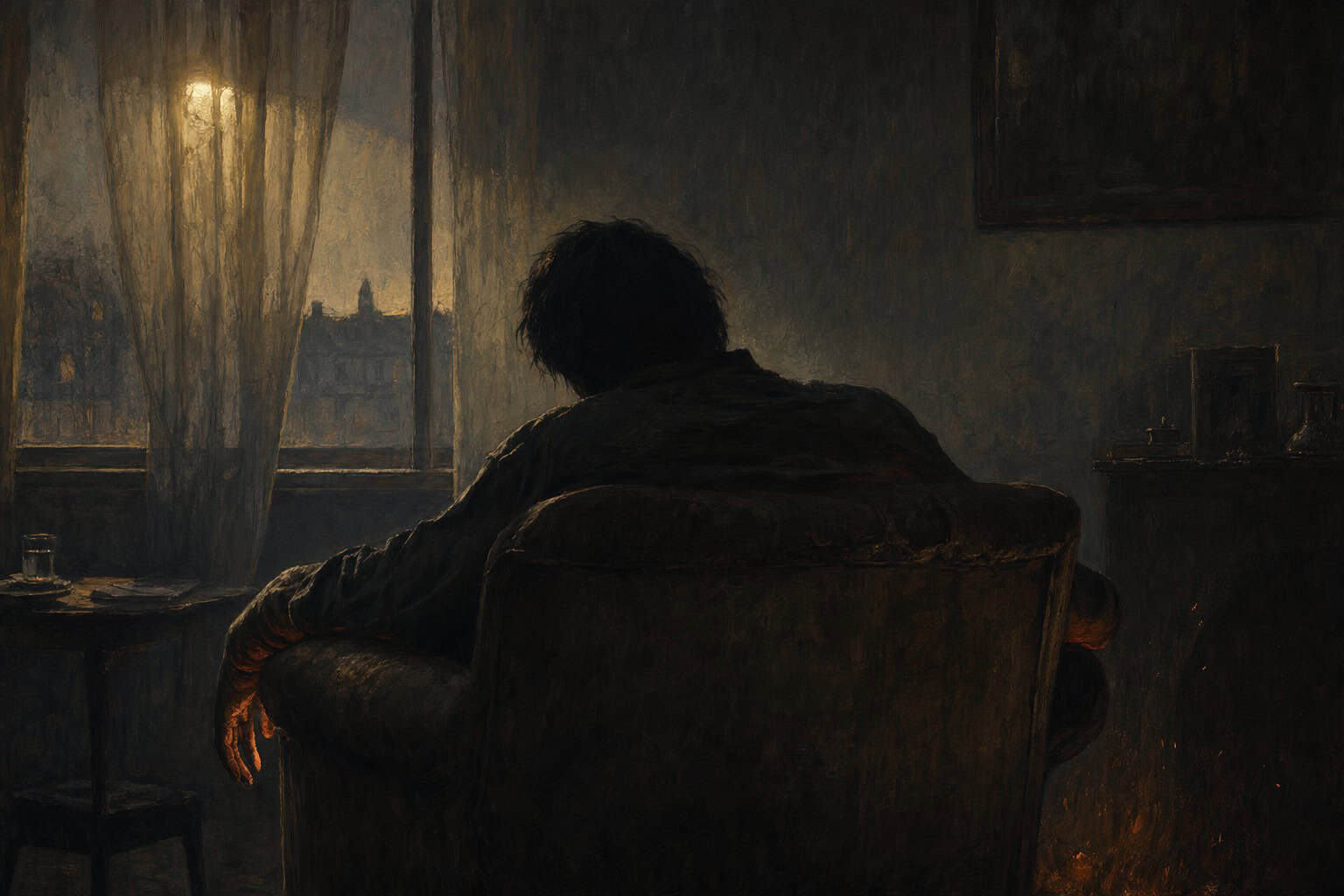
He sinks into the chair that has learned his shape, too tired to notice that the self he is grieving is the one he was always meant to bury.
Weight Of A Body In A Late Chair
A single body slumps into a chair that has learned its shape, the kind of tired that hums in the thighs and behind the eyes. The air is thick with the end of a day, sweat dried into cloth, a faint ache in the lower back that will not negotiate. Prayer feels far away, not because God is absent, but because the body is loud—stomach pulling, spine protesting, eyelids sinking. In this passage, that heaviness is not brushed aside as a distraction; it is studied like an object on a table. The writer names the drag of flesh as the exact surface on which the unseen life grinds itself sharper. Spirit is not shown floating free of muscle and bone, but leaning into them, pushing against fatigue, desire, numbness. The scene does not offer escape from the chair. It asks what it means that holiness begins right there, where the sweat has already dried and the knees do not want to bend.
Skin That Argues With Prayer
Here the moment tightens into a reckoning: this body, with its limits and cravings, is not an accident to be worked around. Every spiritual intention has to pass through skin, joint, and nerve. When the heart rises in aspiration, the flesh responds with its own language—hunger, restlessness, resistance. The passage insists that this clash is not proof of failure but the contact point where real change takes place. To want God while your back throbs and your mind drifts is not hypocrisy; it is the exact conflict in which a human being is forged. Yet that truth stings. It means there is no clean, untouched part of you that can love God from a safe distance. Desire must run through hands that shake and a spine that slumps. The reckoning is simple and severe: either your body is part of your prayer, or nothing in you is praying at all.
When Perishable Flesh Meets The Word ‘Forever’
Pressure gathers around a single, unyielding claim: what decays cannot simply be polished into eternity. The passage turns toward death without flinching, not as a horror story but as a necessary cut. The same shoulders that sag in the chair will one day lie still; the heartbeat that strains to keep praying will stop. That is not treated as a cruel surprise but as the surgery required to separate what can pass through resurrection from what cannot. Yet from the angle of tired nerves and aging joints, this feels like theft. How can the very flesh that has carried love, held children, knelt awkwardly on hard floors, be called perishable and left behind? The text lets that protest stand without soothing it. It lingers in the tension: the body is both honored as the grinding surface of transformation and named as something that must, in some way, be surrendered. The word “forever” hangs over muscles that cramp, and nothing yet explains how those two can belong to one story.
Every real transformation asks its deaths, and sometimes the coffin holds only the self we clung to and never meant to have to bury.
Your Hands On The Coffin Lid
For an ordinary life, the stakes of this passage are not abstract. They land in waiting rooms and at kitchen sinks, in the mirror on a bad morning and at the graveside with damp soil under your shoes. You know the body’s arguments: the chronic ache, the medicated fog, the shame about shape or aging skin. You also know the sting of watching another body lowered into a box, wood closing over a face you once touched. This text dares to say that the coffin holds only what was never meant to be clung to as ultimate, without insulting the love that still clings. It asks how you will see: with eyes that judge every loss as total ruin, or with eyes that suspect some separations might be ordered toward a deeper reunion you cannot yet picture. That choice of sight shapes grief, shapes how you sit in your own chair tonight, how you treat your body—not as a god to preserve at all costs, nor a prison to despise, but a partner you will one day have to release.
Sparks You Cannot Quite See
The passage does not end with comfort, only with a strange kind of courage. The tired body remains in the same chair; the future coffin is not explained away. What changes is the meaning of the grinding itself. Flesh still pulls one way and spirit another, but now that pull is heard like metal striking stone, a sound that hints at sparks even when the eyes cannot catch them. You are left inside that noise: your own boredom at prayer, your fear of dying, your annoyance with limits that do not yield. Nothing resolves. The perishable has not yet let go; the imperishable has not yet shown its full strength. What you are given is a new suspicion that this friction is not wasted, that every clash between longing and limitation shapes an edge in you. The scene closes not with escape from the body, but with a body still pressed into its chair, listening for a faint crackle of unseen fire.