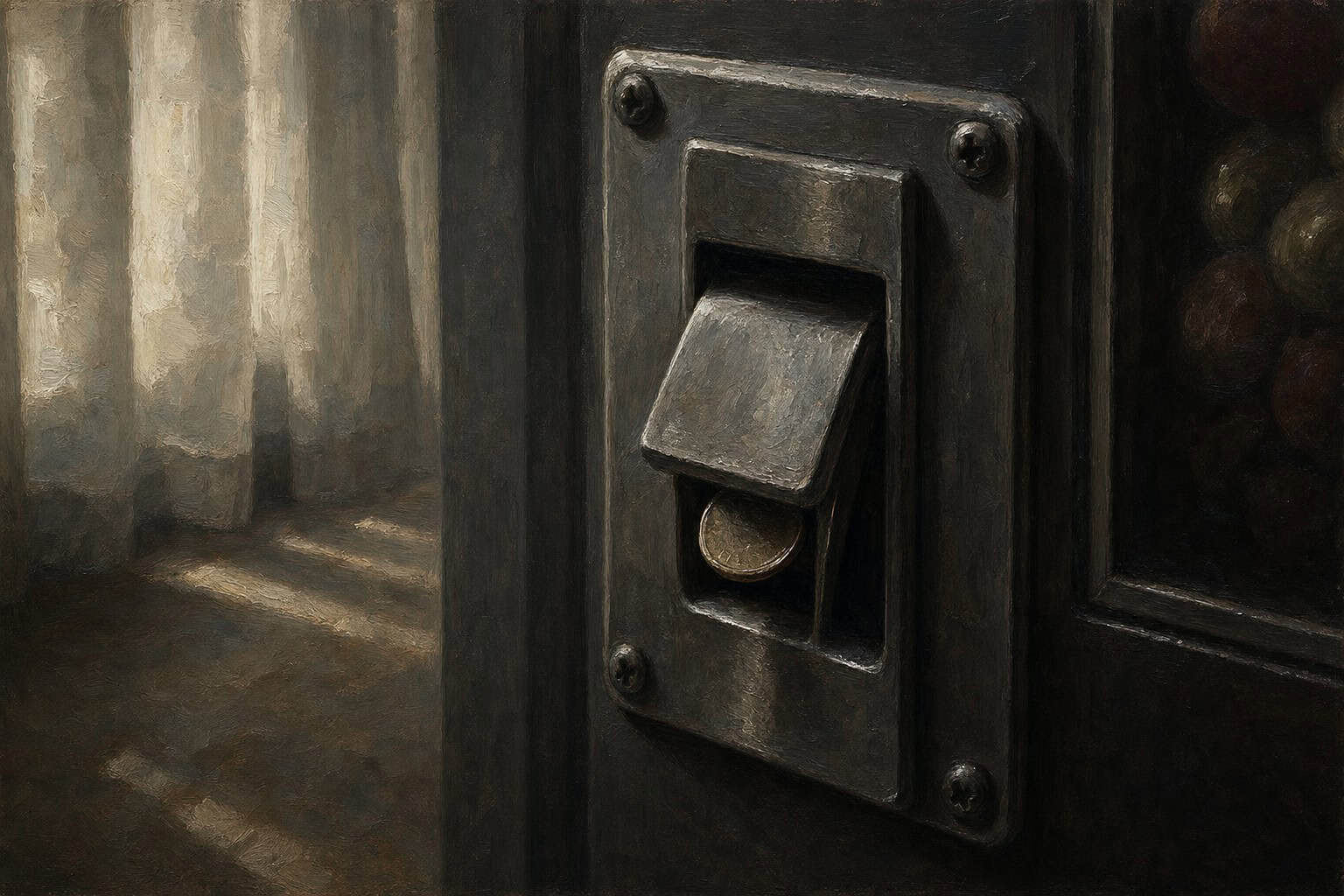
A kind word falls into him like a coin into a machine, and some old accountant inside begins at once to calculate what he now owes.
Coins Counted in the Dark
He is not at a desk but inside his own nervous system, counting. A casual touch, a kind word, a remembered birthday—all of it drops into him like coins hitting the metal tray of a vending machine. He hears the clink, feels the weight, waits for the price to flash. Childhood taught him that every kindness arrives with terms, that affection is a contract you sign in fear. So now, as a grown man, he cannot stop converting each gesture into cost: How much will this require later? What will I owe when the warmth cools? This is not bitterness; it is muscle memory. The early furnace of sorrow lengthened his senses, gave him a strange second sight for the moment love shifts from gift to leverage. In this passage, he stands inside that counting-body, aware that others move through the same exchanges without hearing the metal fall. He envies their ease and distrusts it at the same time.
The Price Tag Torn Off
Then something arrives that does not ring against the metal: a sense of being held by Someone who does not name a price. No demand. No hint of later collection. Just a quiet, steady regard that does not hustle him toward response. It feels wrong, almost indecent, like discovering a store where nothing has labels and the clerk waves you away from your wallet. For a soul trained to believe safety lives in payment, this is not comfort. It is terror. If I cannot pay, I cannot manage the loss when it comes. If You ask nothing now, how brutal will the bill be later? The passage lets this suspicion stand uncorrected. Divine love here is not explained; it is allowed to offend his training. The old arithmetic that once kept him alive cannot make the numbers work, and his very clarity becomes a kind of paralysis. He does not yet know how to live without a price tag.
The Question Left Hanging in the Air
He looks for the old signals: the lifted eyebrow that means you have disappointed, the slight withdrawal that means you must rush to repair. Nothing moves. Heaven holds its breath and refuses to negotiate. The silence is thick, almost bodily, like walking into a room where someone has just stopped speaking. No verses thunder, no sudden consolation floods in to calm him. The refusal to answer becomes its own answer: this love will not be dragged back into the marketplace. In that held air, another fear surfaces, sharper than the rest—if I accept this, what happens to the dark wisdom that has shaped me? The careful distance, the sharpened hearing, the dissonant music that lets me protect others from lies about love—does all of that have to die for this to be real? The passage refuses to tidy that fear away. It lets the question stay between them, humming, with no conclusion offered and no bargain struck.
When a soul is trained from childhood to treat every affection as a debt, love must first undo the terrible arithmetic that once kept him alive.
Where Your Own Calculations Start to Shake
You might recognize the same metal tray inside your chest. You notice favors, track tone, remember who texted first. You overpay in helpfulness, apologies, patience, hoping the surplus will keep abandonment at bay. So when the talk turns to a God who loves in freedom, your first instinct is not joy but recoil. If He will not be managed by your goodness, how will you survive His possible change of heart? This passage presses a hard mercy against that fear. It suggests that your ledger is not proof of cynicism but the fruit of very real history, and yet it also shows the cost of living forever by its numbers. You see a man confronted by a love that refuses both his suspicion and his attempts to earn it. The question slides toward you quietly: what part of your own story have you mistaken for the whole truth about love? The numbers that once saved you begin to blur at the edges.
The Coin That Refuses to Drop
By the end of this scene, nothing has been solved. The man still hears the faint rattle of imagined debts, still feels his body brace for a demand that does not arrive. God does not lean in with a final word to settle the matter or override his fear. There is only that unpurchased nearness, patient and unnervingly unchanged, as if eternity can afford to wait while a wounded mind re-learns what a gift is. The old skills remain intact; he can still read the smallest tilt of human affection like a financial report. But here, in relation to the divine, those talents hang in the air like a coin stuck halfway down the chute, neither reclaimed nor spent. The passage closes on that suspended moment, the mechanism jammed, the expected clatter withheld. Somewhere inside the silence, both man and God keep their positions, and the unanswered generosity continues to press against his practiced caution like water against glass.