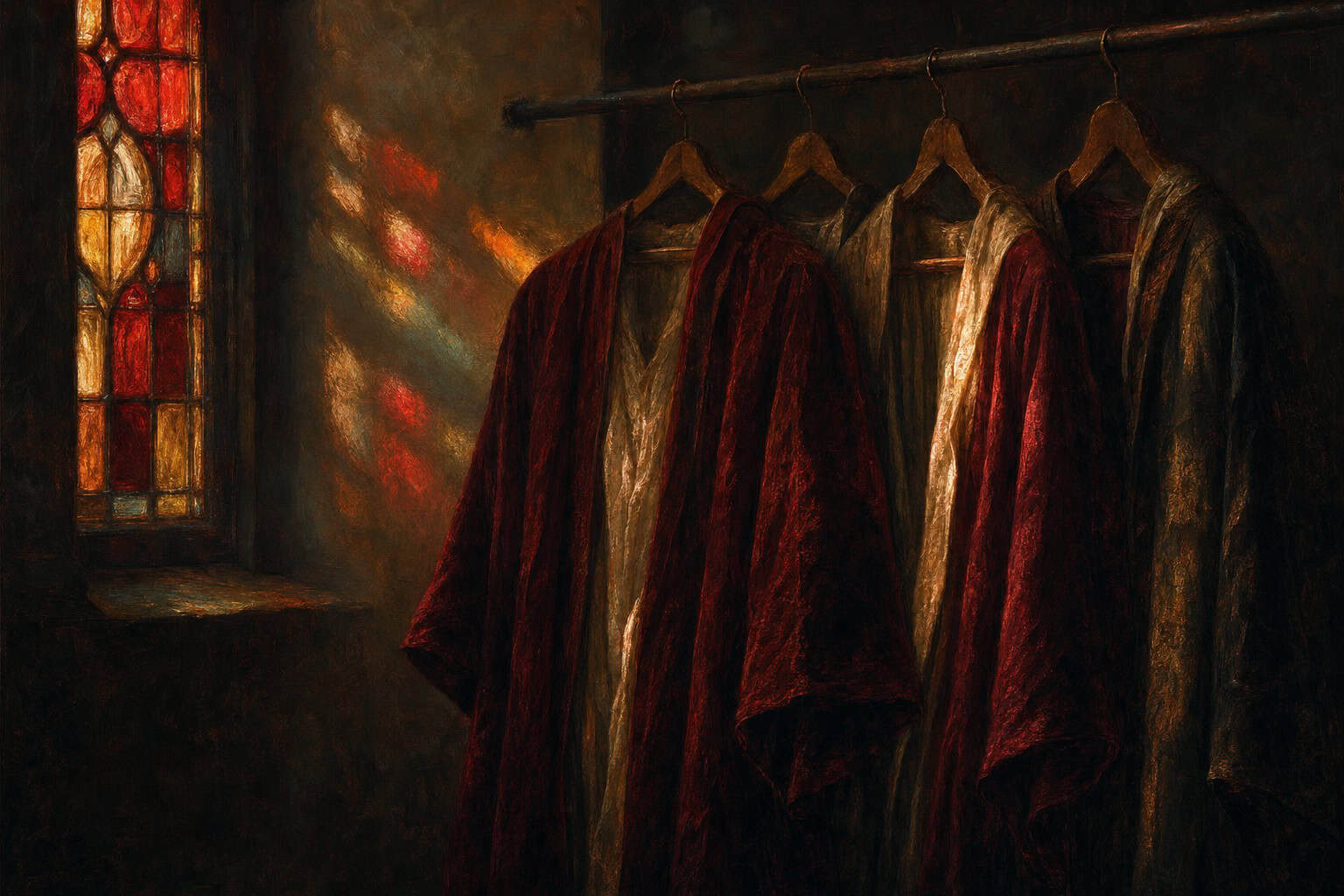
A coat on its hook still holds the warmth of a body, and the living learn that the dead do not leave so much as stop answering.
Clothes That Still Hold a Scent
Death arrives here as the hard edge around every life, not a mood but a border that cannot be crossed twice. The narrator names it as humanity’s inheritance from the first refusal of God, a consequence braided into bone and breath. Men and women react in two broad ways: some numb themselves, stacking pleasures and distractions to create distance from the end; others feel the clock in their chest and treat each moment like a coin nearly spent. Both bodies, he insists, meet the same conclusion, their differences flattened into dust scattered with equal ease. The one who chased transcendence and the one who chased orgasms leave remains that weather the same way. What distinguishes them is not how they die, but how they carried their finitude while they could still move. Around this, the chapter widens its grip: mortality is the ocean under every choice, and all our postures toward it—defiant, resigned, frantic, serene—are just different shorelines around the same dark water.
Photographs Searched for a Spark
The governing insight of the chapter comes when mortality stops being a general truth and collapses into one missing person. When someone dies, it is not only their body that leaves but their entire forward thrust: unread books held open by dog-ears, sentences half-formed in the throat, plans and grudges and jokes that will never ripen. The narrator lingers over what remains: shirts still carrying their smell, pillows with the hollow of a familiar skull, pens lined just so on a desk that no hand will touch again. Old photographs, once ignored, are brought close to the face as if proximity might force the image to give up some secret heat, some trace of intention behind the frozen gaze. But the eyes in the picture do not answer; pixels and paper cannot push back. What is felt now is not presence but a carved-out space in the air where that presence once pressed, a contour of absence that stings more sharply than any previous quarrel.
Grass That Hears Confessions Too Late
From there the chapter walks into the graveyard and refuses to tidy what happens to the living. It describes parents, spouses, and friends making the slow approach to a stone, carrying in their chests a backlog of sentences they never spoke when they had a warm body in front of them. Lips move. Apologies spill out, love finally said without sarcasm, anger admitted as fear, courage arriving years too late. The only listener is soil, grass bending under the weight of knees and flowers. Wind answers more faithfully than the earth below. The narrator laces this with a clear-eyed look at religious reflex: believers who can recite creeds about heaven still find their faith stunned into stillness when a beloved face goes slack. Pious language about being in a better place cracks against the fact that the same arms are empty every night. The supposed divide between “spiritual” and “human” grief shows itself as a false comfort when the whole body grieves in one piece.
Death does not leave us with memories so much as with the exact shape of a silence, the empty place where someone used to stand.
Broken Strings Hanging From a Vanished Kite
All of this sits squarely inside the book’s larger obsession with fragmentation. Earlier chapters traced how men and women splinter themselves to avoid real contact, hiding behind personas, sedations, and rehearsed scripts. Here, death is the final cutting of every script mid-line. The narrator describes the web of ties that once ran between people—parent to child, lover to beloved, friend to friend—as threads suddenly dropped, ends frayed and dragging along the ground with nothing to anchor them. The same fear that kept words trapped behind the teeth during life now hardens into regret that has nowhere to go but inward. In this light, finitude is not only a limit but an accusation: there was never infinite time to get around to truth. The chapter presses the question without solving it—if our hearts are already legion, already split and evasive, what happens when the chance to gather those pieces before another person ends forever? The silence after that question is part of its force.
Perfume Fading in an Unopened Room
Without softening its blows, the chapter offers a kind of severe mercy: it strips away the fantasy that we can outtalk or outmaneuver death. Names carved in stone erode, empires collapse into sand, and within a few generations the world walks past where we once stood without a thought. Yet in this stripping there is a promise about what the chapter will give. It will not cushion with easy afterlife slogans, nor will it pretend that faith cancels the ache of an empty chair. Instead, it holds the fact that the dead are beyond caring and turns, unblinking, to the living who still have lungs, tongues, and unfinished sentences. Death’s indifference to our moral postures sharpens, rather than dulls, the weight of every encounter that is still possible. To step into this chapter is to stand in a room where someone’s scent still hangs in the air, thinning moment by moment, while the question of what to do with one’s remaining breath presses closer than the walls.