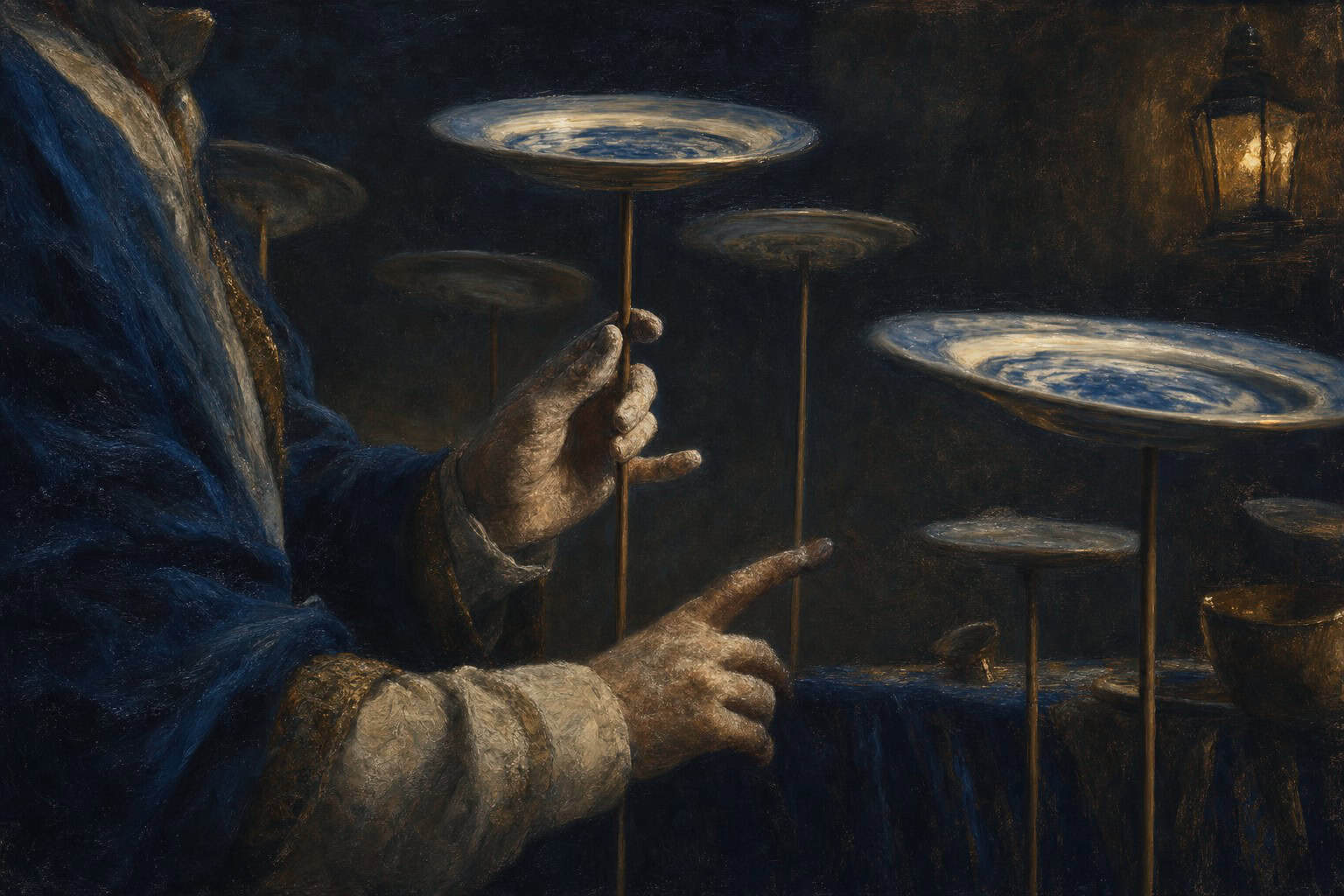
He sets his life spinning like a street performer’s plates — one, then another, then a third — and cannot feel how the trick that keeps him from losing anyone is hollowing him out.
Porcelain Whir on Thin Poles
He lays out a plan the way a street performer lays out dowels and plates. Chalk on the fingers, wrists loose, he sets one, then another, then a third into a humming spin. The trick is speed and spacing: never let one plate hold the whole show. In this passage he decides bodies will work like that—several in motion so no single hand can pull the tent-stake of his heart. He calls it prudence, a clean calculus learned from childhood lack: many small portions beat one feast you might lose. The air trembles with the low ring of porcelain, the steady rub of wood against skin. What literally happens is simple: he permits only arrangements where one person can never matter most. Underneath is a hard belief about love and danger, the thought that safety is earned by distributing need. The image carries it forward—the wobble begins the moment he pretends this is craft and not fear.
A Price Tag on a Spinning Plate
Then comes the turn that changes the room’s pressure. A woman who had once matched him thought for thought slides the whole thing toward trade. It is not an affair that stings here; it is a conversion of meaning. Conversation and prayerful ache are flattened into currency, as if his mind were only a hallway to her body and hers to his. The sound is small—a text, a tone, a sentence that tilts the pole—but it drops weight through his chest. He sees the old error exposed: favor is fickle, and if you stake yourself on it, you ride a wheel that forgets you the second it turns. What is literally at stake is whether he was ever seen beyond use. The deeper idea is theological as much as human: to reduce a person to exchange is to worship a lesser god and call it love. The plate still spins, but it now carries a price sticker, and that cheap paper burns.
Calluses Where Feeling Used to Be
He answers the wobble by hardening the technique. More plates, more speed, less attention to what the touch means. He teaches his body to separate act from ache. Hands move; heart hides. Among men like him, this gets praised as skill. He names it strength: no one can steer him with desire if desire no longer reaches him. Under the noise, fear beats like a second rhythm—the memory of once leaning his whole weight on one person and falling through air when they stepped away. To keep from that fall, he writes rules and keeps them close. No calendars that overlap into care. No staying until after. No questions whose answers can mark him. This is the literal movement of the scene: technique replaces trust; control sits where communion might stand. The idea presses hard: numbness poses as peace, but it is just friction-thick skin over a soul starving for contact.
The tricks we use to keep from losing anyone slowly carve us hollow; strategy, practiced long enough, becomes its own exile.
Letting One Plate Slow in Your Own Kitchen
For an ordinary life, the stakes here are not about scandal but about habit. You can spend your days juggling texts, maintaining backups, keeping three friendships warm so none can singe you. You can split yourself into safe pieces and call it prudence. Or you can try the harder thing this passage leans toward: set one plate down. Make one call without checking who else might answer later. Do one simple task no one will praise, like washing the pan until the grease lets go, and let that small labor empty out the panic that says you must be admired to be real. The spiritual current is blunt: stop feeding hurt with attention until it becomes a god. Consent to being loved where you cannot edit the outcome. The narrator is not there yet in these lines, but the pressure is clear: if you never let one plate slow, you will never know whether your hands can hold anything that weighs.
Chalk Dust on Knuckles, One Pole Still Humming
What remains unresolved is the risk he will take next. The passage holds at the edge of a choice: keep the show going, or let one circle lose its spin and feel the weight of it in both palms. The old systems—clever, cold—have begun to fail in him, not by argument but by exhaustion. There is talk here of a presence you cannot measure, a dark hour where answers stop working and yet Someone does not leave. If love is to be more than applause, he will have to consent without demanding to be paid back in control. The ache that makes him himself does not need to be sanded flat; it needs to be offered without disguise. No tidy resolution follows. Just chalk dust settling on his knuckles, wrists buzzing from the effort, and the faint hum of a pole still singing on the floor.