He stands across from Leigh with the honesty of a blade held to a stone, refusing to seem softer than grit, not yet ready for a love that will burst in his chest like shrapnel.
Steel on Stone in a Small Living Room
He stands across from Leigh with the blunt honesty of a man holding a blade to a sharpening stone, refusing to pretend he is anything softer than grit. There is no candlelight glow, no scripted tenderness—just his body, tense, shoulders slightly forward, as he names himself as friction rather than refuge. Leigh listens, jaw working, fingers worrying at the seam of her jeans, while he explains that loving him will mean being ground against his convictions until the sparks show what is real. The air between them feels like metal shavings, fine and abrasive, catching in the throat. This is not a confession of brokenness begging to be healed; it is a declaration of purpose. He has chosen to live as whetstone, to let his hardness be the surface where another soul either finds its edge or walks away bleeding. The scene holds that choice like a knife balanced on its spine.
When Dark Water Meets Springwater
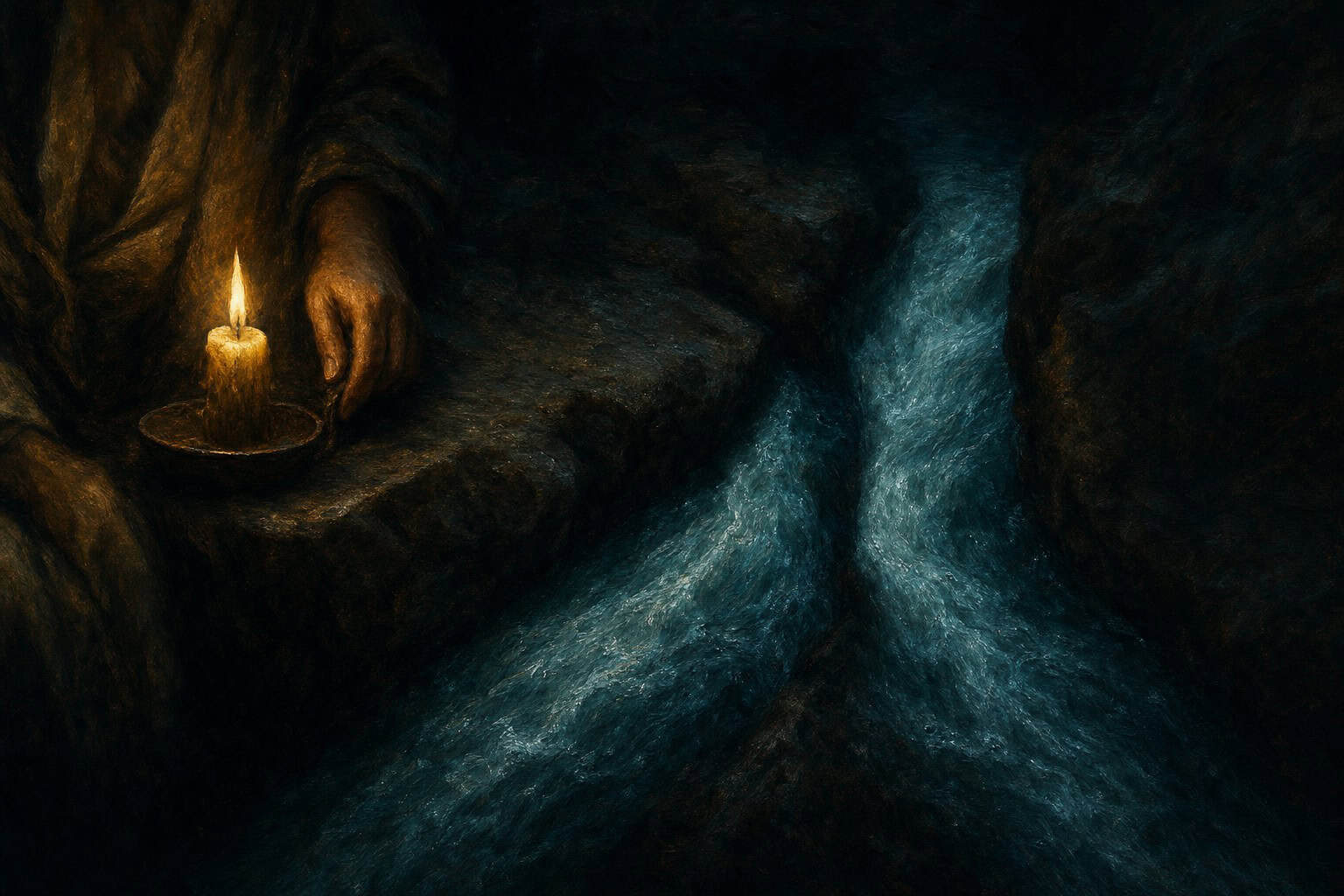
Inside that same body, as he speaks, two long-familiar currents collide: the dark, restless surge that has haunted him since boyhood and a quieter, sorrowful pull that smells of incense and old stone churches. Leigh’s nearness does not silence either stream; instead, they run along each other’s banks, the muddy torrent and the clear spring refusing to mix yet somehow not destroying the channel. He notices it first in his breathing, how the usual chest-tight panic loosens without dissolving, how the urge to flee coexists with an unexpected desire to stay. Her laughter does not chase away his inner demons, but it keeps them from swallowing the last traces of prayer. This is not clean harmony—more like two rivers fighting for the same narrow gorge—yet for once, the rocks do not break. He recognizes the danger in this beauty: if he consents to it, he may never again be able to tell where torment ends and grace begins.
The Taste of Salt at the Back of the Throat
Even as those inner waters hold their fragile truce, another image burns behind his eyes: a woman frozen in mid-turn, crusted in salt, punished for one backward glance. He thinks of Leigh’s face, of children not yet conceived, of a kitchen table he has not yet sat at, and feels his spine stiffen with the terror of becoming that statue. The call upward presses on him like altitude sickness, a thin air of prayer and fasting that seems to demand he release every earthly weight, including the very people who have just begun to steady his step. He imagines his own neck starting to crystallize the moment he looks back toward their lives, caught between ascent and affection. The fear is not poetic; it is bodily—jaw clenched, tongue dry, hands flexing as if to shake off invisible dust. To move toward God, he suspects, might require a refusal even of holy-looking attachments. Yet each time he pictures walking on without them, the imagined salt at the back of his throat burns like a held scream.
When divine love erupts like shrapnel in the chest, the hardest thing is not the wound but letting grace reach the very edge of your darkness.
When God Enters Like Shrapnel, Not Balm
Into this already crowded chest, God does not slip like a quiet thought; He arrives like shrapnel from an unseen blast. One moment Anthony believes he knows the contours of his own darkness, the next his ribs feel pried open from the inside, breath ripped short as a pressure greater than panic crushes and expands him at once. There is no soft glow of reassurance, only the raw sense that something alien and absolute is occupying the cavity he had mistaken for his private self. Memories, fears, and old vows spill out under that weight—names, faces, sins he had stacked neatly in the corners now scattered like debris. This is not comfort; it is conquest, a love that refuses to negotiate with the arrangements he has made with his inner shadows. In the wake of that inner explosion, he understands that praying for healing can mean inviting a demolition crew into the foundations, not a nurse with a warm cloth.
Breathing Between Edge and Embrace
When the shock subsides enough for him to stand without swaying, Anthony realizes his life has taken on a strange rhythm, as if he is learning to breathe with two sets of lungs. One draws in the thin, sharp air of prayer, silence, and a God who tears open his chest; the other fills with the thick, human warmth of Leigh’s presence, family dinners, the ordinary clatter of dishes and future plans. Each inhale toward God seems to demand an exhale into these concrete loves, and each immersion in their world drags him back to that terrifying vertical summons. He does not know yet whether his whetstone self can survive this back-and-forth without grinding everyone down, including himself. He only knows that abandoning either breath would mean a kind of suffocation. The passage leaves him there, standing like a man between river and forge, chest rising and falling, trying not to drop the blade he has become.