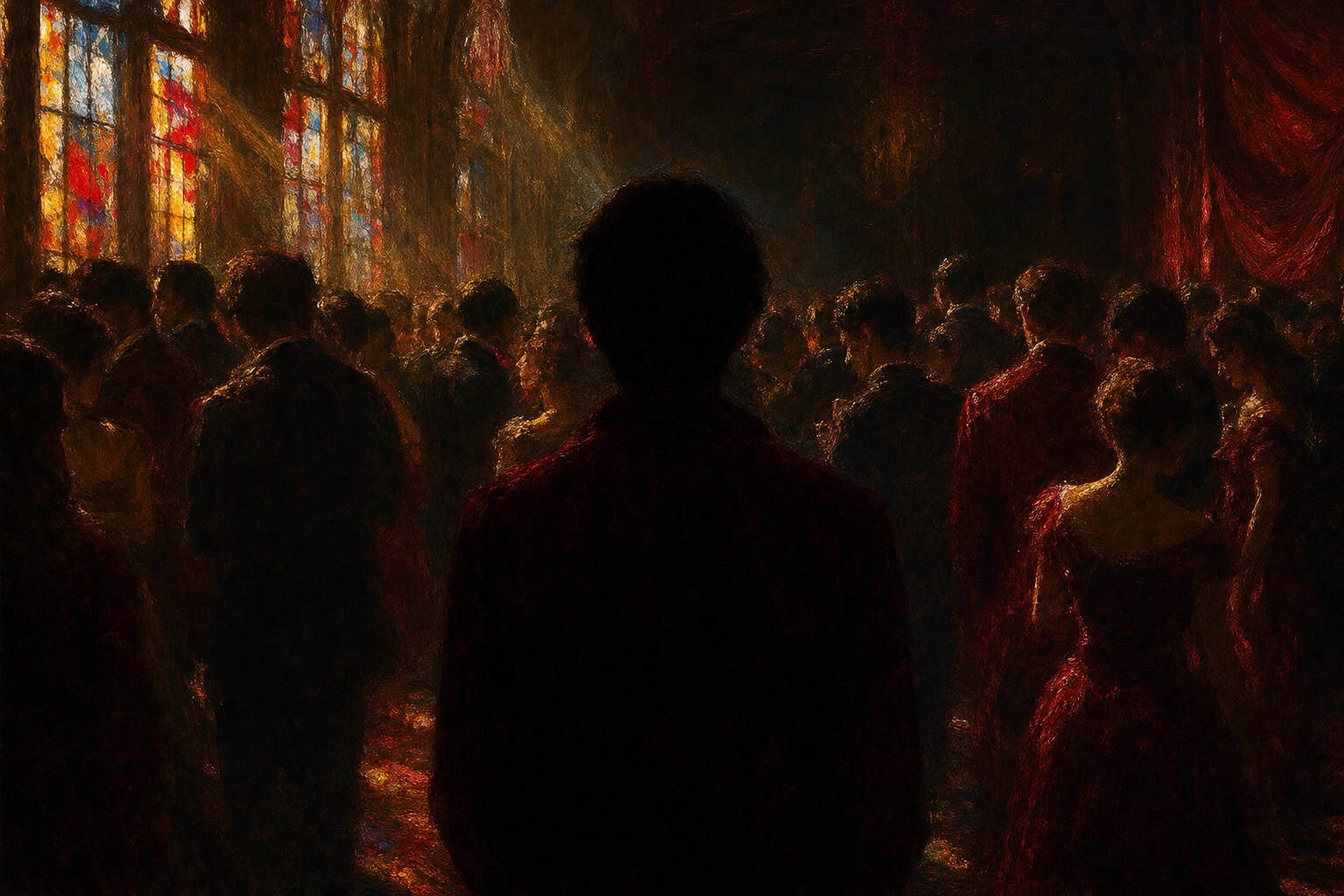
Cutlery and laughter and a song turned up too loud, and his whole world shrinks to the sweating glass in his hand — proof that grief will cross any ocean and leave a man spectral in a crowded room.
A Raised Glass That Never Reaches His Mouth
Noise swells around him—cutlery against plates, sudden bursts of laughter, a song someone put on too loud—but his whole world has shrunk to the weight of the glass in his hand. It sweats against his palm, cold, unsteady, lifted halfway and held there like a signal flare no one has learned to read. He has shown up to this gathering as a silent emergency, suit pressed, hair in place, every visible detail calibrated to say he is fine. The only honest thing on him is that shaking hand. Bodies brush past, a friend claps his shoulder, someone jokes about jet lag, and he nods on cue while his arm stays extended, drowning in plain sight. His presence in the room is more costly than any confession would be, but cost leaves no mark others can see. The music changes, the circle shifts, and still the glass hovers just below his lips, the unspoken plea growing heavier by the minute.
The Suitcase Arrives, and Grief Is Already Home
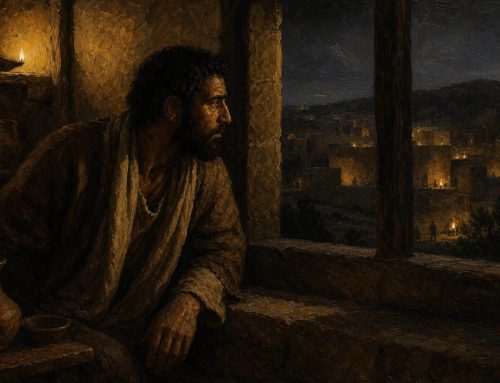
Outside these parties, another scene has already played itself out: the long flight, the hopeful exhaustion, the taxi from the airport to a new street that smells of diesel and pastry. He turns the key in a foreign lock and steps into an apartment he has never seen, yet one corner is instantly familiar. The same invisible weight sits there, where a chair will eventually go, the same unoccupied place that haunted the old kitchen table. He had sailed across an ocean convinced that distance could thin the ache, that a new skyline might rewrite the story pressed into his bones. Instead he finds that sorrow travels lighter than luggage and needs no passport. While he queued for customs, grief slipped through uninspected and set up its quiet post. The discovery is not dramatic, just steady and sickening: there will be no clean break, no fresh start untouched by the old absence. Whatever this new life becomes, it will be arranged around that waiting space.
Watching the Living from Behind the Glass
Back at the long table, plates are refilled and wine bottles tilt, but he sits with the odd stillness of someone who no longer belongs to the same category as the others. He laughs when they laugh, yet the sound feels dubbed, slightly out of sync with the scene. Around him, hands find shoulders, knees bump under the table, two friends lean close to share a private joke, their faces easy and open. He notes every touch with the detached attention of a man taking field notes on a species he has already ceased to be. The warmth in the room moves like current through copper wires, humming along bodies that know, deep down, they are allowed to be there. His own body registers only the cold outline of where that current does not pass. It is not that no one sits beside him; it is that their nearness cannot cross the distance he has become. The feast continues; he observes it like weather behind a window he cannot open.
Grief will follow you across any ocean, and there is a loneliness that makes a man spectral even in a crowded room.
The Backward Step at the Moment of Contact
At one point in the evening, someone finally drifts his way—a woman whose eyes actually linger, a man who remembers a detail from an earlier conversation, it hardly matters who, only that the approach is real. A hand lifts toward his arm, a question forms on a mouth that for once is not rushing past. In that split second, his body performs its oldest liturgy: muscles tighten, shoulders angle away a fraction, the weight shifts toward retreat. The motion is small enough to pass as shyness, as mere awkwardness in a crowded room, but inside it feels as drastic as running for the exit. Pride whispers that he will not be pitied, that he will not owe anyone the sight of his need. Hunger protests, flares, then folds. The offered touch hangs in the air a heartbeat too long, then is rerouted into a joke, a refill, a polite nod. The party absorbs the moment without a ripple, but he feels the backward step like a fresh bruise he has inflicted on himself.
Learning to Taste What Once Looked Like Poison
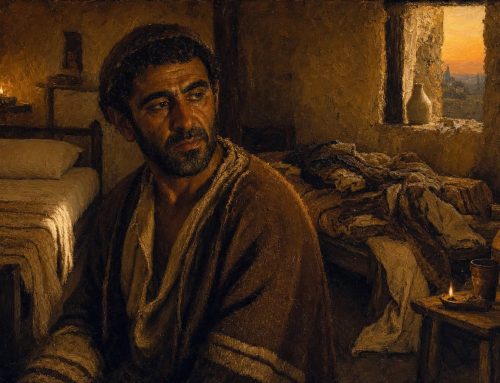
Later, when the last guest leaves and the night drops its noise, he returns to the small apartment where the unpacked boxes wait beside that same invisible chair. The glass from the party sits in the sink, a dried ring of wine marking how far it got. In this quiet, the question sharpens: not whether God can cross oceans or crowded rooms, but whether he can bear to be touched by anything that does not match his darkness. Divine love in this chapter does not arrive as a clean, abstract promise; it steals in through messy dinners, careless laughter in the next room, the reckless kindness of people who forget to be impressive. All of it feels at first like threat, like poison to the careful system that has kept him intact. To accept even a fraction would mean letting the music inside him change key. For now he stands at the sink, fingers resting on the lip of the abandoned glass, wondering how a body trained for famine could ever learn to trust the taste of bread again.