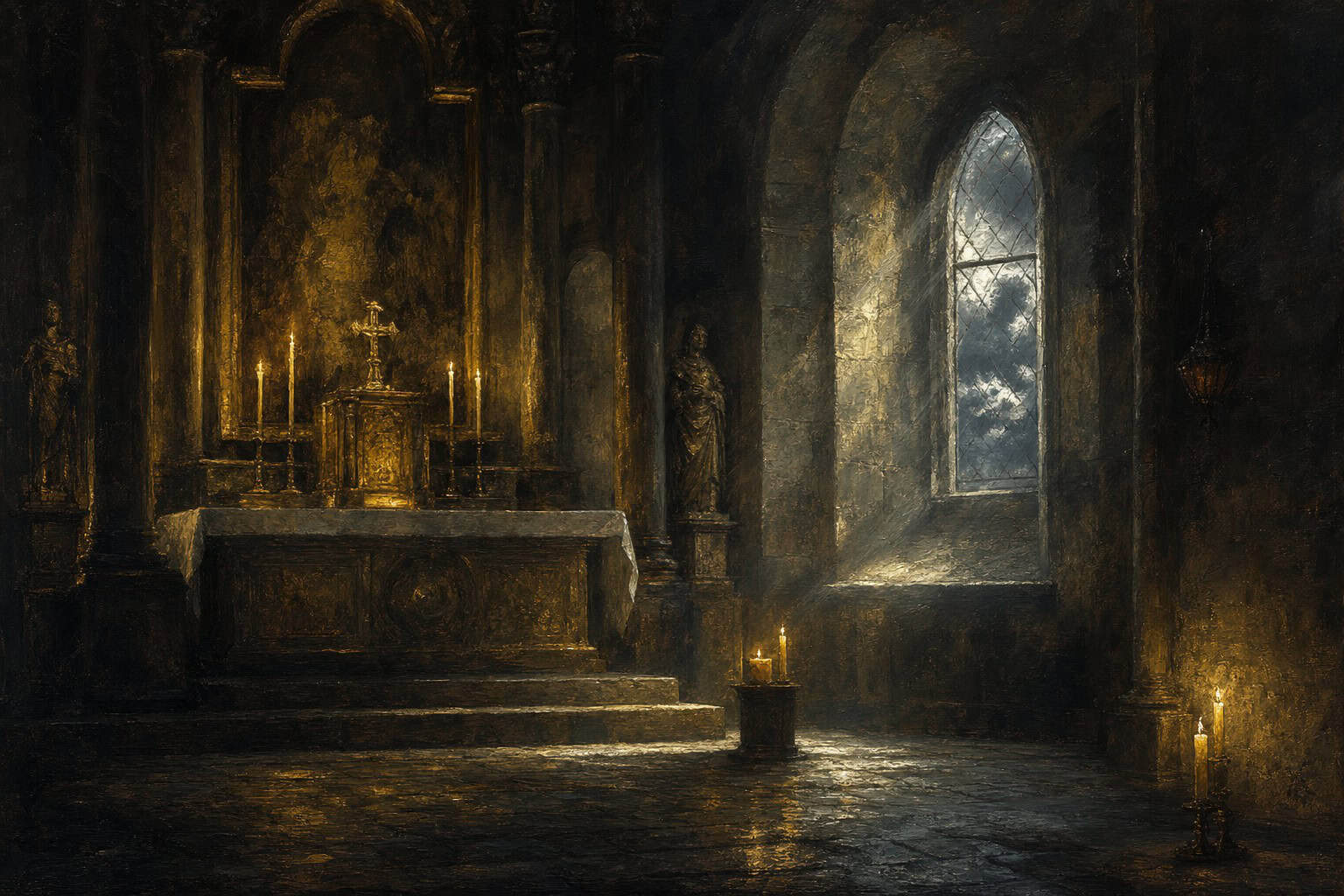
His knees press into cold stone while the campus sleeps and the chapel air, made for prayer, only dries his mouth — a divided man for whom even pleasure now wears the same face as betrayal.
Cold Stone And A Tongue Full Of Dust
Knees press into unforgiving stone while the rest of the campus sleeps. The chapel smells of candle wax and old wood, the kind of air that should cradle prayer but now only dries his mouth. He tries to shape familiar words toward the tabernacle, but they fall flat, dead syllables that never leave his chest. Above him, the crucifix hangs in its usual place, yet tonight it feels less like comfort and more like a weight bearing down, a gaze he cannot escape and cannot feel. He has come here because his body has crossed a line, because pleasure has written itself into muscle and memory, and he wants heaven to erase it. Instead he finds a silence that feels active, almost hostile, as if the very walls are amplifying every remembered touch. In this hard light, the chapel is no longer refuge; it is an echo chamber where abandonment booms louder than any spoken condemnation.
Hands That Don’t Feel Entirely Your Own
While he kneels, his skin still carries a ghost sensation: the first real rush of desire, the way his own hands had moved like they belonged to someone older, someone shameless. That encounter did not feel like gentle discovery; it felt like being seized, steered by an intelligence of the flesh that knew its routes by heart. Ecstasy arrived tangled with terror, because even in the height of it he imagined eyes on him, not human eyes, but a gaze that measured and found him wanting. The sweetness of the act was what condemned him most in his own mind. He cannot stop replaying the hunger that rose so easily, as if waiting just beneath the surface all along, listening for a signal from the dark. Childhood rejection had already taught him he was marked; this new pleasure feels like proof the mark was not a lie but a kind of invitation written under his skin.
A Body That Refuses To Stay Buried
By day he moves through corridors and lecture halls with the practiced calm of a polite ghost. He laughs in the right places, raises his hand at the right times, lets beer soften his edges at crowded tables so no one notices how far away his eyes drift. This thin, agreeable version of himself is meant to bury what roils beneath: the raw mix of grief and wanting that threatens to spill into every glance. But desire has already punched a hole through that careful shell, reminding him that he is not just a mind with grades but a body with pulse and heat. The more he tries to freeze himself in melancholy, the more his flesh insists on being felt—tightness in his throat when someone brushes past, a low ache in his gut on the walk back from the library. Each attempt to retreat into numbness only throws the aliveness of his limbs into sharper relief, like ink bleeding through paper he meant to keep clean.
For the divided soul, even joy arrives with the weight of being watched, and pleasure and betrayal learn to wear the same face.
When Joy Feels Like Evidence Against You
For anyone raised inside the tight weave of sin and grace, this is a familiar courtroom. The body’s pleasure is entered as Exhibit A, the memory of wanting as Exhibit B, until the verdict feels obvious before the trial even begins. You start to believe the worst thing is not what you did but that you liked it, that you would do it again if the chance came quietly enough. So you design small punishing rituals—avoided calls, ended flirtations, self-sabotage dressed up as principle—to prove to an invisible judge that you are sorry. You tell yourself your standards are high, that you are waiting for someone worthy, but beneath the language about value is simple fear of being seen whole. It becomes easier to keep connection at the level of jokes and rounds of drinks than to risk someone noticing the war between your hunger and your image of holiness. You learn to confuse self-erasure with penance, and the sentence never ends.
Keeping The Dissonant Note Alive
Alone on the stone, he realizes that the part of him most ashamed is also the part most violently alive. The same nerve that carried forbidden pleasure now quivers when he thinks of God, as if body and prayer had been wired to the same circuit all along. He fears that saying yes to mercy would require cutting out this unruly music, sanding himself down into something smooth, simple, lifeless. Yet he cannot unknow what his skin has learned, cannot go back to the flat gray world from before his first real surge of wanting. The question hardens in his chest like a lodged seed: is there a way to let himself be loved without betraying the dark, discordant thread that has shaped him since childhood exile? No answer comes from the sanctuary, only the faint crackle of candle wicks burning low. He stays anyway, listening to his own pulse pound in his ears like a stubborn, unfinished chord.