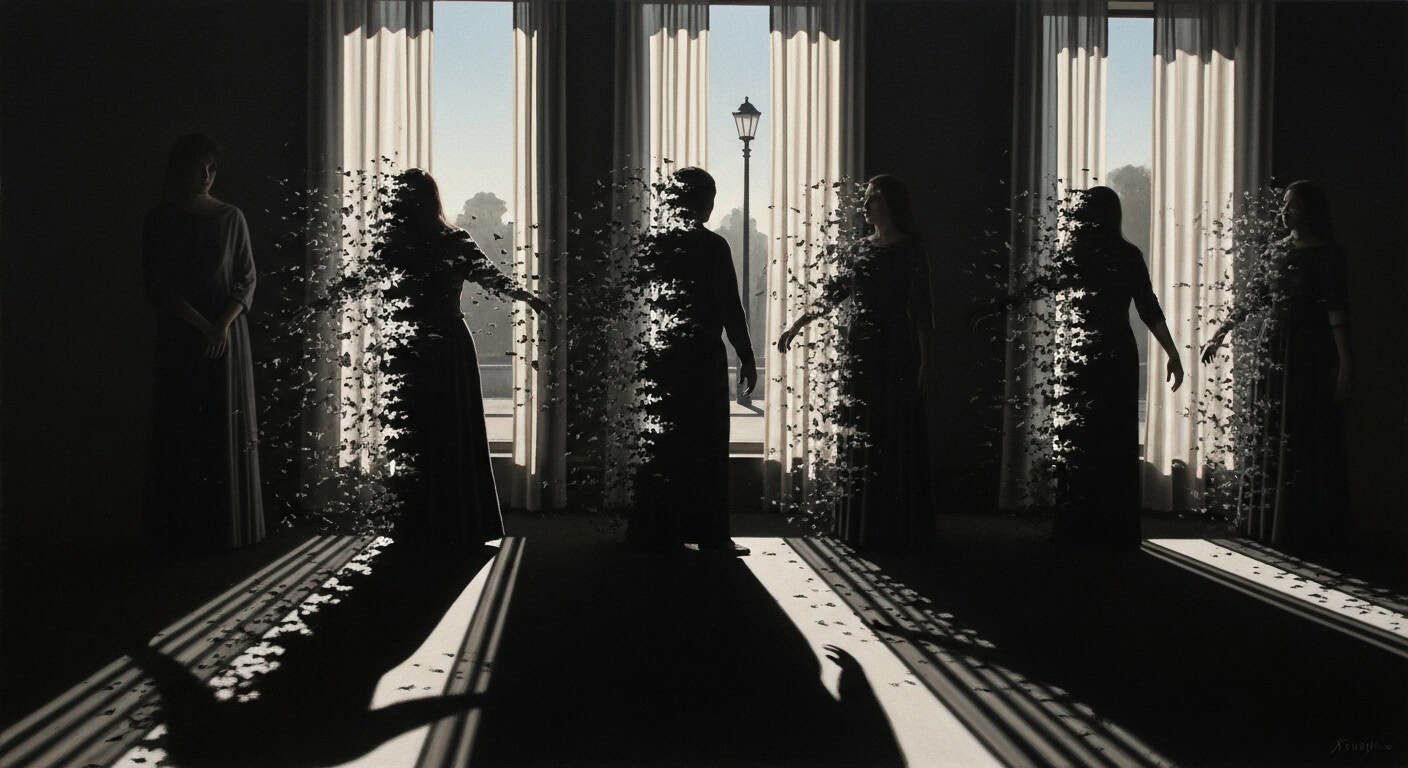
Sweat slicks his back before he reaches the center of the Dallas floor, the bass commanding from below, and he loses the wound of one love in the mercy of a hundred nameless bodies.
Bass Thudding Through Bone
Sweat slicks his back before he even reaches the center of the Dallas floor. Light rips across the room in brief, violent strokes, but the real command comes from below, from the bass that climbs his shins and lodges behind his ribs. Bodies move in a dense, wordless current, shoulders bumping, hips grazing, the air thick with cologne, spilled liquor, and something animal. He stops trying to track individual faces; the strobe erases them faster than memory can store them. His own thoughts blur in the same way, the careful, cutting analysis that usually runs under every interaction momentarily drowned by the drum. Here, names are irrelevant, stories unnecessary. A hand across his chest, a body pressing back into his, and he lets his muscles answer without consulting his mind. The darkness is not empty; it is crowded, noisy, hot, and for now it holds his history at bay like a sound swallowed by louder sound.
Ink on Pages, Armor on Skin
Back in his head, even while his body keeps the rhythm, he carries another structure: the Codex, a stack of unwritten rules he treats like scripture. Every glance from a woman, every tilt of her chin, every delayed reply has already been dissected somewhere inside that system. Seduction becomes a flowchart: demonstrate value, provoke laughter, withdraw at the right moment, never show need first. He tells himself this is simply understanding human nature, but the effect is narrower and harsher. The Codex keeps his chest from opening, turns each woman into a case study, a problem to solve rather than a person whose no could actually wound him. Behind the practiced smirk and timed compliments stands a young man terrified of being looked at with mercy or disappointment. The notes he’s taken on desire wrap around him like a second skin, stiff and polished, more shell than clothing.
Calling Down the Night Woman
Somewhere between one drink and the next, he performs a quiet ceremony no one around him can see. In the dim throb of the club, he shifts his allegiance from the Virgin who watched over his childhood to a darker, older figure in his imagination, a woman of the night who blesses separation instead of union. He lets her stand at the edge of the dance floor, amused, approving, as he leans into a stranger’s ear and feels her laugh against his throat. Under her gaze, tenderness becomes a liability, and touch without promise turns almost holy. He makes a covenant with this unseen patron: he will give his body, never his ache; he will take what is offered and owe nothing beyond the present hour. The more he repeats this liturgy of use and withdrawal, the easier it becomes to believe that heaven is indifferent, that this substitute altar will be enough to keep him from collapsing in the pew he abandoned.
We flee the wound of love into crowds of nameless bodies, mistaking the anonymity of the dark for the safety we lost.
When Depth Becomes Dead Weight
For someone reading this from a quiet apartment or a college dorm, the club might feel distant, but the Codex will not. It shows up when you text a joke instead of the truth you actually want to say, when you decide it’s smarter to impress than to be known. If you are the kind who leads with thoughts and long sentences, you may recognize his mistake: offering the most hidden parts of himself to people drawn only to the spark of the moment. In this passage, he learns—brutally—that bare sincerity thrown down too early is not noble; it is leverage handed to someone who has given almost nothing back. His ache for God, for meaning, for covenant, becomes invisible in a room tuned to dopamine and drama. The question under his calculations is simple and raw: how do you keep your hunger for something eternal without placing it in the hands of someone who only came for a good story?
The Tomboy at the Edge of the Dance Floor
Near the speakers, he watches a particular kind of woman move—ball cap low, sneakers instead of heels, trading insults with the guys and clinking bottles like one of them. She knows the stats of their teams, laughs loud at their crudest jokes, leans on a shoulder as if nothing in her were breakable. The men circle loosely, relaxed, disarmed by the shared language of sports and sarcasm, not realizing how much space she occupies in their thoughts once they go home. He studies her as if she were a live illustration in his Codex: a strategy embedded in denim and cotton, a presence that invites projection while revealing almost nothing of her own longing. She never has to say she is unavailable; her closeness without claim does the work. In her, he recognizes a sibling craft—remaining central and untouched at once—and feels the chill of seeing his own tactics reflected back, like catching his face in a darkened window between flashes of light.