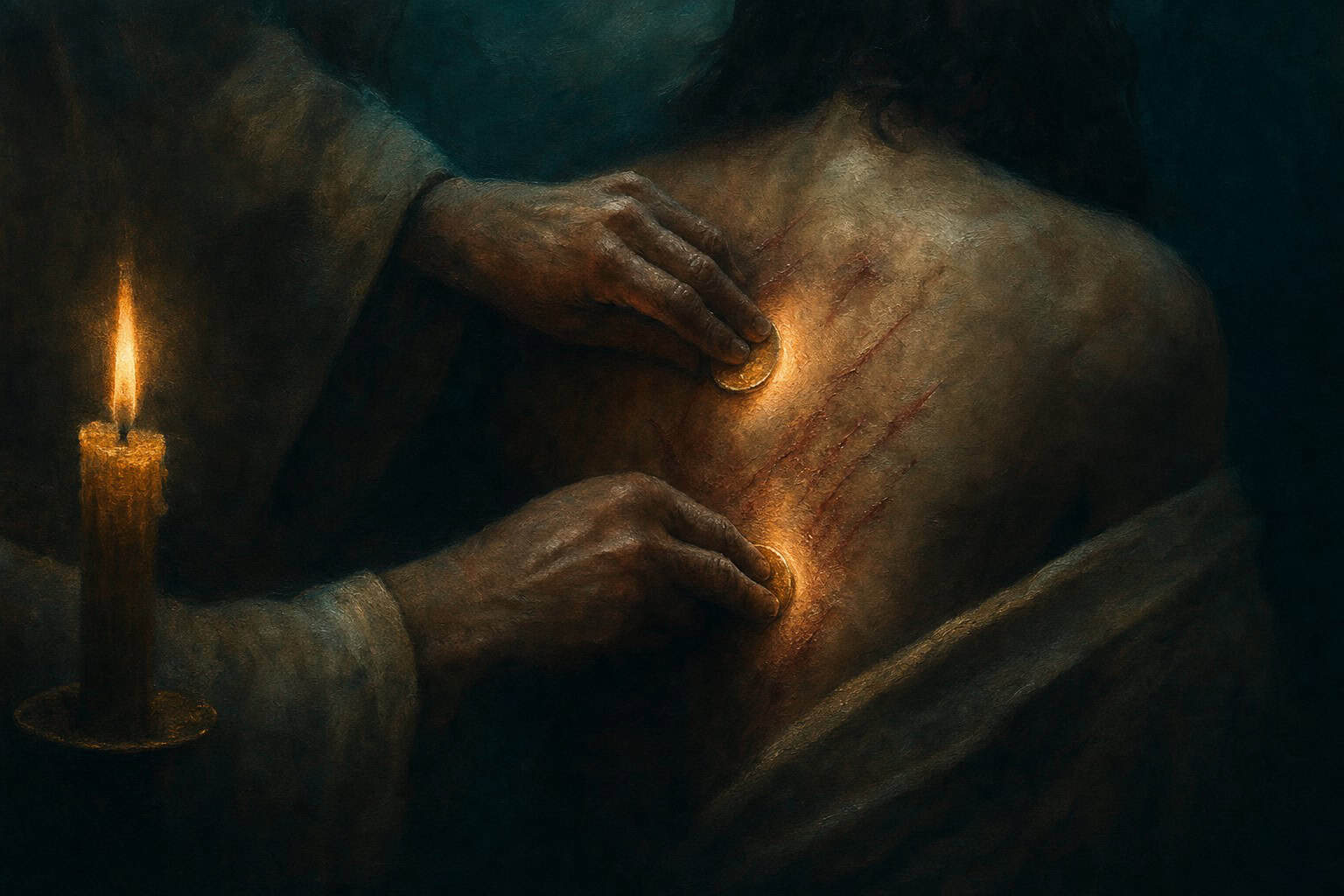
Fall of 1990, a dorm bed, a young man facedown with two sore spots on his back, when something he never asked for touches them warm and then is gone — a heaven that comes down only far enough to mark him with its leaving.
Two Coins Of Heat Pressed Into Bruised Skin
Fall 1990: a college dorm bed, a young man facedown, two sore spots on his back that have become part of the background noise of his body. Then, without his asking, something touches those bruised places with the weight of heated coins, and the ache simply unhooks. From that single point in flesh, everything else follows. A hand seems to reach inside his chest and twist his heart against its usual direction, sending a current outward like a cool wind across sweat-soaked skin. Tingling begins at his scalp and runs down his spine, across limbs and fingers, a wash of power that feels more solid than the mattress beneath him. He knows his own inner storms well enough to recognize that this is not self-made. Love and peace do not drift in gently; they invade, reorganizing his inner world in a matter of seconds. He lies rigid, almost afraid to breathe, as if one wrong move could send this uninvited presence back into hiding.
Words Spilled Like Blood While The Warmth Recedes
From that physical jolt, the chapter bends around a single reckoning: what it means to be chosen and then seemingly left. As the heat in his chest begins to ebb, he does what any child would do when a parent pulls away—he clings, begging, telling this Presence not to go, his face wet, his throat raw. But instead of securing a promise of permanent nearness, something stranger happens. Sentences pour out of him that he did not plan, a kind of self-indictment spoken in the tone of a covenant: instructions to be chased when he runs, remembered when he forgets, rescued when he abandons. He hears himself predict his own future disloyalty in the very moment he feels most held. The mind that once trusted only its own logic now finds itself staring at words it cannot source and a God who answers longing not with possession, but with a mysterious vow laid over the certainty of coming failure.
A Chest Still Buzzing In A World Gone Gray
Once the warmth drains from his nerves, the real movement of the chapter begins—not in ecstasy, but in its echo. His back remains pain-free, yet the rest of life dulls; colors flatten, time thickens, the campus around him feels like cardboard scenery. The memory in his chest hums like a low, leftover charge, while everything external turns thin and gray. Grace does not soften the edges of his exile; it sharpens them. Knowing the taste of fullness makes ordinary hunger unbearable. Old darkness from Lilith’s ritual, her mark near his spine, does not vanish under this new touch; it fuses with the fresh grief of loss, knotting into one deeper melancholy. He grows quieter, more inward, his cynicism no longer just a defense but also a protest: how do you go on with classes and small talk after having your heart spun by an unseen hand? The current of the chapter pushes from shock, to aching absence, into a brooding, almost angry longing that refuses to fade.
The cruelest gift is a heaven that touches down and then withdraws, leaving you forever marked by the memory of a presence that would not stay.
A Heart Spun Backwards That Can’t Spin Forward Again
This is where the book’s central question takes on muscle and nerve. The boy who was branded by spiritual violation now discovers that God’s touch does not erase that brand but writes alongside it. The heart that felt itself gripped and turned cannot simply resume its old rhythm. The double music grows louder: one line mournful and hungry for the God who held him, another restless, suspicious, already preparing defenses against ever being that vulnerable again. The chapter shows how divine love does not arrive as a clean replacement for darkness; it arrives knowing the prior contamination and chooses to enter anyway. In doing so, it refuses his fantasy of a self-made purity. The same mind that had weaponized logic now finds its logic bent under the weight of what it has felt. He is not healed into a single melody. Instead, his very wiring to think and desire becomes the stage on which God and shadow will continue to wrestle, neither disappearing, both claiming him as theirs.
Manna On The Tongue, A Vocation Drawer Half-Filled
By the chapter’s end, the dominant image is not the visitation itself, but the restless hunger it births. Having once been fed like a starving infant, he now walks through days with that taste still on his tongue and a stomach more hollow than before. Out of that ache grows a fierce, almost possessive desire to cling to whatever might keep him near the Source—altar serving, scriptures, the first secret thought of priesthood as a way to stay within arm’s length of the One who slipped away. A drawer begins to gather proofs and tokens of belonging, each object a small attempt to trap lightning in wood and paper. The promise this chapter makes is harsh and honest: divine touch may come early, not to shield a soul from later compromise, but to ensure compromise can never again be simple. From now on, every choice will be made with the memory of coins of heat pressed once into bruised skin, still warming him from the inside out.