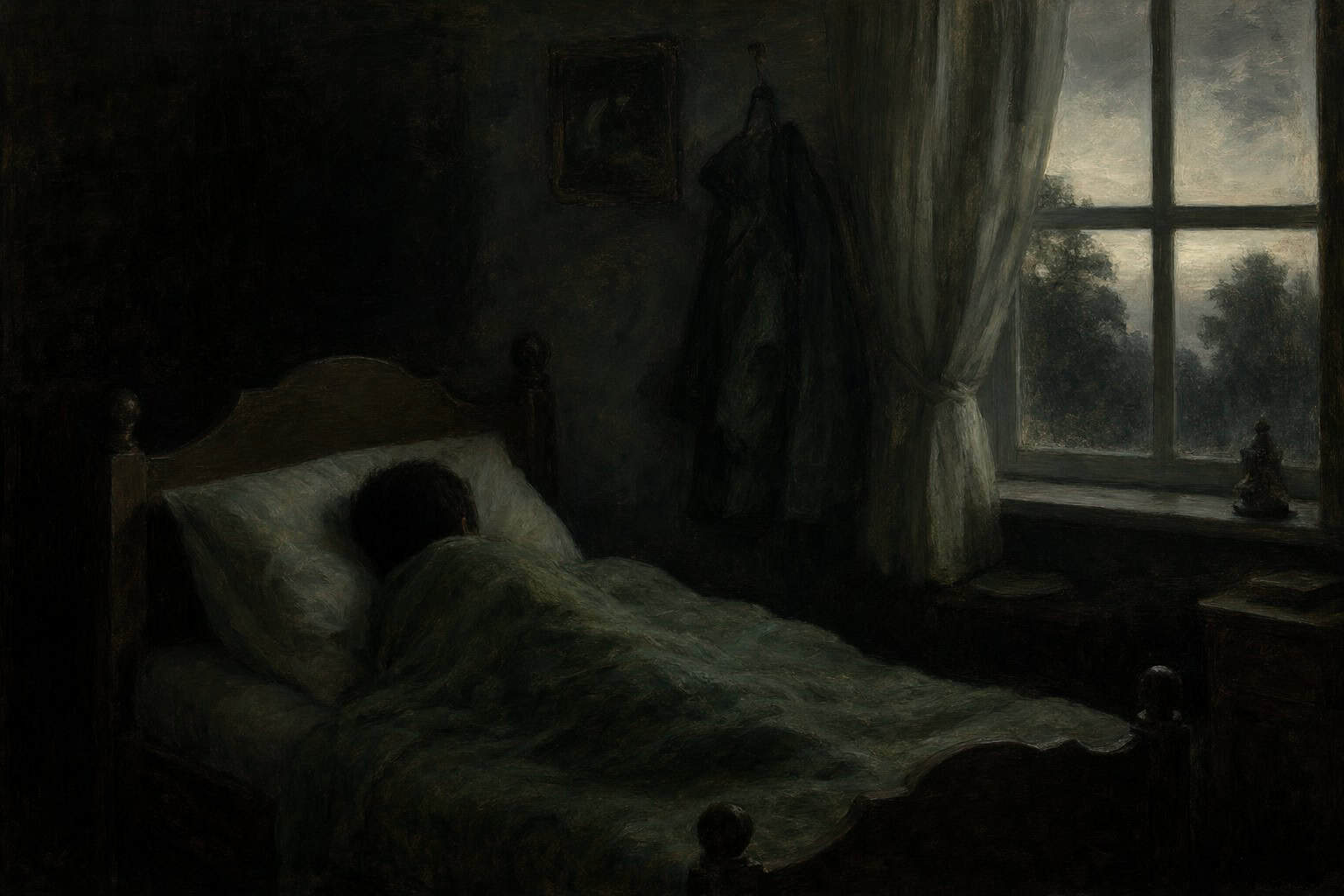
A small body lies stiff beneath a thin blanket, cotton damp where his hands grip it to his chin, and out of the dark, inches from his ear, comes not a scream but an obscene little sound — the ridicule that brands deeper than any terror could.
A Child Frozen Under the Covers
A small body lies stiff beneath a thin blanket, the cheap cotton damp where his hands grip it tight against his chin. Out of the dark, inches from his ear, comes that obscene little burst of sound—a wet raspberry, the noise adults make to tease a baby into laughter. Here there is no laughter, only a cold rush through his limbs as the childish sound lands on him like spit. The bedframe does not shake, no shadow looms on the wall; only this ridiculous, intimate mockery presses against his terror. The place meant for sleep and stuffed animals becomes a stage for a presence that refuses to show its face, that chooses to mark him not with spectacle but with humiliation. He knows no language for spirits or sin, only the raw fact that something invisible is playing with him, and that the play is filthy. That single, stupid sound brands the night far deeper than any scream would have done.
Heartbeat as Seismograph
His chest drums so hard it feels like someone knocking from the inside, begging to be let out. Breath comes in shallow sips, the metallic taste of fear rising at the back of his tongue while sweat cools too fast along his spine. Whatever is in the room cannot be measured, but its arrival writes itself in chemicals and nerves: pupils wide, muscles locked, bladder squeezed to the edge of shame. The body becomes the only gauge he has, registering a presence the grown-ups will later file under nightmares or imagination. In that instant, the neat line between what is “just in your head” and what is “really there” tears like tissue, and the rip runs straight through his nervous system. His thin ribs, his racing pulse, his chattering teeth all testify that something has crossed a line and touched him without touching him. Long after the sound stops, his flesh keeps ringing like struck metal.
When the Air Turns Sour
The raspberry ends, but the air in the bedroom thickens, as if the oxygen has been mixed with something rancid. He feels it in his skin before he feels it in his thoughts—a heaviness that carries not just fear, but a sly, curling delight that is not his. Pride presses close, not as a thought about himself, but as the sense of being toyed with by something that exalts in its own refusal of mercy. Anger flickers at the edges of his terror, an urge to hit back at whatever is laughing, even though there is nothing to swing at. The emotional weather turns strange: shame, hatred, disgust, all crowding into a room that should hold only schoolbooks and pajamas. This is not neutral haunting; it is a kind of anti-prayer, a ritual performed over him without his consent. The cheap bedroom lamp stands dumb on the nightstand, useless against an atmosphere that has decided what it wants from him.
Evil rarely announces itself in terror; more often it brands us through ridicule, and the laughter wounds deeper than any scream.
Drafted at Seven Years Old
No adult signs a form on his behalf, yet tonight his name gets written, without ink, into a conflict older than his bloodline. The absurd assault in this little bed is not random; it functions like an initiation, a grotesque rite that pulls him into a story he has no tools to understand. He will not know to call it a thinning of the veil, only that after this, the world never fully seals itself up again. Classrooms, church pews, family dinners will carry a faint echo of this bedroom—proof that another layer of reality can intrude without warning. While other children fear monsters in closets, he has already learned that sometimes the monster uses baby tricks and comes close enough to feel his warmth. This night begins to bend his future vocation, his prayer, his very sense of what love must contend with. He is not asked if he wants this role; his trembling body is simply treated as if it is already on the front line.
Putting Language to the Wet Sound
Years later, a grown hand rests on a desk, pen hovering, or fingers pause over a keyboard as he weighs whether to write that stupid, obscene detail: the wet raspberry in the dark. He knows how it will sound—petty, childish, almost comic—and that is exactly why it feels dangerous to tell. To name it plainly is to drag that farce out of the shadows and refuse the shame that kept him silent as a boy. This is not about exhibition; it is about debt. The adult who has prayed his way through that memory now owes the child he once was, and every other child like him, words sharp enough to cut through disbelief. When he finally sets the scene down, without embroidery, he turns poison into something like medicine, not by sweetening it but by refusing to edit its absurdity. The written rasp of that sound sits on the page, waiting for eyes that will flinch in recognition and know they have not imagined their own midnight mockery.