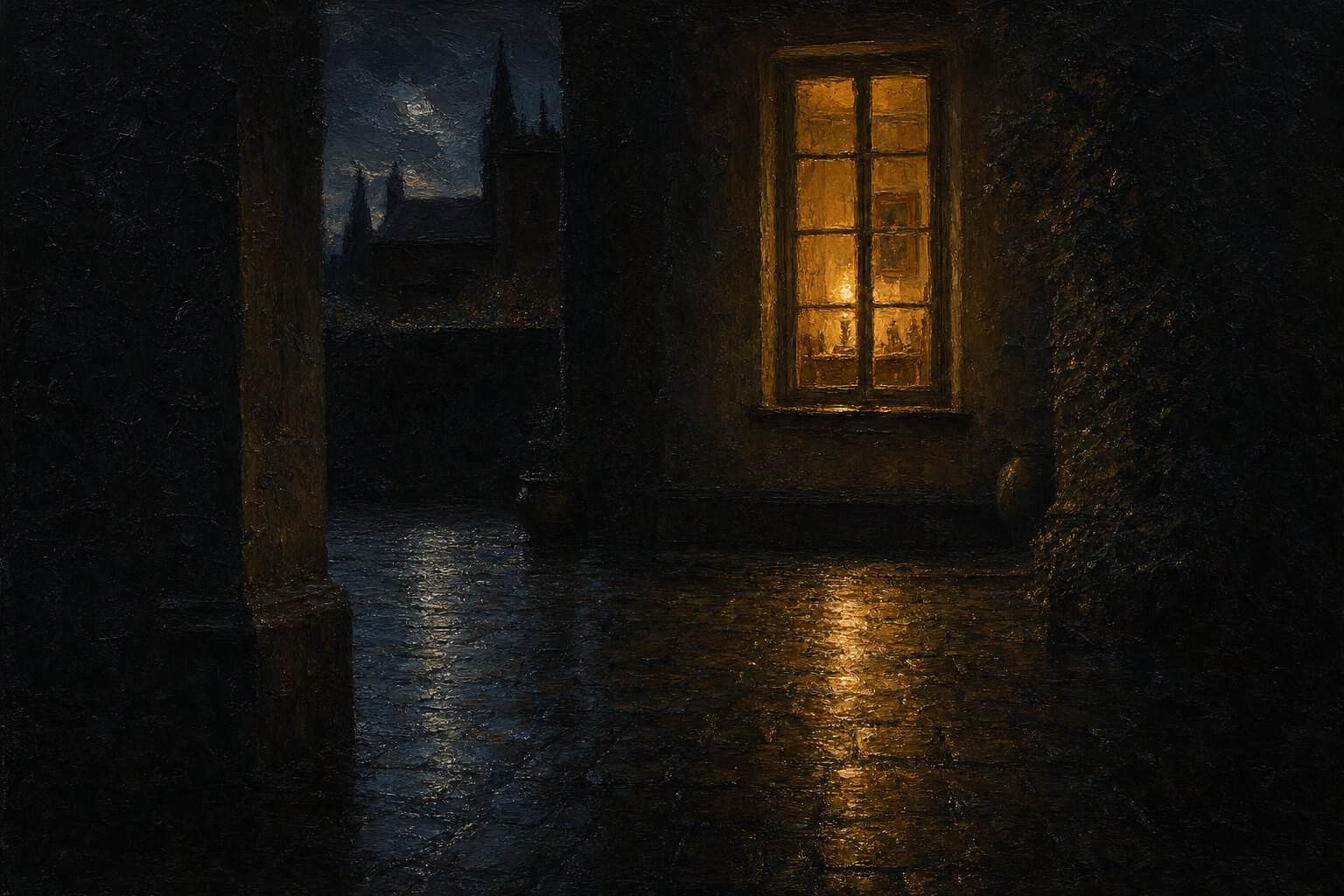
To see love truly, Husserl teaches, one must first suspend belief in it – but the eye that brackets the world discovers it has bracketed itself out of the world’s warmth.
The Suspension That Sees
Edmund Husserl gave philosophy a discipline that reads, at first, like an act of pure devotion to the visible: the epoché, the bracketing of the natural attitude, the deliberate suspension of our naive belief in the world so that its essential structures might at last stand revealed. He called it the radical return to ‘the things themselves.’ Not to deny the world – never that – but to stop taking it for granted long enough to see it. The phenomenological reduction does not close the eye; it opens it violently, stripping away the comfortable film of assumption through which we ordinarily move. What remains, in the clarity of the reduction, is pure consciousness as the absolute field where all meaning is constituted. It is a beautiful ambition, and a terrible one. For to bracket the world is to step, however briefly, outside your own life.
The Observer’s Exile
In Fractions of the Soul, Adoré names a discipline he did not know he shared with a German phenomenologist: the observer’s exile. To see love clearly, he had learned, one must remain outside its spell – hidden, detached, reason held steady against the tidal pull of emotion. This is the epoché performed not on a mathematical object but on the human heart. He suspends his belief in the very thing he loves, brackets the natural attitude of trust and surrender, so that he might perceive love’s essential structure without being deceived by it. And here the corpus discloses something Husserl’s own texts hold only implicitly. The reduction has a cost. The seeing eye that brackets the beloved has, in the same gesture, banished itself from the beloved. Adoré perceives love with terrible clarity precisely because he is no longer standing inside it. The lucidity and the loneliness are one act.
The Pattern of the Withheld Self
There is a relational pattern that runs, unspoken, beneath this discipline – the one Adoré circles when the figure of Jeannètte enters his pages obliquely, never exposed. It is the pattern of the self that studies intimacy rather than dwelling in it, that converts presence into observation the moment presence becomes dangerous. To love is to be constituted by another, to let one’s consciousness be inflected by an intentional object one cannot fully master. The bracketing self refuses this. It holds the beloved at the distance of a phenomenon, examines the essential structures of the affection – its retentions, its modifications, its passive syntheses – and in so doing keeps the affection from ever fully touching it. The tragedy the corpus renders is not that this seeing is false. It is devastatingly true. It is that the truth was purchased by absence. What he saw so clearly, he could no longer be inside of.
The eye that brackets love to see it clearly has, in the same gesture, exiled itself from the love it sees.
Post-Edenic Bracketing
Read through Adoré’s private theology of post-edenic ontology – the self as always-already fallen – the epoché takes on a darker lineage. Perhaps the reduction is not merely a philosophical method but a symptom of the fall itself. In Eden, one imagines, there was no bracketing: the creature dwelt in the world without suspending belief in it, saw without needing to defend the seeing against the seen. After the fall comes the divided attention, the watchfulness, the shame that first taught the human eye to observe its own nakedness rather than simply to be. Husserl’s suspension of the natural attitude is, in this light, a repetition in miniature of the primal exile – a stepping-outside that promises certainty and delivers estrangement. The empty chair of the Confessions is the perfect phenomenological object here: it demands to be perceived, its structure of absence-and-presence analyzed, and yet the very act of analyzing it confirms that the one who should have filled it is not being embraced but examined. Even before God, the fallen self brackets.
The Cost of the Seeing Eye
And so we arrive at the wound at the center of this luminous method. Husserl sought apodictic certainty, an absolute ground beneath the shifting sands of the natural attitude, and he found it – in consciousness as the field where all being is constituted. But certainty and communion do not always keep the same house. You, reader, know this in your own frame: that the moment you begin to watch a love in order to understand it, you have already, subtly, stepped out of the room where it was happening. The reduction reveals essential structures by suspending existence; the observer reveals the essence of the beloved by suspending his participation in her. What Adoré’s corpus offers, finally, is not a rejection of the seeing eye – clarity is not a sin – but a reckoning with its exile. To see love from the outside is to see it truly and to lose the truth of being loved. The seer stands on the far bank, describing the river’s essence with perfect accuracy, dry to the ankle, and thirsty. The question the empty chair asks is whether one dares, someday, to un-bracket – to close the analyzing eye, to fall back into the natural attitude of trust, and to be, at last, inside the thing one had only ever perceived.