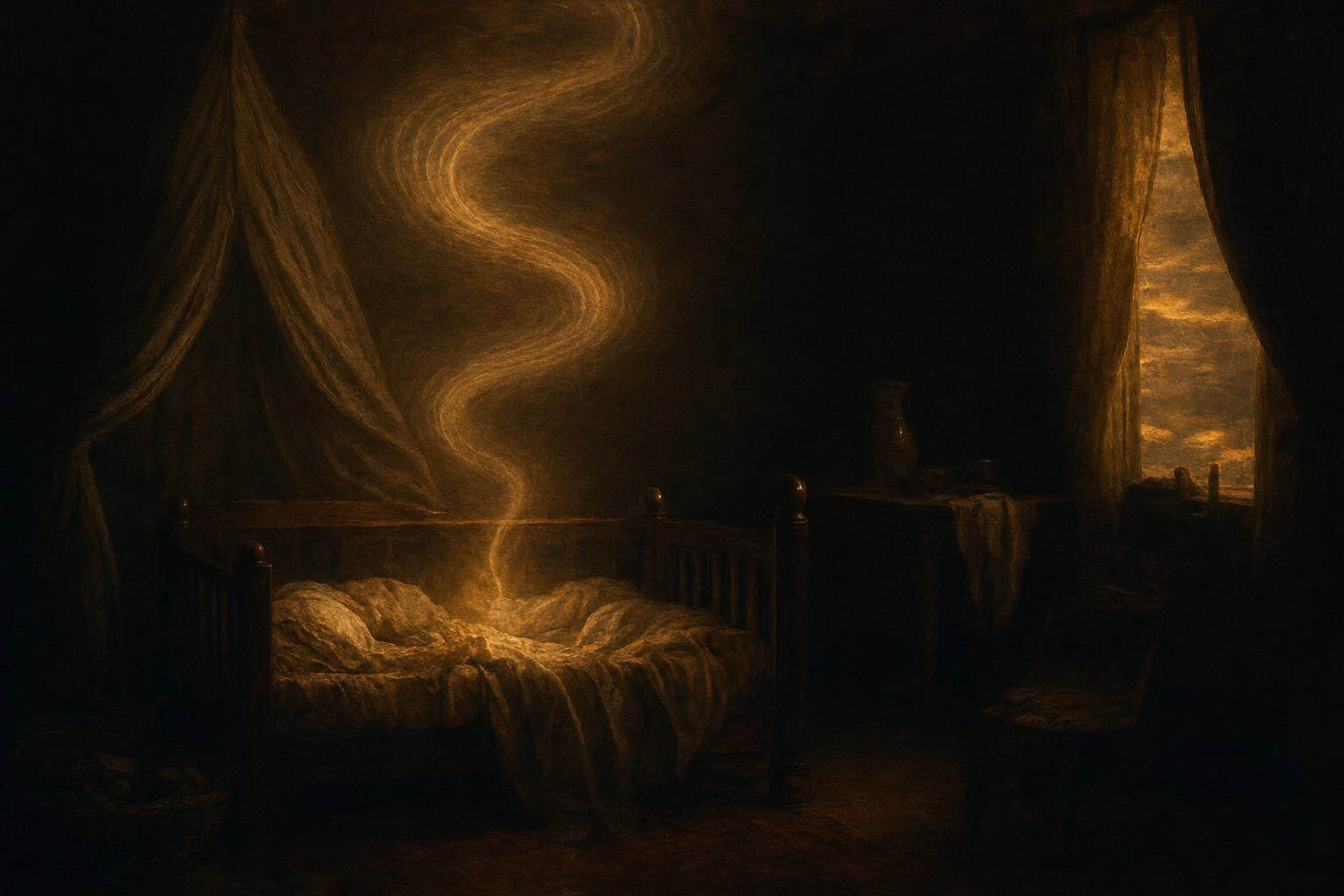
She rubs slow circles into the denim at her knees, talking about the men who come at midnight and never at morning, never guessing how the oldest, most innocent cry carries only to those who would feed on it.
The Cry Drying in the Throat
A woman sits on a low chair, thumbs rubbing circles into the denim at her knees until the fabric whitens. She speaks about men who arrive at midnight, never at morning, men whose wedding rings leave pale bands when they slip them off in her hallway. She swears she never looks for them; somehow, they just appear. At the therapist’s gentle push, the scene jolts backward and her body is in a crib, cheeks wet, chest heaving. There is no lamp, only the dim blur of streetlight leaking around the curtains, and the cry keeps rising until it thins out, until her tiny throat rasps and gives way to a dry, open-mouthed silence. In that stretched-out darkness, her body learns a first commandment: the clean, honest howl for milk brings nothing. Something inside shifts its pitch, not toward hope, but toward any answer at all. Years later, that altered cry lives in her skin like a signal she does not know she is sending.
When Other People Never Quite Appear
In the quiet of the office, one word lands between them: not monster, not villain, but something more chilling—replicant. She recounts wrecking a man’s home life with the same small shrug she uses to describe misplacing her keys. He begged her not to call during dinner with his children; she dialed anyway, listening to his voice crack while staring past the phone, bored. Faces pass through her stories like extras in a film—wives, sons, daughters—soft shapes with no weight. She can outline what guilt should sound like, even angle her eyebrows in practiced sorrow, yet inside there is a flat, humming blankness. This passage dares to say aloud that such blankness is not born last year in a bad choice but in that crib, in that long abandonment that taught her no one truly came. Once you have been placed outside the circle where you are held and seen, you may grow a body that walks among the living while never quite registering that they are real.
Hunger Converted into an Echo Chamber
Here the text starts tracing lines like a cold geometry across her life: crib to club, bottle to barstool, milk to vodka in a stranger’s glass. The infant’s body, once starved for warmth and fullness, has not stopped crying; it has only changed dialect. The same ache now pulls her toward men who answer lustily but never stay, as if the universe keeps offering the same meal with a different flavor of poison. Each unanswered night in that nursery seems to stretch into a future evening where she waits by a buzzing phone, stomach knotted, telling herself he is just busy. The old, raw cry has been translated into an adult broadcast that only certain ears catch—ears trained to exploit, to taste the tremor in her voice and move in. The haunting claim here is that the hunger did not fade; it condensed into a tight, invisible chamber where sound just bounces, louder and louder, until the only ones who hear it are those who came to feed, not to feed her.
The oldest, most innocent cry for love can become a frequency only predators hear, drawing to us precisely those who would consume what we needed given.
When Your Body Keeps Dialing the Same Number
You may never have stood in a stranger’s hotel room, yet you might know this pattern in quieter forms. Maybe you answer every late-night text from someone who never remembers your birthday. Maybe you stay late at a job that drains you because some part of you believes any attention, even harsh and grudging, is better than being overlooked. This passage suggests that such choices are not random failures of willpower but the body redialing the only number it learned in the dark. If your first lessons of need were met by steady arms and warm milk, your nervous system tends to scan for faces that resemble that safety. If those lessons were taught in neglect, your radar bends toward intensity over goodness, toward people whose neglect feels oddly familiar. The text does not excuse harm but insists on tracing its wiring, so that a reader can begin to see how their own repeated hurts might be rooted not in secret defect, but in an ancient, misdirected call for relief.
The Unanswered Cry Still Vibrating in the Air
By the end of this passage, the woman steps back into the street, cars hissing on wet asphalt, couples brushing past with grocery bags and small arguments. She moves among them like someone walking under a different weather system, carrying sunlight or storm that no one else quite feels. Inside her chest, the crying infant and the desirous adult are not two stories but one continuous sound, stretched over decades. The insight she has just touched does not yet heal her; it simply lets her hear the pitch of her own life with unbearable clarity. The central tension remains: can a frequency set by abandonment be tuned toward communion, or will it keep drawing in the very hands that repeat the crib? The page does not tidy this into comfort. It leaves her—and anyone listening—standing in that city noise, suddenly aware of a thinner, older wail still hanging in the air like steam that has not yet decided whether to rise or disappear.