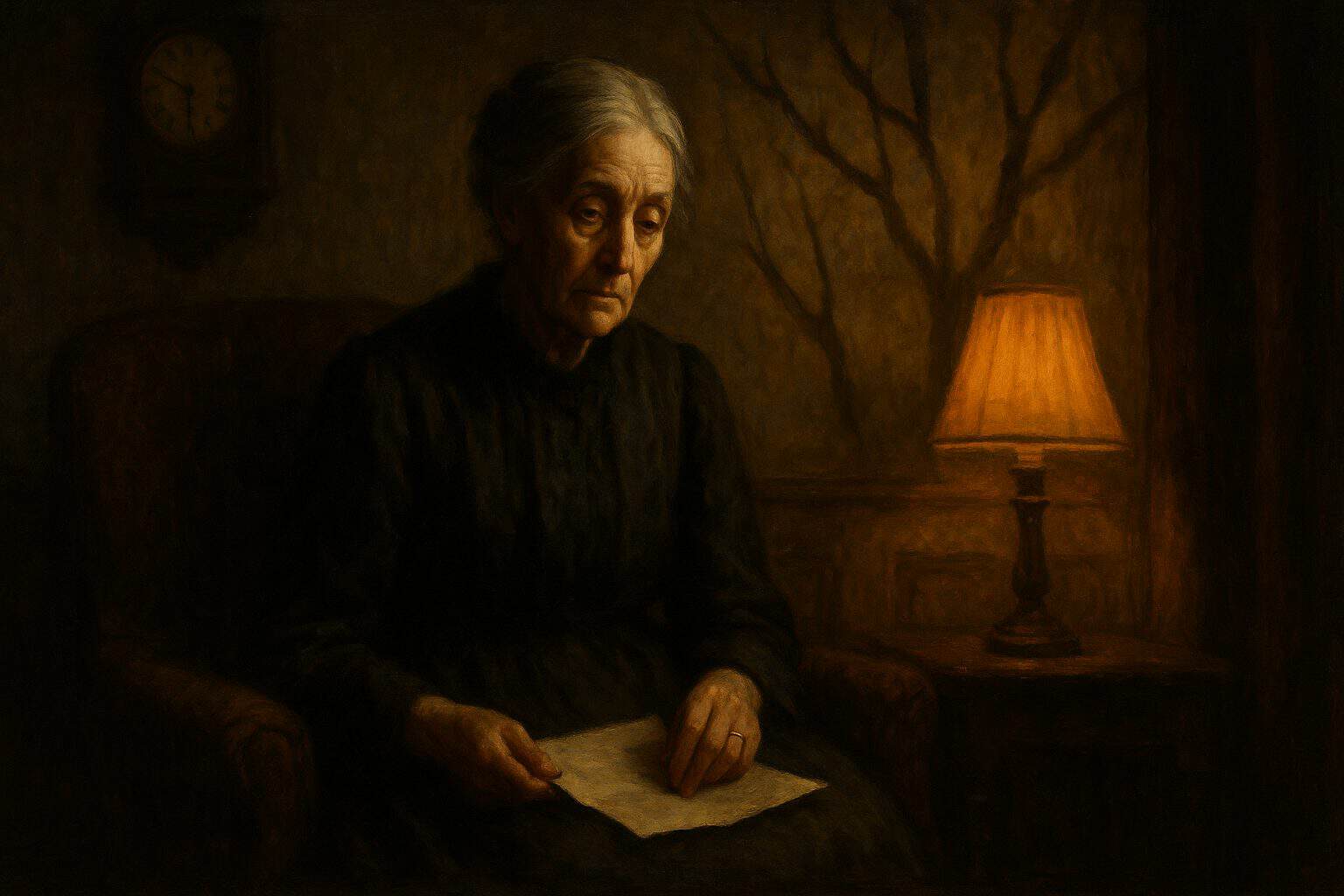
When the horizon collapses into the present moment, eternity opens through the wound of finitude.
The clock on the mantle reads quarter past three. Outside, afternoon light slants through bare branches, casting shadows that will lengthen, deepen, then disappear into dusk—except this afternoon they won’t. Not today. Today the shadows remain fixed, the light neither brightening nor dimming, the clock’s hands moving yet measuring nothing. This is the hour without a future, when time’s arrow breaks against the wall of an absolute limit, and we discover ourselves suspended in a present that has nowhere to go.
The Horizon That Will Not Yield
Every moment of ordinary life carries within it the assumption of the next. When I lift this cup of tea to my lips, my body already anticipates the warmth spreading through my chest. When I begin a sentence, its completion hovers just ahead, drawing the words forward. Even in sleep, the body maintains its faith in morning. We live perpetually leaning into what comes next, our entire being organized around a horizon that recedes as we approach it, maintaining that essential distance that keeps time flowing.
But sometimes the horizon refuses to recede. Sometimes it rushes toward us and plants itself directly in our path, solid as stone. The doctor’s words hang in the air: “There’s nothing more we can do.” The letter arrives: “This is our final communication.” The door closes with a particular quality of sound that announces: this will not open again. “Nor shall we speak again until the return of Christ,” and suddenly the entire temporal structure by which we navigate existence seizes up, leaving us stranded in a present moment that has lost its essential reference point.
What Husserl called the horizon—that misty fringe surrounding all perception—reveals itself most clearly in its collapse. Only when the future fails to function do we recognize how thoroughly it had been organizing our present. Every gesture, every thought, every breath had been secretly borrowing its meaning from what was to come. Now, with that borrowed meaning recalled, we discover ourselves in a strange new territory: pure presence without projection.
The Paradox of the Final Hour
“Being human is a choice and all choices limit themselves to the horizon within which they appear.” But what happens when the horizon itself becomes the limit? When there is no further shore toward which to navigate? The final conversation with a dying parent, the last meeting before an irreversible departure, the moment when a relationship’s ending becomes undeniable—these experiences thrust us into a temporality that contradicts itself. We are still in time (the minutes pass, the heart beats) yet somehow outside it (nothing these minutes contain will matter tomorrow, because tomorrow has been canceled).
The lover sits across the table, speaking of plans for next weekend, unaware that you have already decided: this is the end. “What is” between you has become grotesquely severed from any “not yet” together. The words exchanged become hollow, mere sounds filling space, because the future that would have received them and given them meaning has already been erased. You participate in a conversation that is already posthumous, a ghost dialogue between two people, one of whom knows they are already gone.
“Time is nonlinear, and past and future intertwine in the present in a meaningful way as a function of how one finds themselves situated in the here and now.”
This non-linearity becomes acute when the future vanishes. Without tomorrow to flow into, today begins to eddy and pool, creating strange temporal whirlpools where past and present collapse into each other. The dying grandmother becomes simultaneously the young mother she once was and the absence she is about to be. The ending friendship replays its beginning even as it enacts its conclusion. “The strings of attachment that once bonded one to the other droop to the ground like a limp broken string detached from a distant kite”—except we can see, with terrible clarity, both the moment the string breaks and the day it was first tied.
The Weight of the Unlived
In the hour without a future, the unlived life achieves a terrible density. All the conversations that will never happen, all the reconciliations that will never occur, all the possibilities that will never unfold—they crowd into the present moment with suffocating intensity. The friend you’ve been meaning to call for months lies dying three states away. The words of forgiveness you’ve been preparing remain unspoken as the divorce papers are signed. The child you might have had becomes a ghost more real than the empty room it will never inhabit.
Sartre understood this weight of nothingness, how consciousness exists as pure negativity, a néantisation that introduces lack into being. But in the hour without a future, this lack becomes absolute. It’s not merely that we are separated from our possibilities; those possibilities themselves are being erased, one by one, like lights going out across a city at dusk. “My spirit writhed in futile protest before collapsing, succumbing to a new desolate sorrow… the disorientation of being thrown back into the world”—thrown back, but into a world that has lost its most essential dimension.
The cruelty lies in awareness. We can see exactly what is being lost, can catalog with excruciating precision each future that will not unfold. The relationship that might have healed with time—but there is no time. The understanding that might have dawned with maturity—but maturity requires duration we no longer possess. “If we do nothing and make no attempt to grasp the meaning secreting from the other… we will never expand and fertilize our internal horizons”—except now those horizons have crystallized into walls.
The Strange Freedom of Finitude
Yet something unexpected emerges in this temporal prison. When the future closes off, when tomorrow becomes impossible, a different kind of presence announces itself. The cup of tea in my hands—this particular cup, with its small chip on the rim, the steam rising in this specific pattern that will never repeat—suddenly achieves an almost unbearable vividness. Without a future to escape into, the present moment reveals depths that were always there but never noticed.
“Biological reality and material causality are accepted as facticity and set the horizon within which meaning, openness, consciousness, and perception appear.” When that horizon contracts to the immediate, to this room, this breath, this fading light, the ordinary world begins to glow with significance. The texture of the wooden table, the quality of afternoon silence, the particular way light falls across a loved one’s face—these become, not symbols pointing elsewhere, but realities sufficient unto themselves.
This is what Merleau-Ponty glimpsed: consciousness not as pure constituting power but as perpetual dialectic between the anonymous life of the body and personal acts of meaning-making. In the hour without a future, this dialectic intensifies. The body, knowing nothing of tomorrow’s cancellation, continues its ancient rhythms—breathing, pulsing, sensing—while consciousness must reconcile this continuing life with its approaching limit.
The Wound That Opens
“Her sudden, silent refusal, therefore, did more than just end the moment. It shattered the entire graph.” The graph—that projected arc of possibility that extends from present into future—cannot simply be erased. It must be broken, and in breaking, creates a particular kind of wound. Not the clean cut of surgical decision but the ragged tear of something ripped from its natural trajectory.
This wound has its own phenomenology. It throbs with the phantom pain of the future that should have been. Like an amputee feeling sensation in an absent limb, we continue to experience the pull of tomorrows that no longer exist. Plans surface automatically before remembering they are impossible. Hope rises involuntarily before crashing against reality’s wall. “Reaching hesitantly toward emotion, only to retract, abandoning it before it could inevitably abandon me”—except now the abandonment is not potential but actual, not feared but faced.
“Do not resent the descent; it is where the ascent finds its meaning and purpose.”
But perhaps this wound is not merely destructive. Perhaps, as Lewis intuited, there exists a fundamental pattern of transposition where lower, poorer systems point toward higher, richer ones. The wound created by the future’s absence might be precisely the opening through which something else enters. “He was not fixing me; He was simply filling the empty chair. The loneliness I had carried since childhood, the chasm Jeannètte widened—God had claimed that void.”
The Presence That Remains
When tomorrow disappears, what remains? Not nothing, though it might first appear so. What remains is a present so intensified it almost cannot be borne. Every word spoken carries the weight of being among the last. Every gesture becomes memorial. Every shared silence grows heavy with significance. “The space between us dissolved…exploring beyond the boundaries we had previously held”—boundaries that include the boundary of time itself.
In the hospice room, daughter holds mother’s hand. There will be no next visit, no future conversation to correct today’s inadequacies. Everything that needs to be said must be said now, or never. And yet, paradoxically, in this terrible pressure, something releases. The trivial concerns that normally fill conversation fall away. The defensive structures that protect us from intimacy crumble. What emerges is a kind of communion that ordinary time, with its endless deferrals, rarely permits.
“Desire is not meant to be an end in itself… but instead requires an object outside of itself, ‘knowing,’ to pursue in order to actualize its purpose.” But when the outside collapses into the inside, when the future that desire pursued vanishes, desire itself undergoes transformation. It becomes presence rather than pursuit, being rather than becoming, a dwelling rather than a journey.
The Eternal Hidden in the Temporal
The mystics have always known something about the hour without a future. They speak of the nunc stans, the standing now, the eternal moment that neither comes from yesterday nor leads to tomorrow but simply is. Usually, we encounter this eternal present only in glimpses—in prayer, in love’s consummation, in art’s absorption. But when the future fails, when tomorrow’s door slams shut, we are forced into an encounter with this strange temporality that was always there, hidden within ordinary time.
“It is like finding a sunlit clearing in the forest after traveling through the dark wood.” Except the clearing is found not by moving forward but by being stopped, absolutely stopped, and discovering that here, in this arrested moment, a different kind of light falls. Not the light of progress or development or achievement—all those require future—but the light of sheer presence, of being itself, of the “is” that underlies all “becoming.”
This is what Heidegger approached in his meditation on Being-toward-death, though he perhaps emphasized too much the anxiety and not enough the strange peace that can emerge when anxiety exhausts itself. When we can no longer flee forward into possibility, we might discover a different relationship to the impossible. “These tensions do not mark God as inconsistent; they reveal the terrain where He meets a fallen world without shattering human freedom.”
The Gift of Ending
Every relationship carries within it the seed of its own ending. Every life moves toward its limit. Every project contains its completion or abandonment. We know this intellectually but rarely experience it directly. The future’s presence usually masks the reality of ending, allowing us to live as if continuation were guaranteed. “Keeping an ex-lover or an intimate friend around after their relationship ran its course serves to offer one more option, a known option, a backup option”—the option that tomorrow might undo today’s conclusion.
But in the hour without a future, ending reveals itself as not merely negative—not just cessation or failure or loss—but as the condition that gives shape to what has been. Without ending, there would be no story, no meaning, no form. The symphony requires its final note. The sentence needs its period. The life demands its death. Not as punishment or tragedy (though it may include both) but as completion, as the frame that allows the picture to be seen.
“Let us pause time and halt the courtship unfolding before us with our mind and ponder the conditions of possibility that made such an interaction meaningful.” What we discover is that meaning requires limit. Without the boundary of ending, experience would dissolve into an endless, formless continuation. The very preciousness of each moment derives from its finitude, its irreplaceable singularity, its inability to be repeated or extended indefinitely.
The Community of the Futureless
In the hour without a future, we discover we are not alone. Everyone we have ever lost inhabits this space with us. All the ended friendships, the deceased beloveds, the terminated possibilities—they crowd around us in a strange communion of the finished. “In the quiet click of the door, I felt no sadness, but the cold satisfaction of a theory being proven correct. I lost her as a friend.” But that loss, properly understood, is not an absence but a presence—the presence of an ending that defines what was.
This is the hidden solidarity of human existence: we all face the hour without a future. It comes to each of us, in different forms and at different times, but it comes. The terminal diagnosis, the final goodbye, the last chance that passes unused—these are not exceptional experiences but the very structure of finite existence making itself known. “I no longer interpreted her availability as genuine affection. I knew better. Her approach sprang not from desire, but from calculation”—and in that knowing, that disillusionment, we join the vast company of those who have watched futures close.
The Opening Through Closure
“This was the trap: I could either be wrong… or I could be right (which meant the world was inauthentic, and I lost another piece of my hope).” But perhaps there is a third option, visible only in the hour without a future. Perhaps the world’s authenticity lies not in its endless possibility but in its radical finitude. Perhaps hope’s true form emerges only when false hopes have been stripped away.
When the future closes, something else opens. Call it depth rather than extension, intensity rather than duration, presence rather than progress. The hour without a future is not empty but full—full of everything that is and has been, undiluted by everything that might be. In this fullness, a different kind of time reveals itself: not the linear time of clocks and calendars but the gathered time of meaning and memory, where past and present interpenetrate without the mediation of an expected future.
“I wanted to love again, for the first time since Jeannètte, so I slowed my soul, reorganized it, and opened myself after closing my heart for so long.” This opening after closure, this love after ending, this hope after hope’s failure—these are the gifts of the hour without a future. They come not from tomorrow’s promise but from today’s presence, not from what might be but from what is, in all its terrible and beautiful finality.
The clock still reads quarter past three. The shadows remain fixed. The light neither brightens nor dims. But in this suspended moment, this hour without a future, something eternal pulses. Not the eternity of endless duration but the eternity of depth, of presence, of the now that holds all time within itself. This is what awaits us all: the moment when tomorrow fails to come, and we discover that everything we ever needed was already here, waiting in the present we were always too busy fleeing to see.