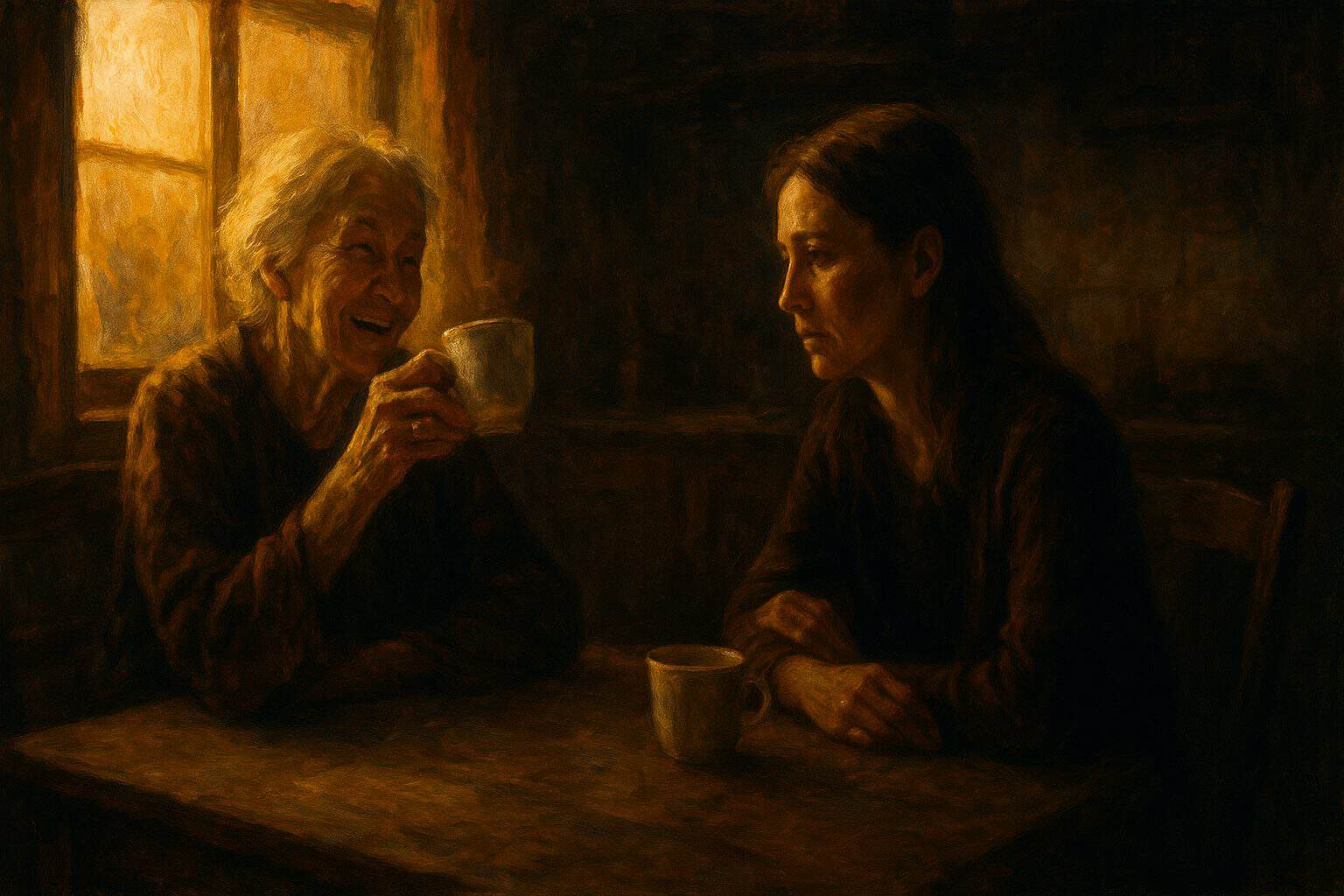
How finitude arrives not as idea but as presence—sudden, uninvited, reorienting everything.
The Uninvited Guest
There are moments when death stops being a concept and becomes a presence. Not the death that hovers abstractly at life’s edges—that philosophical notion we can discuss over coffee—but death as it actually gives itself: pulling up a chair at your table, settling in beside you with a weight that changes the room’s atmosphere entirely.
It happens without warning. You’re speaking to someone you love, and suddenly—perhaps in the way afternoon light catches their face, perhaps in a gesture that reveals their fragility—you see them dead. Not metaphorically. The vision arrives complete: yourself standing at their grave, the peculiar silence that surrounds absence, the way earth looks when it has recently been disturbed. The living person before you continues speaking, unaware that death has just introduced itself into the conversation, that you are simultaneously here with them breathing and there without them grieving.
This uninvited seeing changes everything. What Heidegger called Sein-zum-Tode—being-toward-death—stops being a structure to contemplate and becomes a lived weight. The person across from you, still lifting their coffee cup, still finishing their sentence, has become transparent to their own finitude. And in that transparency, everything they are doing right now—the way they hold their cup, the particular tilt of their head, the specific words they’re choosing—becomes almost unbearably precious.
The Grammar of Endings
Death teaches a different grammar. In ordinary time, we speak in continuations: “I’ll tell you tomorrow,” “We’ll figure it out later,” “There’s always next year.” But when death pulls up its chair, language shifts to a different tense—what might be called the perfective present, where each moment contains its own completion.
“Either you will live your life or you will be lived by it. Your death will close further opportunities to do something different.”
Watch how conversation changes when someone receives a terminal diagnosis. Suddenly, nothing can be postponed. The trivial falls away not through decision but through a kind of gravitational pull toward what matters. People stop talking about the weather and start talking about love, regret, forgiveness. The social masks that usually mediate our encounters become too heavy to maintain.
This isn’t choosing authenticity—it’s authenticity choosing us. When time becomes finite in a way we can feel, not just know, the luxury of postponement evaporates. Every conversation might be the last conversation. Every gathering might be the final gathering. This possibility, always true but usually hidden, now saturates experience like water soaking through paper, changing its very texture.
The Weight of Unlived Life
In the presence of finitude, unlived life becomes visible. Not as abstraction but as weight—a specific gravity that pulls at consciousness. All the words never spoken, the risks never taken, the love never declared: they gather like shadows in the room where death has taken its seat.
The phenomenon presents itself most acutely at funerals, in that strange ritual where we speak to the assembled about someone who cannot hear us. “Why did you wait so long to speak your passion to the grass and dirt when you had the opportunity to do so eye to eye, mouth to mouth, and chest to chest?” The question isn’t rhetorical. It rises from the specific anguish of discovering that death has made all future corrections impossible. The conversation is over. The relationship has assumed its final form.
But this weight of the unlived isn’t only about regret. It’s revelatory. In showing us what we failed to do, death simultaneously shows us what still remains possible. Every unlived gesture toward the dead becomes an imperative toward the living. The love we couldn’t express to the one who is gone transforms into urgency toward those who remain.
The Rebellion of Grief
Grief arrives as the body’s rebellion against finitude. Not the mind’s rebellion—the mind might accept, might even find comfort in theological propositions about eternal life. But the body knows nothing of such abstractions. The body knows only presence and absence, touch and its withdrawal.
“Grief is the liturgy the heart recites when love remains but presence departs. Do not rush its cadence.”
Watch someone at a wake, touching the deceased’s hand. They know—intellectually, theologically—that this is “just a body,” that the person “is with Jesus.” Yet they touch anyway, speak anyway, weep anyway. The spiritual part might trust in resurrection, but as they often say, “the human part misses them.” This isn’t failure of faith. It’s the honest structure of incarnate existence, where spirit and flesh refuse the clean duality we try to impose.
In grief, love discovers its own permanence against death’s interruption. The one who died took their future with them—”their push toward the future, their telos, their ‘for the sake of which'”—but left love behind, still pulsing, still reaching toward an object that no longer gives itself to touch. Grief is love with nowhere to go, circling the absence like water finding its level.
The Wisdom of the Dead
Yet something strange happens in this confrontation. The dead, who cannot speak, begin speaking through us. Not mystically, but phenomenologically—through the specific way their absence reorganizes presence.
“Even though the dead cannot speak for themselves, our voice can unite with theirs and they can speak through our interpretations.” This isn’t metaphor. Watch how the bereaved begin incorporating the deceased’s perspective: “She would have loved this,” “He always said,” “I can hear her laughing.” The dead become a lens through which the living see. Their wisdom, crystallized by finitude, enters the bloodstream of the living.
This incorporation is not mere memory. It’s a structural transformation. The dead become part of the interpretive framework through which we encounter the world. Their absence becomes a presence of a different order—not the presence of a body across the table, but the presence of a perspective within consciousness, a voice in the ongoing dialogue of meaning-making.
The Stimulus of Mortality
“Death itself offers a profound stimulus to individuals sedimented in average everydayness, enabling them to ‘wake up.'” This awakening isn’t gentle. It arrives as rupture, as the sudden visibility of what was always there but covered over by the business of living.
To live life, death must be ignored—we cannot function if every moment carries the full weight of its own ending. But “to live abundantly, death must be confronted.” This confrontation doesn’t happen once. It happens repeatedly, each time death pulls up its chair, each time finitude makes itself felt rather than merely known.
The confrontation changes the arithmetic of existence. When death is abstract, time feels infinite and choices reversible. When death becomes present, time reveals itself as the non-renewable resource it always was. “Either we live our lives in fear… or, because we know death is coming, we live out our remaining time with a sense of precious urgency.”
The Theater of Ending
Imagine your own death. Not abstractly, but concretely: the specific room, the particular faces gathered, the actual words being spoken. “Now imagine that as part of your funeral, individuals rise and stand before the gathering to say a few words.”
What would they say? More importantly, what would you want them to be able to say? The gap between these two—what would be said and what you hope could be said—maps the work that remains. This isn’t morbid fantasy. It’s the imagination pressed into the service of urgency, future absence creating present imperative.
Without this imagination, we risk becoming “the book that no one will read, the song that no one will hear, and the film playing in an abandoned theater.” Not because we lacked talent or opportunity, but because we never fully inhabited our own existence, never took ownership of the life that was ours to live.
The New Tunnel
In the end, finitude offers what Anthony Adoré calls “a new tunnel leading out of the habitual.” The wisdom of the dead becomes the wisdom of the living—not through transmission of information but through the transformation that occurs when death’s presence makes life’s preciousness palpable.
This new way of being “always-already exists to those willing to search for it, perceive it, and act upon it.” It doesn’t require dying, only the honest encounter with death as it gives itself—not as future event but as present possibility, the chair already pulled up to our table, waiting to be acknowledged.
The dead do not care that we weep for them, “their work complete.” But the living care, must care, because in our grief and our urgency, in our rebellion against finitude and our acceptance of it, we discover what it means to be human: thrown into time, destined for death, but capable—precisely because of these limits—of love, meaning, and the courage to speak our passion eye to eye, mouth to mouth, chest to chest, while there is still time.
“Part of me died,” we say when loss arrives. But perhaps more accurately: part of us comes alive, awakened by the proximity of ending to the irreplaceable value of what remains.