Where the ledger of pretense finally closes, and the self stands naked before its own gaze.
The Feigned Courtesy
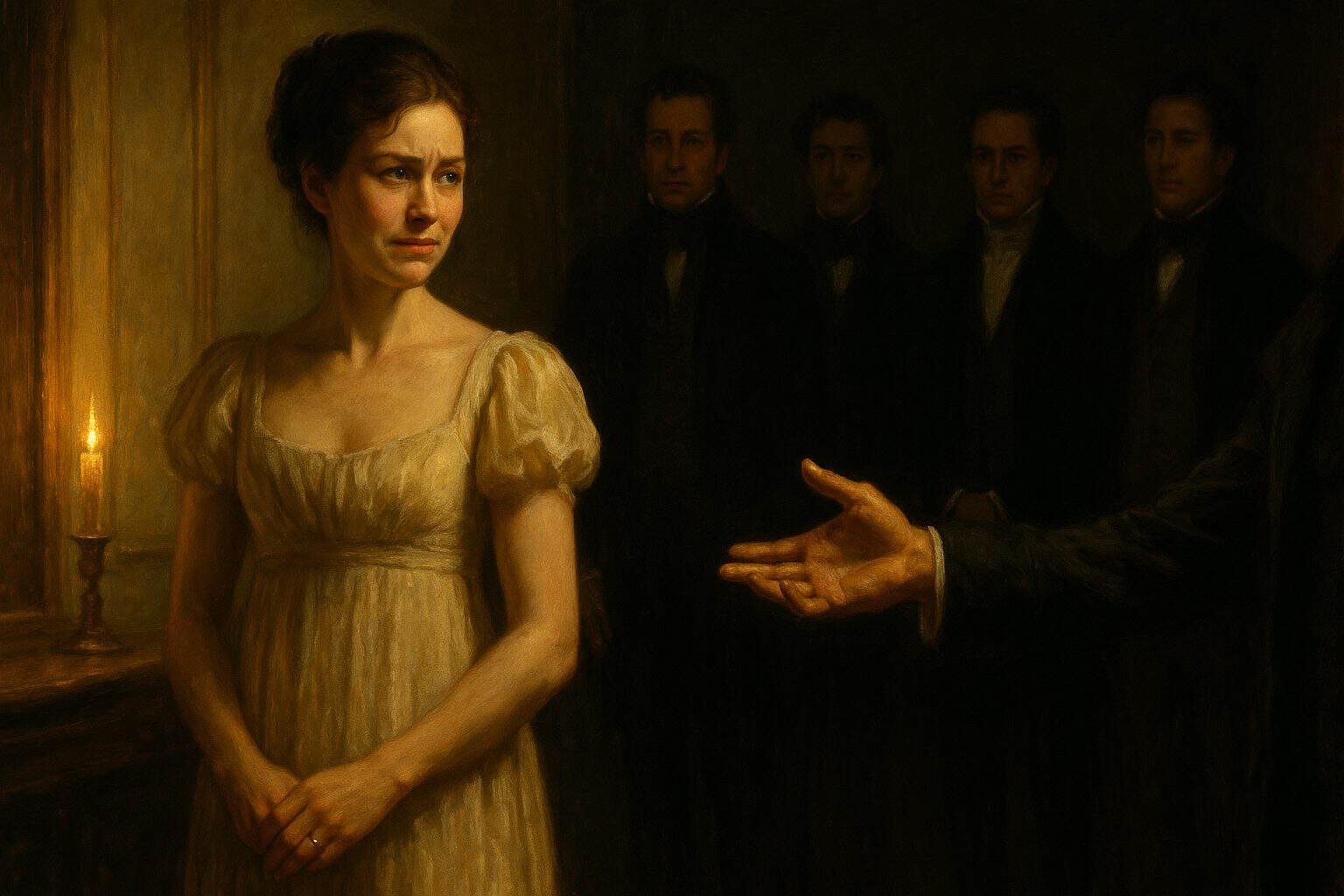
There is a moment when choice reveals itself as theater. Not the grand theater of decision where paths diverge in yellow woods, but the small, suffocating theater of the already-decided wearing the costume of option. Anthony names it precisely: “the feigned courtesy of her option to refuse.” The man directs the woman to choose a partner from the assembled men, this directive itself already containing its own completion. The courtesy is not courtesy. The option is not option. It is power dressed in the garments of freedom, and everyone in the room knows the script.
Watch how this unfolds in lived experience. The woman stands before the assembled men, supposedly sovereign in her selection. But sovereignty here wears quotation marks so heavy they bend the very air. She will choose—must choose—because the refusal itself has been pre-refused. The men stand like items in a catalog she must browse, their bodies become objects under her gaze that is not really her gaze but the gaze she has been directed to perform. Everyone plays their part: she the selector, they the selected, he the generous granter of agency.
“Choosing one means excluding others; pursuing one means ignoring others. We perceive existence with our limits.”
But here the limits are not the natural boundaries of finitude that shape authentic choice. They are the artificial walls of a maze where every path leads to the same chamber. The phenomenology of bad faith begins precisely here: in the gap between the gesture of freedom and freedom itself, in the space where we pretend not to notice that the choosing has already been chosen.
The Leash Disguised as Gift
The body enters the space between two people, but how it enters makes all the difference. Anthony’s lived encounter: “She did not offer her body as a gift to be received, but wielded it as a leash—a tool to measure my compliance.” The body that could be presence becomes instead instrument. The flesh that might speak communion speaks instead control.
Feel the texture of this moment. A woman moves closer, her proximity carrying what seems like invitation. But invitation implies the freedom of response, the genuine possibility of yes or no. Here, the approach carries its own demand. The body becomes not bridge but barrier, not opening but test. Each gesture measures not desire but obedience, not connection but submission to the script she has written in advance.
The phenomenology reveals itself through the very air between bodies. Where authentic encounter creates a charged space of mutual recognition—what Merleau-Ponty might call the chiasm of touching-touched—this weaponized intimacy creates only the hollow space of manipulation. The other does not appear as other but as director of a play in which you must perform your assigned role. Your desire itself becomes not yours but a response she has calculated, a reaction she has engineered.
The Passive Voice of Evasion
Language itself becomes accomplice to bad faith. “She will take on the role of passive recipient, the one to whom the action is done, not the one doing the action.” The grammatical structure mirrors the existential structure: agency disappears into the passive voice, responsibility dissolves into the grammar of happening-to rather than choosing-for.
Consider how this lives in actual speech. “It just happened.” “One thing led to another.” “I found myself…” The self that finds itself has not actually found anything—it has hidden itself in the syntax of accident. The passive voice becomes a refuge from the weight of decision, a linguistic space where actions occur without actors, where consequences arrive without choices.
But the phenomenology of speech reveals what the grammar conceals. Even in the moment of saying “it happened to me,” the speaker knows—somewhere beneath the words—that they happened it. The very effort required to maintain the passive voice testifies to the active voice it suppresses. Bad faith requires constant work, constant maintenance of the mask that pretends it is not a mask.
The Hypocrite’s Pew
“While I still contemplated Him in private, under the moon and stars, I refused to worship Him among hypocrites.” Here bad faith takes its collective form, becomes not individual evasion but communal performance. The church pew fills with bodies that have left their souls at home, voices that sing words they do not mean to a God they do not actually address.
Feel the specific weight of standing among them. The hymnal heavy in hands that know these are not prayers but performances. The collective rising and sitting, kneeling and standing—choreographed movements that mimic worship while worship itself has fled. Everyone knows everyone else knows, yet the knowing itself becomes part of what must not be acknowledged.
The stars and moon become refuge precisely because they demand no pretense. Under open sky, contemplation can be what it is. But among the hypocrites, even genuine faith becomes suspect, contaminated by the bad faith that surrounds it. The refusal to worship among them is not mere preference but necessity—the preservation of something real from the contagion of the performed.
The Unwinnable Scenario
“This was my Kobayashi Maru—the unwinnable scenario. If I remained silent, Angela’s narrative would win. If I spoke, I would hand Jane the very tools to crucify me.” Sometimes bad faith is not chosen but imposed, becomes the only available response to an impossible situation. The double bind creates a space where every action is already a betrayal, every choice already a loss.
The phenomenology of entrapment: standing between two accusations, both false, both believed. Silence becomes complicity with one lie, speech becomes confirmation of another. The very structure of the situation forbids authentic response. You must choose not between truth and falsehood but between falsifications, not between good and bad faith but between bad faiths.
Yet even here, in the space of the impossible, something remains. The recognition of the scenario as unwinnable is itself a form of truth. To see bad faith as bad faith, even when forced to participate in it, preserves some kernel of authenticity. The mask worn knowingly is not the same as the mask that has replaced the face.
The Approval That Precedes
“None of it… matters if a man does not first meet her physical approval. The power of his personality will fall on deaf ears if his body does not first interest her.” Here bad faith takes the form of the prerequisite, the condition that invalidates everything that follows. The conversation that seems to be about connection is already over, decided by a judgment that preceded the first word.
Watch how this structures encounter. Two people appear to be meeting, getting to know each other, discovering compatibility or its absence. But one has already decided based on criteria that will never be acknowledged. The questions asked are not real questions. The interest shown is not real interest. It is the performance of consideration after the verdict has been rendered.
The phenomenology of the predetermined: every gesture of openness carries its own closure, every seeming possibility its own impossibility. The other person speaks into a void disguised as attention, offers themselves to a reception that has already refused them. Bad faith here means not just self-deception but the deception of the other, leading them through the motions of a dance whose outcome was decided before the music began.
The Shattered Graph
“Her sudden, silent refusal, therefore, did more than just end the moment. It shattered the entire graph.” There comes a moment when bad faith can no longer maintain itself, when the mask cracks and falls away. Not gradually, not through patient peeling, but suddenly, catastrophically. The entire structure of pretense collapses at once.
Feel the specific quality of this shattering. It is not like breaking a single promise or revealing a single lie. It is the retroactive revelation that everything has been false, that the entire graph of relationship has been drawn in disappearing ink. Every moment must be revisited, re-understood. What seemed like connection reveals itself as manipulation. What felt like intimacy shows itself as strategy.
“Consequently, the master doubts his ability that allowed him to perceive potential in his chosen student in the first place.”
The shattering extends beyond the immediate relationship. If I could not see this, what else am I not seeing? If this person could maintain such complete deception, who else is deceiving me? The graph that shatters is not just the graph of this relationship but the graph of trust itself, the basic faith that allows human connection.
The Defection
“Slowly, we realized he was not a spy. He was defecting.” Sometimes the end of bad faith comes not as shattering but as quiet crossing over. The one who has been performing suddenly stops performing. The mask is not torn off but gently set down.
The phenomenology of defection: the gradual recognition that someone is changing sides, not from one team to another but from pretense to presence. Watch how this unfolds. First, small inconsistencies in the performance. Moments where the mask slips, where something genuine flickers through. Then larger breaks, refusals to play along, declining to speak the required lines.
The day comes when invitation is extended: “I asked him to sit with us on the day their table was fullest.” This is the moment of choosing, but not the feigned courtesy of the pre-chosen choice. This is real selection, real risk. To sit at the new table when the old table is fullest means to publicly end the pretense, to let the mask fall in front of everyone who still wears theirs.
The Seed Withheld
“I declined. I have not yet met a woman worthy of my seed—one who can embrace my fire without trying to cage it.” Here is refusal that knows itself as refusal, that does not hide behind the passive voice or the feigned courtesy. But notice what is refused: not just this woman or that woman but the entire structure of possession disguised as partnership.
The phenomenology of the withheld: keeping back what others assume you must give, maintaining reserve where others expect surrender. This is not the bad faith of pretending to give while withholding, but the good faith of acknowledging the withholding itself. To say “I have not yet met” is to remain open to meeting while refusing to pretend it has already occurred.
The fire that must not be caged—this is what bad faith always seeks to contain. Not through honest restriction, which would at least acknowledge what it restricts, but through the pretense that the cage is not a cage, that limitation is liberation, that control is care.
The Resignation
“Resigning ownership over personal freedom, choice, and responsibility to others, ignoring death and finitude.” This is bad faith in its purest form: the abdication disguised as delegation. Not the honest acknowledgment of limitation but the pretense that someone else can carry what only you can carry.
Feel how this lives: the relief that comes with saying “it’s not up to me,” “I had no choice,” “my hands were tied.” The weight of freedom transferred to others who cannot actually bear it because it is not theirs to bear. The responsibility that remains yours even as you insist it has become theirs.
Death and finitude—these are what bad faith cannot face. The absolute limit that makes choice real, that gives weight to decision. To ignore them is not to escape them but to live in the shadow of their denial, to structure existence around the absence that is presence, the limit that limitation itself.
The Reckoning
The accounting that ends the mask is not a judgment from outside but a recognition from within. The moment when the energy required to maintain the pretense exceeds the energy available for life itself. When the cost of bad faith becomes visible not as moral failing but as existential exhaustion.
This is what Anthony’s memoirs trace: the slow, painful, necessary end of pretense. Not through moral resolution or spiritual breakthrough but through the simple inability to continue the performance. The mask does not fall because we become good but because we become tired.
And in that exhaustion, paradoxically, freedom appears. Not the false freedom of infinite options or the feigned courtesy of the pre-chosen choice, but the real freedom of finitude acknowledged. To choose one thing means to exclude others—this is not limitation but the very structure of authentic choice. To perceive existence through our limits—this is not failure but the condition of genuine perception.
The well that receives these confessions is not the well of judgment but the well of recognition. Everyone who reads these words has worn masks, has lived in bad faith, has participated in the collective pretense. The accounting that ends the mask is not Anthony’s alone but ours, each of us tallying the cost of our own performances, weighing the exhaustion against the fear of being seen.
What remains when the mask falls? Not the pure self, finally revealed—that too is a fantasy, another form of bad faith. What remains is the ongoing work of presence, the daily choice between performance and presentation, between the feigned courtesy and the genuine risk of refusal. The accounting never quite closes; it remains always a reckoning in process, a crossing that must be crossed again, a well that must be returned to with new confessions, new recognitions, new unmaskings.
The truth that emerges from Anthony’s memoirs is not that we can live without masks but that we can know them as masks. The bad faith that recognizes itself as bad faith has already begun its own overcoming. The accounting that ends the mask begins with the simple acknowledgment: this is a mask. I am wearing it. I am tired.