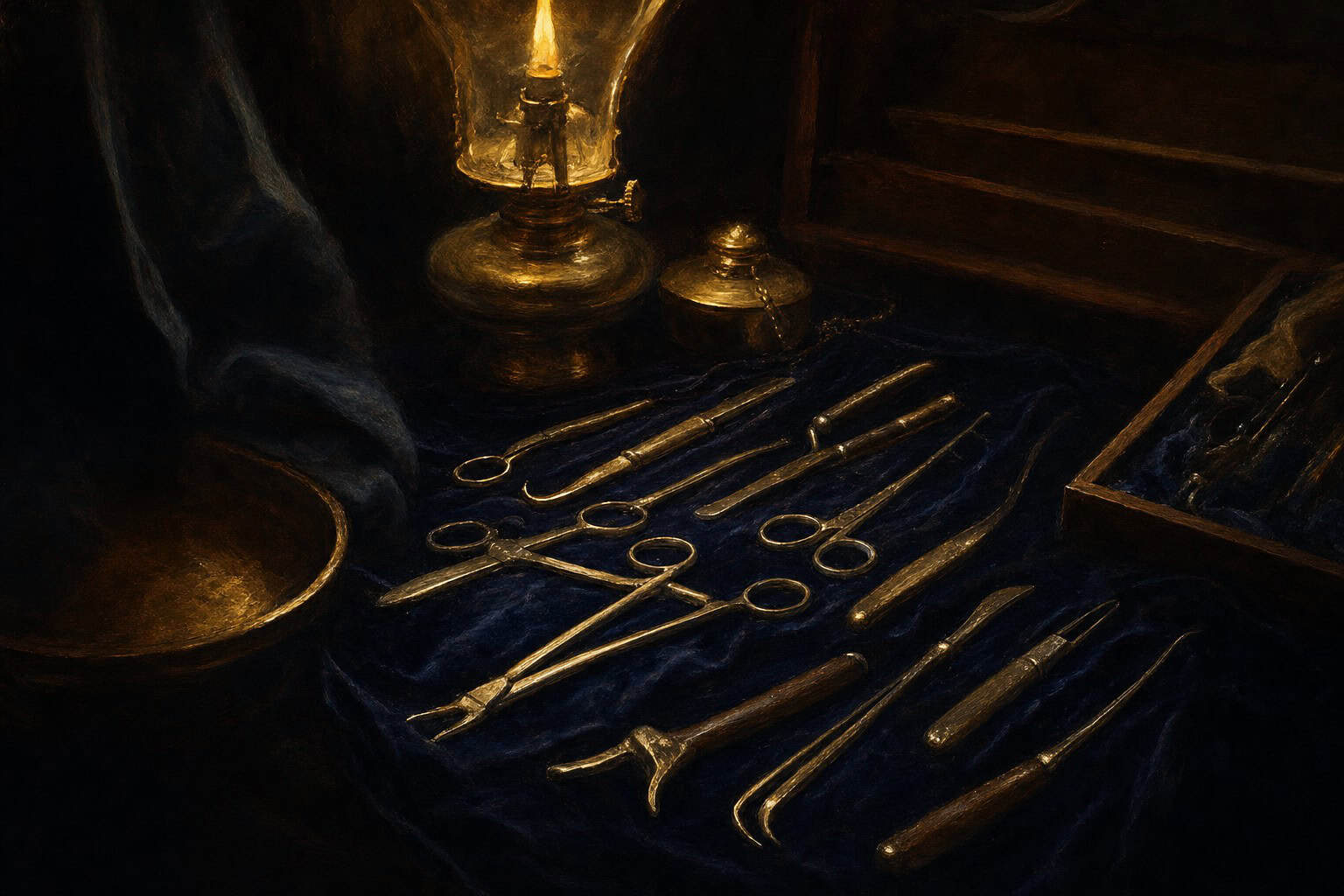
There is a man at a desk, no beating heart on the wood, only dog-eared theology and diagrams drawn like surgical charts — cold reason not as arrogance but as a tourniquet on a bleeding heart.
A Chest Split Open on the Study Desk
There is a man at a desk, not with a beating heart on the wood, but with notebooks, dog‑eared theology, and scribbled diagrams that function like surgical charts. He traces lines between memories and doctrines the way a surgeon traces arteries, trying to find where the bleeding starts. Friends see only the books and call it overthinking, but inside, his ribs feel pried apart, everything tender exposed to cold air. Each definition he writes is less a theory than a clamp, each careful distinction another stitch meant to hold something from spilling out. This passage stays tight in that domestic space where paper, pen, and stacked texts become an improvised operating table for the soul. He is not admiring his own intellect; he is shaking, exhausted, forcing his mind to stay steady enough to cut. Analysis here is not a hobby. It is the one clean blade within reach while his inner shirt soaks red.
When Thought Becomes a Bloodied Instrument
The reckoning in this moment is simple and brutal: feel everything and collapse, or freeze the feelings long enough to keep breathing. The author chooses the freeze, but he does it with precision, not numbness. He watches himself almost from above, naming motives, mapping betrayals, drawing cause and effect like a doctor charting a spreading infection. He knows this habit makes him look distant, even arrogant, to those who want quick tears or shouted prayers. Yet the text makes clear that what appears as detachment is more like clenching a tourniquet with both hands. If he lets go, if he surrenders fully to the dark conviction that God tailored him for suffering, the whole inner vessel could rupture. So he sharpens his concepts, not to escape his body, but to buy his heart a few more minutes of ordered beating. In this chapter-section, thought is not clean; it comes away from the work stained and shaking.
The Mind Holding Pressure on a Hidden Wound
As the scene narrows, the pressure builds around one unbearable idea: that his agony is not random but intentional, almost crafted. That suspicion hums beneath every line he writes, a low, poisonous current. To face it directly would mean screaming accusations at heaven until his throat tore, so he displaces the scream into careful arguments on paper. The more he writes, the more the air in the room thickens, like the smell of iron when blood has been exposed too long. His hand cramps, but he keeps going, because stopping would leave him alone with raw, unmediated pain. The scalpel of cold reason is doing double duty now, both opening and holding closed, nicking at lies while also pressing down on a vein that threatens to burst. There is no resolution offered here, no warm reassurance. Just a man working furiously over an invisible gash, trying to make it through the night without bleeding out on his own desk chair.
Cold reason is not always arrogance; sometimes it is the tourniquet a bleeding heart reaches for just to stay alive.
For the One Accused of Thinking Too Much
Anyone who has ever been scolded for “living in your head” will recognize the quiet terror under this scene. You might remember your own late nights with the lamp burning, scrolling through articles, replaying conversations, parsing every word like evidence. People told you to stop analyzing and just feel, not seeing that feeling already filled the room like smoke, choking you. This passage names that hidden logic: sometimes the only way to bear a history of betrayal, divine or human, is to step back and turn it into something you can study instead of drown in. The intellect becomes a shaky bridge over a ravine, not a tower to lord over others. You test each plank with questions, not because you distrust truth, but because you no longer trust that the ground beneath you was ever meant to hold. The stakes are not academic. They are as immediate as whether you make it to morning without tearing yourself apart with your bare hands.
A Scalpel Laid Gently Beside the Heart
By the end of this passage, the desk is still crowded: open books, half‑filled pages, a pen left uncapped like a tool between cuts. Nothing has been solved. The core accusation—that maybe you were fashioned for hurt rather than for grace—still lies there, pulsing under the bandages of argument. Yet something subtle has shifted. The same mind that sliced feelings into pieces has also, in its own wounded way, refused to turn away from them. He has not thrown the scalpel across the room, but neither has he driven it all the way in; it rests, for a moment, beside the work. The reader is left not with a fixed doctrine or neat answer, but with the image of a man breathing hard over his own opened story, hands trembling, deciding whether thought will keep serving as a shield—or whether, one day, it might become the steady hand that finally dares to touch the wound without cutting.