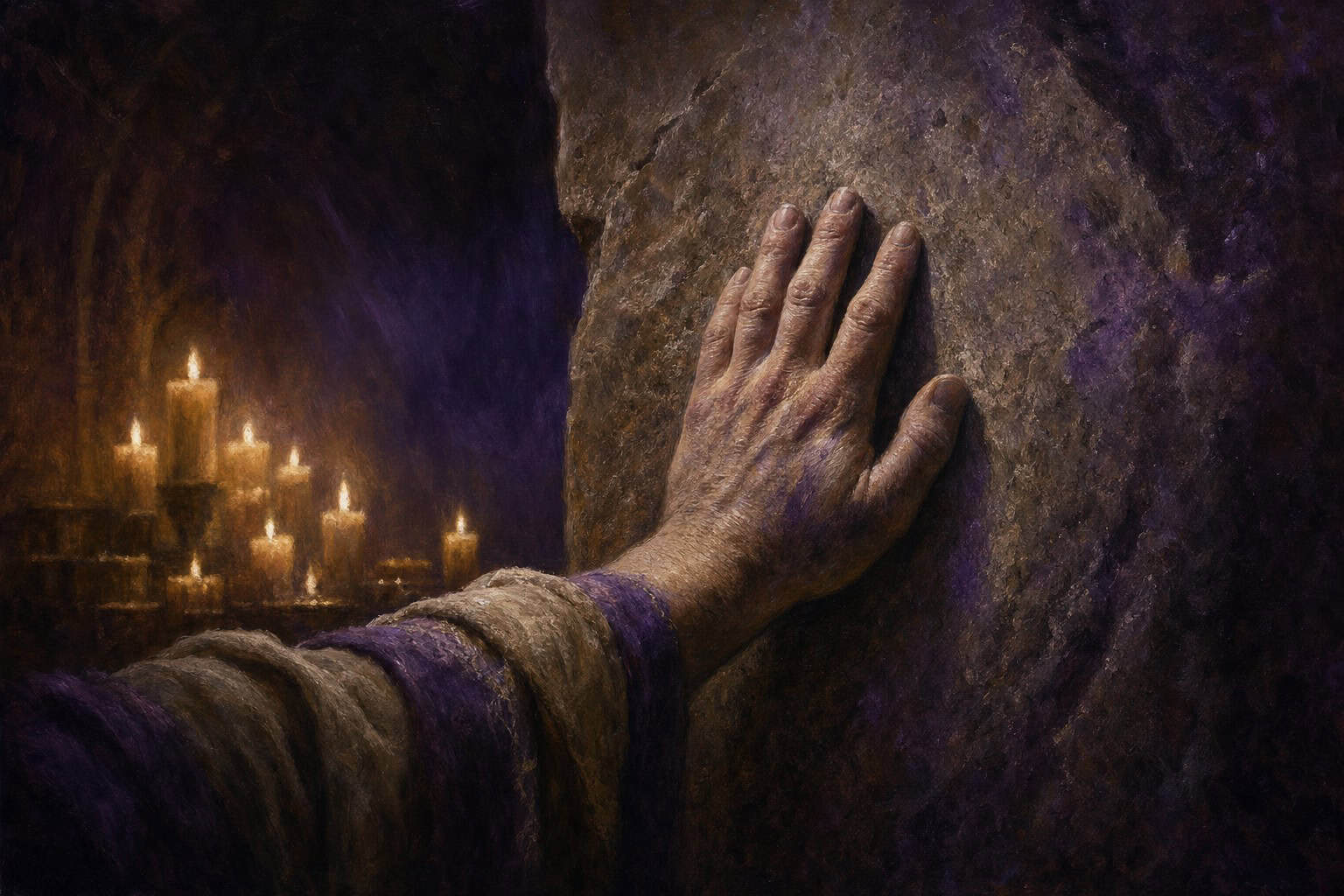
He turns his palm slowly up, as if to show what we are made of and what we are not, moving from shared DNA to shared stardust, until the very reaching toward rock or angel exposes how he sees.
Stardust Under the Fingernails
This chapter stands like a slow turn of the wrist, palm up, showing what we are made of and what we are not. The narrator moves from twin bodies sharing DNA to rocks sharing our stardust, from storms and pets to angels and demons, always pressing the same point: we inhabit one narrow kind of being. We do not turn into stone or flame or pure spirit; we only imitate, paint ourselves gray, hold still, pretend. Even God, when He wants to be known, bends down into smoke, sea spray, blood-colored water, a breeze against human skin. The whole span of the chapter lives in that tension: shared particles with everything, shared attributes with almost nothing. Human nature becomes both frame and cage. Every attempt to cross the line—into rockness, animal fear, angelic purity, divine seeing—throws that line into sharper relief. What appears at first like an abstract lesson in categories becomes a long look at the stubborn fact of our own kind of flesh.
A Human Hand Tracing the Grain of Stone
Running through the chapter is one hard admission: there is no view from nowhere, only a human gaze pressed against whatever it studies. The narrator names our habit of reading ourselves into the world—calling a storm angry, a breeze gentle, a fish terrified, a dog loving—as if the whole creation were a mirror hung for us. That same habit stretches upward toward the divine. Revelation itself must take on vowels and consonants, must pass through human tongues and ink, must be shaped into stories that sit in a lap. Even evil does not remain an abstract chill but needs bodies, systems, illnesses, and choices to grind against human bone. All knowledge becomes human knowledge, not because nothing else exists, but because nothing reaches us except through this single channel of flesh and nerve. The reckoning is simple and severe: every claim to see clearly, whether about God or another person, is already marked by the hand that points and the eye that looks.
Blood-Tinted Water and the Edge of Our Sight
The movement of the chapter feels like walking from a bright field into a canyon whose walls rise higher with each step. It starts with obvious borders—we cannot choose to become rocks or volcanoes—and the tone almost plays at thought experiment. Then the ground drops. The narrator stacks images: seas that rip open for human feet, rivers turned to blood for human horror, a voice in a mountain wind speaking to human fear. Even angels are described in human terms, shielding faces and bodies as if they too had skin that could burn. Each scene tightens the same knot: everything that reaches us, even God’s most terrifying nearness, does so in a form our senses can bear. As this builds, the narrator’s voice thins from confident explanation to something closer to panic held in check. By the time he turns to our inability to fully grasp what we most revere, the canyon walls feel close enough that sound should echo, yet the sentence itself fractures before the thought can land.
We cannot choose to be anything but human; even when we reach for rock or angel or God, the reaching itself exposes every crack in how we see.
A Blemished Lens Ground from Dust
Within the arc of the book, this chapter lays down the stone floor on which later betrayals and self-deceptions will unfold. The larger journey asks whether a fractured heart can ever meet another without multiplying its own cracks. Here, the narrator names the first fracture: perception itself. If every storm, animal, text, lover, and even God must enter us through the same warped lens, then every relationship already begins bent. The teaching posture that marked the earlier pages is still present—biblical citations, confident claims about angels and demons—but it is serving a different master now. It prepares the ground for the later indictment of relational bad faith by insisting that our error does not start in romance; it starts in how we see anything at all. Before women can splinter into replicants or men can sink into sedative routines, there is this: a human creature who cannot step outside his own nature long enough to behold another as they are, not as they are useful, fearful, or consoling to him.
When the Eye Reaches for What It Cannot Hold
The promise of this chapter is not comfort but clarity about the cell we pace without knowing its bars. It hints that if we cannot clean our own lens, then authentic encounter—whether with God or a beloved face across a table—will demand help from beyond our range. The narrator piles scenes and elements, from twin blood to river water, not to impress with learning but to corner himself into admitting his own blindness. The unfinished last line, cut off on the brink of naming a lesser object of sight, reads like a hand stopping mid-scratch, unwilling to carve the final word. Something about our boasting in small perceptions, in reading people and situations, is about to be exposed, but not yet. Stepping into this chapter means standing beside a man who has pressed his forehead against the limit of human seeing and come away with a bruise. The bruise is real, darkening under the skin, and the touch to it will come later.