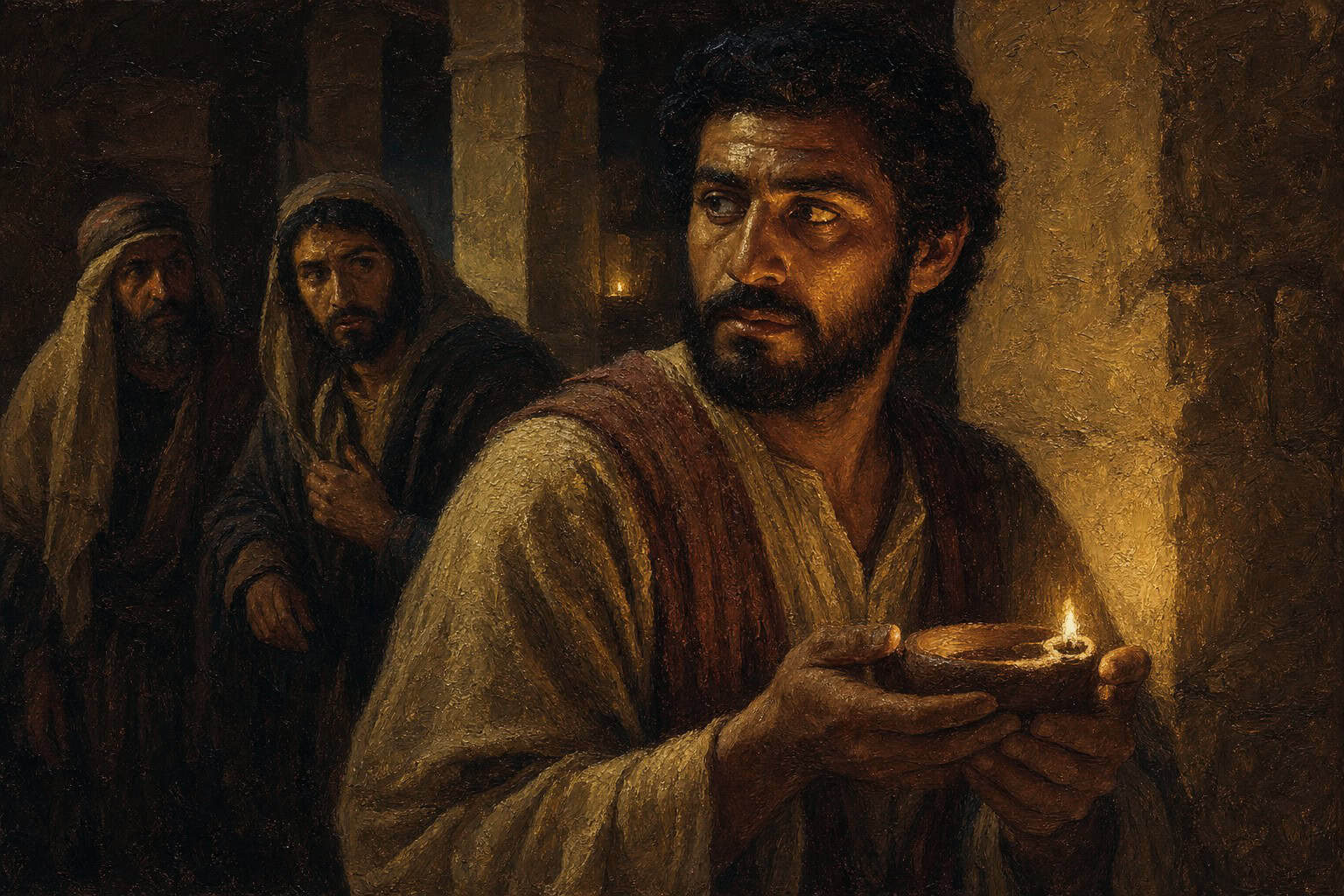
A late-night walk through a clinic, a doctor who stepped forward without permission, and what her boldness taught a cautious man about grace.
The Hand Always Near the Brake
Why did I keep both hands so ready to stop? That is the question I put to myself now, older, reading back through the long fluorescent hush of that clinic and the woman who moved through it without permission. For most of my life I approached every closeness the way a driver approaches ice at night. I measured what could be said before I said it. I measured what should be felt before I let myself feel it. One hand stayed near the emergency brake at all times, ready to slow the descent into feeling before it cost me anything I could not get back. I told myself this was wisdom. I told myself the cautious man survives while the reckless man bleeds out on the shoulder of the road. But caution is not the same as virtue, and I have learned, slowly and against my pride, that the two can look almost identical from the outside. The mind that watches for the bait and switch, that waits six or twelve months for the mask to slip, that quietly files every woman as either the one who settles or the one who hunts—that mind is not protecting love. It is protecting itself from love. I had built whole relationships around this careful distance, and I called it discernment. In truth it was a small, cold room where I lived alone with my own suspicions, letting no one all the way in past the last locked hallway. This scene sits late in Confessions to the Empty Chair, and it does something I did not brace for. It holds a mirror up to my caution and shows me its true face in the glass. I had grown so skilled at reading other people’s hollowness that I never once turned the reading on myself. The women I dissected for their patterns of avoidance—the ones who kept admirers circling in a holding pattern, the ones who chased the fleeting high of a new arrival—were performing a distance I had perfected long before I ever named it in them. Their emptiness mirrored mine, plainly, if I had been willing to look. I saw it in them because I carried it in my own chest. That is the first hard thing the clinic gave me: the recognition that my careful watching was itself a kind of hiding, that the calm surveillance I mistook for maturity was fear in a good suit, and that the mask I kept accusing others of wearing had grown onto my own face so gradually I never felt it fasten. I flinched at masks because I wore one and knew its weight.
A Different Compass in the Corridor
The doctor did not consult the map I had spent years drawing. That is precisely what unsettled me, standing there under the low buzz of the ceiling lights. In my accounting, everyone moved by the same fearful logic—advance a little, retreat, test the ground, keep the exits clear and lit. I had reduced every woman to a type and filed her before she finished speaking. There was the pragmatist, who orbits her chosen men, feeds off their affection like a low fire, and finally settles for the one she kept in reserve all along. There was the one who lives for the hunt, driven by a hollowness no conquest can fill, who wields the promise of new sensation because she never built a stable self to offer instead. I knew these scripts by heart. I could name the next move before the person made it. And then, in that corridor, someone acted from a compass I did not own and could not chart. She did not ask if it was permitted. She did not glance around to gauge the safe response, did not measure the watching faces, did not wait for a nod. She simply came forward while others stood by and watched, and her coming forward carried no calculation I could detect anywhere in it. This is the moment the older self keeps circling, unable to leave it alone. Was she truly free of the games, or did I only want her to be, starved as I was for a gesture that felt unguarded and true? I have to be honest in the reckoning. A man kept too long on a feast of crumbs will mistake ordinary warmth for something world-altering, will taste a small kindness and call it a banquet. I know this hunger in myself; it distorts what I see. So part of my mind still asks whether I read her rightly, or whether my own emptiness gilded the moment past its real worth. But something in it resisted my usual suspicion, and resisted it hard. The pattern I dreaded always arrives through the flesh first—I feel the offer in my body before I name it in my mind, and my body had long ago learned to flinch on cue. Here the flinch did not come. What came instead was a shock, clean and disorienting, that a person could step toward another human being without the endless permission-seeking I had mistaken all my life for respect. She took a chance in full view. That was the risk that shook me down to the floor. It shook me because it exposed how little risk I had ever taken, how thoroughly I had dressed my cowardice as care and worn it out to dinner. To watch someone move without the brake was to see, all at once, that the brake was never keeping me safe. It was only keeping me from being reached by anyone at all.
Mud Instead of Balm
Then the reading turned, and it turned on a single word: mercy. I had always pictured mercy as a soothing thing—a cool cloth laid on fever, a balm pressed to blind eyes, gentle and asked-for and welcome at the door. The clinic broke that picture in my hands. Mercy sometimes arrives not as balm but as mud, coarse and startling, smeared across the face before anyone thinks to seek consent. Grace comes as an interruption rather than a comfort, the uninvited entrance of desire and confidence into a moment I never planned and could not have planned. This is the hinge of the whole passage, and it undid a belief I had held so long I mistook it for bedrock. I had wanted salvation to knock politely, to stand outside in the hall until I decided I was ready to open. But the doctor’s gesture taught me that the moments which save us often violate the very rules we built to keep ourselves protected. She did not ask if it was okay. She reached, and the reaching itself was the grace—precisely because it refused to wait for a permission I would never have granted. My whole life of caution had been a way of ensuring that nothing unearned could ever get in. And an unearned gift is exactly what mercy is; there is no other kind.
Grace does not knock and wait for an answer; it steps forward while everyone is still deciding whether to allow it.
I sit inside that now with more trembling than triumph. Because the shock cut two ways, and I will not smooth over the second edge. It was mercy, yes, but it also fell across a situation that was not clean—a one-sided attachment, a heart already spoken for elsewhere, a longing that had no clear and honest home to go to. Grace does not always arrive in tidy rooms with the windows washed. Sometimes it interrupts us exactly where we have no business being reached, and the interruption is real even when the ground beneath it is crooked. I refuse to pretend the moment was simple, that it resolved into something I could set on a shelf. To call it mercy is not to call it permission. It is only to say that God, whom I have felt to be more inward to me than my own most inward part, chose to appear in the eye of the flesh, in the coarse and the unrehearsed, walking beside me inside the very confusion I could not sort out or excuse. The mud stayed mud on my hands. That it could also be mercy at the same time is the thing I am still learning to hold without dropping one half or the other. He did not clean the scene before He entered it. He came in anyway.
Grace does not knock and wait for an answer; it steps forward while everyone is still deciding whether to allow it.
What the Watching Cost Me
After the shock came the long reckoning, the accounting that took years to add up. If her boldness was grace, then my caution was the loss I had spent decades calling wisdom. That is the fallout I have to face reading this now, and it does not comfort me. Every relationship I built around measurement had quietly cost me the very encounter I claimed to be hunting for. I kept one hand on the brake so that no one could hurt me, and the price, which I never wrote down, was that no one could truly reach me either. The two were the same hand doing the same work. You cannot half-open yourself; the guarded heart guards against love and wound with equal force, and calls the whole locked arrangement safety with a straight face. I had spent so long diagnosing the hollowness in others—the woman who uses her career as a human shield against the commitment that would expose her emptiness, the one who drags men through a roller coaster of soaring highs and crashing lows and then discards them to begin the ride again with someone unaware—that I never once asked what my own careful distance was shielding under all that vigilance. It was shielding the same emptiness, the identical hollow. I dressed mine in the language of discernment; they dressed theirs in the language of freedom or of impossibly high standards. Underneath the wardrobe, both were a refusal of the naked encounter where another person actually sees you and you lose all control over what they do with the sight. The doctor’s step forward was the exact opposite of that refusal. She let herself be watched. She let the coming-forward be visible, exposed, unretractable, with nowhere to hide the gesture once it left her body. And I, who had spent my life ensuring that nothing about me was ever unretractable, felt the floor tilt under my shoes. There is a shame in this I do not want to sand down for the sake of a cleaner ending. The self-protection I had been so quietly proud of was, in the end, a kind of poverty. I had so little to give because I had risked so little to keep. The man living on a feast of crumbs is hungry precisely because he never set a table of his own for anyone to sit at. I question, still, whether I even knew how to receive the gesture when it finally came, or whether I received it the way a starved man tears into food—too fast, without discernment, unable to taste it rightly or honor it. Grace can arrive and still find us unready to hold it. That may be the hardest part to swallow. The gift came. Whether I met it well is another matter entirely, and one I cannot answer cleanly even now, years on.
Learning the Weight of a Gesture
So where does it settle, this late-night walk through the clinic and the woman who reached without asking a soul? Not in a resolution, not in anything I can tie off with a bow. It settles, for me, in a changed understanding of what I was actually looking at all those watchful years. I had believed the great danger was being deceived—that the mask would slip and reveal the disinterested face beneath, and that my whole task in life was to spot the switch before it cost me. I still believe deception is real; the patterns I traced through the dark are not fictions I invented to feel clever. But I misjudged which failure would cost me most in the end. It was not the times I was fooled and left holding nothing. It was the times I refused, in advance, before anyone even reached for me, to be reached at all—the long stretch of years I mistook a cold vigilance for a clean conscience and a shut door for a safe house. The doctor’s compass pointed somewhere mine had never once gone. She acted before permission because some things simply cannot wait for it and remain what they are. Love that first asks the room’s approval is already something less than love. Mercy that waits patiently to be deserved has stopped being mercy the moment it starts waiting. I carry that now not as a rule I have finally mastered and can teach, but as an accusation I keep answering with my life. God did not remove my caution or wash the situation clean before He walked in; He entered it exactly as it was, coarse and one-sided and unresolved, and let a single unguarded gesture undo a lifetime of guarding. That is how He tends to come in Confessions to the Empty Chair—not lifting me out of the dark by the collar but standing inside it with me, near, unhurried, present in the very confusion I could not fix myself. I do not end this able to claim I have learned to drop the brake for good. I am a cautious man still, and the hand still drifts toward it in the quiet. But I have seen, now, with my own eyes, what it looks like when someone moves without it, and I cannot unsee the terrible plain freedom in that. The gesture had weight because it was unearned, given for nothing. It shook me because it exposed me to myself. And it draws me back, still, to sit with the man I was and the mercy I did not schedule—not to close the account, but to keep asking why the boldest thing anyone ever did for me was simply to come forward, in full view, and refuse to ask if it was allowed.