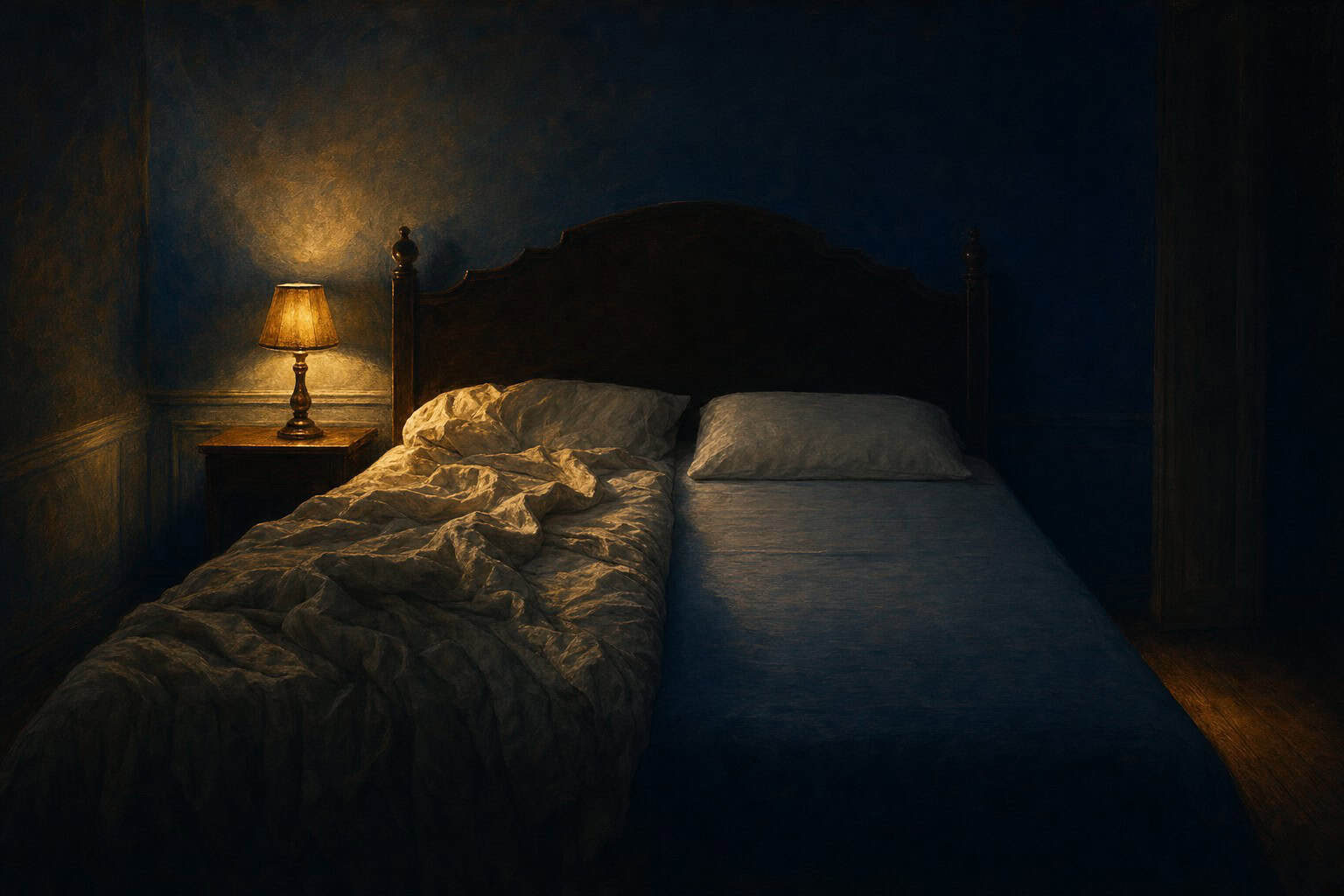
Jane sleeps in his bed and brushes her hair in his mirror but never leaves a single thing behind, and the whole verdict is read in what she quietly withholds.
A Bed That Never Collects Her Clothes
By fall of senior year, the world has shrunk to a one-bedroom apartment and a woman who refuses to unpack. Jane sleeps in his bed, uses his soap, brushes her hair in his mirror, but leaves each morning like a guest determined not to overstay—no change of clothes in the closet, no toothbrush by the sink, no towel left damp on the rack. Antidepressants shape her inner weather, yet she still paints on earth-toned calm and walks out to lives he never sees. She skips classes without flinching, buffered by university parents and a sense that consequences belong to other people. He, the scholarship-strapped son, lives in low-grade terror of failure and cannot fathom her drift. Over the summer he has taken his own liberties with other women and buried them; she has kissed Tommy and never really come back. The chapter opens on this uneasy truce: two bodies sharing a mattress while their real allegiances and fears stay folded away, somewhere far from the bed that never gathers her clothes.
An Invisible Trial Around an Unoccupied Seat
At the center of the chapter sits an image he has named before: an empty chair that now follows him inside his skull. Jane does not need to be present; her absence arranges the furniture. In that mental seat he lays out evidence like exhibits—missed dates, unanswered calls, male friends who multiply whenever he voices concern, the kiss that rewrote their gravity. Each small omission becomes a piece in a pattern that carves itself into him, until affection feels indistinguishable from disregard. He recognizes the quiet choices behind her habits: never leaving a toothbrush, never leaving a dress, never leaving anything that would make departure difficult later. He extends this pattern backward, re-reading Jeannètte, Angela, Kerri through the same lens: bodies that spoke first, schedules and silences that completed the sentence. The reckoning here is brutal in its simplicity. Either these women never knew him, preferring their fantasy of his resilience, or they knew him and did not care. The empty chair does not comfort; it hands down a verdict with no right to appeal.
Rough Rituals After Her Vanishing Acts
From that verdict the chapter turns inward, dissecting why he stays inside an arrangement he now sees clearly. He names a seventy-thirty split between sloth and pride: sloth, because seeking someone new, reading fresh signals, and negotiating unknown boundaries sounds exhausting; pride, because conceding another relational defeat would gouge what little self-respect remains. Other possibilities hover at the edges—a striking girl impressed with his research design, the pull of Deep Ellum nights—but he closes his hand around what already hurts. After Jane’s disappearances, their reunions harden into rough intercourse, not tenderness: a wordless attempt to make her body register what her mind refuses to acknowledge. The bed becomes an altar for minor punishments, a place where he tries to balance a moral ledger without ever naming the debt. Parallel to this, his analysis grows colder, almost laboratory-clean, as he frames her choices in terms of an impersonal female drive toward better genes and firmer security. The more he explains her, the more he exposes himself: a man clinging to a woman whose primal response to him, he suspects, is not merely disinterest but physical aversion.
Love conducts its quietest trials in the evidence of small absences, and the verdict is often read in what a person quietly stops leaving behind.
Hypergamy in a One-Bedroom Lab
Here the book’s larger question tightens around biology and blame. In that small apartment he treats his own heartbreak like a research problem, importing the language of hypergamy to make sense of Jane’s cool indifference. Women, he argues to himself, carry a kind of built-in selfishness that ranks men by breeding and security, discarding yesterday’s provider when a better prospect appears. Through that lens, her behavior ceases to be personal sin and becomes a kind of merciless programming. Yet the chapter refuses to let him hide inside theory. He has evidence that her verdict on him is not universal—other women have wanted him and been refused in favor of Jane. His codex of conquests, designed to shield him from being at the mercy of one woman, has instead delivered him to that very place. The dual music of his life sounds here in its harshest chords: the sharp, proud melody of analysis and dominance, and a buried, aching line that still longs to be chosen without condition. This is not yet grace, but it is the stripping-away that has to come before grace can be heard.
A Dead Leaf on an Unmade Mattress
The promise of this chapter is not resolution but exposure. Senior year’s “new creation” is not a happy couple moving toward permanence; it is a man watching hope die in real time on a cheap mattress where only one side ever feels lived-in. As the evidence stacks up, the fantasy that the right phrase, the right tenderness, might win Jane over finally collapses. That collapse, harsh as it is, frees him from a certain kind of superstition—the belief that better performance could have saved him. The chapter offers a close look at how absence becomes its own form of communication, how missing towels and unreturned calls say what lips refuse to speak. It also hints, without yet naming it, at a different use for the empty chair: a place where someone other than these women might one day sit, listening without gaslighting or calculation. For now, we are left in the winter clarity he describes: a bare tree outside, an unmade bed inside, and a single dead leaf stuck to the sheet like a small, unwanted seal of truth.