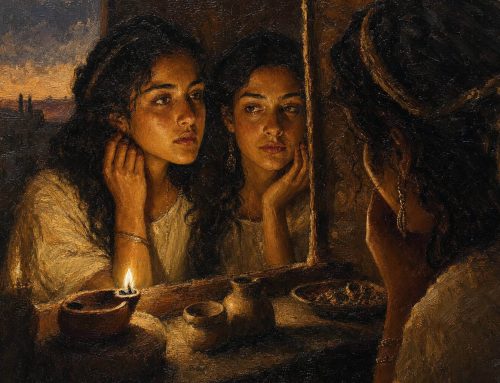
Powder hangs like workshop dust as she leans to the mirror with a practiced hand — not getting ready, assembling Tuesday — building one more self to send out among the others that no longer share a memory.
The Mirror That Manufactures a New Face
Powder hangs in the air like dust in a workshop as she leans toward the mirror, steady hand, practiced strokes. She is not getting ready; she is assembling Tuesday. The eyeliner traces out a woman who will sit across from a man in a café and feel only what this morning allows, untouched by last night’s vows to someone else. Tomorrow’s self is not a mask hidden in a drawer but a separate creature waiting to be born when the alarm rings again. The daughter who texts about Mass will never meet the stranger who scrolls and deletes under the bedsheet glow. One body, yes, but inside it, a row of sealed rooms that do not share air, memory, or guilt. This is not confusion. It is craft. If she can keep each self small enough, brief enough, sincere enough in the moment, then no one of them will have to answer for the others when the mirror fogs over.
The Ledger Where Guilt Is Split Into Fractions
Behind the quiet routine of foundation and lipstick, a harsh arithmetic hums. Responsibility is broken down like a bill split among too many diners: no one owes enough to feel the cost. The office version who bends the truth about hours never has to sit with the friend who swore she would show up and didn’t. The late-night lover who whispers forever does not have to face the noon-day self who treats those words like someone else’s lines from a forgotten play. Each fragment moves with a narrow honesty, meaning it, there, then, because it does not carry the weight of what any other part has promised. Hypocrisy would at least require a single conscience to feel the clash. This is different: a careful erasure of the continuous thread that could tie word to deed, vow to outcome. The more she multiplies, the lighter each shard feels in her palm, too small to wound and too small to repent.
Old Lovers Kept Like Specimens in a Glass Case
Across town, in neutral cafés and glowing group chats, the other half of this system shivers. Former lovers sit with her over coffee, fingers wrapped around warm cups, talking about shows, deadlines, traffic, anything but the nights their bodies still remember in exact detail. Their laughter is smooth, controlled, but their shoulders tense at the brush of her sleeve, the way her mouth curls on a certain word. She insists on this new category—“friends”—as if language alone can dam the river running just beneath the surface of each joke. She will not let them go entirely; she needs them pinned here, like insects under glass, alive enough to twitch but not free enough to fly. The play-acting hurts them, but it feeds something in her: proof that each discarded self still lives on in another’s nervous system. They are not allowed anger, not allowed declaration, only the performance of ease while their pulse keeps telling the older truth.
We manufacture a different self for each audience, until the fragments stop sharing a memory and no single conscience is left to answer for them all.
A Phone Screen Wiped Clean Like a Crime Scene
Back home, the same control moves through her thumbs. An intimate photo goes out, a line that strips her guard for a moment, and then the evidence vanishes from her device as if it never crossed her skin. She is not blushing as she deletes; she is editing. The camera roll becomes a curated museum of innocence, stripped of the moments that might let someone, someday, reconstruct the whole. Messages are cleared, threads erased mid-flirt, not to stop the act but to prevent a history from forming. If no record survives, then no one can point and say: this is who you were, then, here. In this age, she has learned, holiness can be faked through absence. A clean log looks like a clean life. Each deletion is a quiet execution of a self that actually did feel, want, give. The screen goes dark, her face reflected back on it, smooth, unreadable, as if nothing had passed through at all.
A Field Crowded With Seeds That Never Meet
Yet at night, when the makeup is wiped off and the notifications fall silent, the clean surfaces do not stay empty. The selves she thought she had sent out and erased begin to stir like seeds scattered too thickly over hard ground. Tuesday remembers a name that belonged to Thursday. A passing scent on the street jerks one body into the posture of a long-finished embrace. Deleted words rise unbidden, full sentences with no chat bubble to hold them, and they echo in the dark curve of her skull. None of these fragments is strong enough to stand alone, but together they crowd her like a field that has been planted and replanted without ever being tended. The question presses, not as theory but as a weight in the chest and an ache behind the eyes: how long can a heart keep dividing before something in it insists on being one thing again, even if that unity feels like fire in the throat?