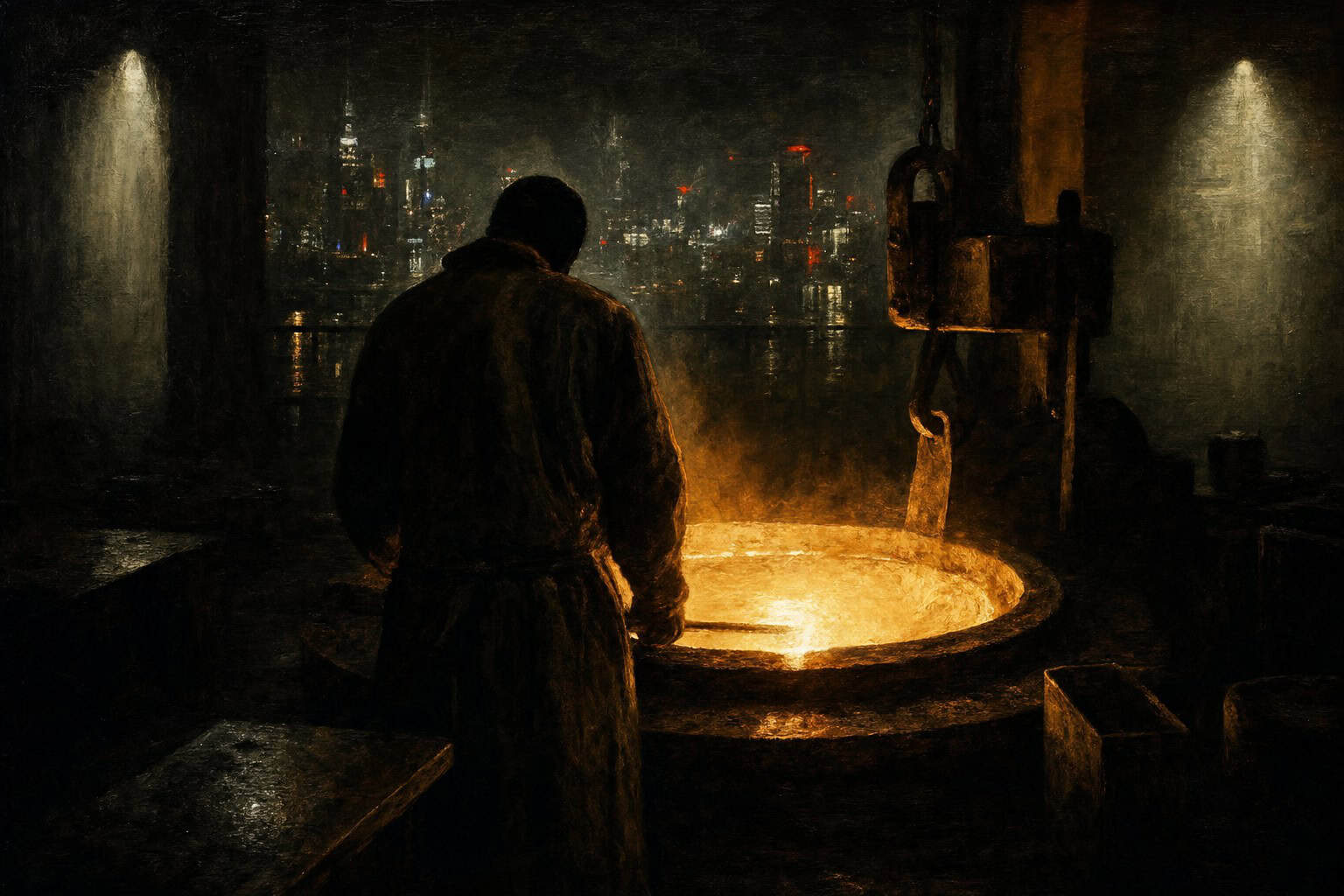
Orange light throws hard shadows as the metal churns and spits, and in the inner room of memory he melts every inherited belief down to slag, the fire less dangerous than the forgetting it invites.
Hands Blackened Over the Crucible
Orange light throws hard shadows on the walls as the metal churns and spits. Anthony stands over a small glowing crucible, not in a forge but in the inner room of memory where the air tastes of burnt metal and old incense. Into that heat he drags everything that once felt holy and safe: the childhood talk about pure love, the promise that virtue makes you lovable, the neat diagrams of boy meets girl under God’s smiling gaze. They do not stay solid for long. Under the heat of being fed on as a brother and battery, under the humiliation of watching the women he adored return rumpled from other beds, each doctrine softens, slumps, and slides into the molten swirl. He does not look away. The fire is his own life: nights driven by whiskey and dark eyeliner, Dallas streets gleaming with wet neon, the ache of being desired only as background warmth. All of it burns together, until nothing inherited can keep its original shape.
When the Old Coins Lose Their Faces
In the fierce glow of the crucible, distinctions blur. What once stood apart as sacred and profane now runs together like metal stripped of its stamp. Promises that God rewards chastity, scripts that say patience will one day be sexy, the quiet hope that goodness will be seen—inside this heat, they become so much melted coin. Anthony realizes the fruit of his obedience: nights alone, desire dismissed, devotion scooped off the ground like loose change by women headed back to men who never paid that price. If a tree is known by its fruit, then the tree that bore this loneliness must be rotten at the root. That conclusion does not come in a lecture hall; it arrives here, over the hiss of liquefying certainties, with the sick-sure taste of betrayal. The pain is not that he was rejected, but that his very way of loving became proof that something fundamental in his moral world was warped. The kiln turns that suspicion into a verdict.
Pouring the Molten Self Into Sharper Molds
Once the metal glows clear and shapeless, a new hunger rises: to make sure this burning never happens again. Anthony lifts the crucible—hands steady from long practice with self-denial—and tilts it toward waiting molds. Each mold is a rule scored in his own scar tissue. Never offer tenderness that wasn’t asked for. Assume every soft confession will be used, not honored. Treat every woman who circles close as a potential collector of warmth, not a partner. The molten self flows into these grooves and channels, hissing as it touches cooler air. This is the birth of the operating manual he will carry: highly structured, mercilessly logical, built on the expectation of being harvested and discarded. Yet as the metal settles, there is a drag in his chest—a sense that what he is shaping to protect his heart might also lock it in. The pour continues anyway. In the roar of the kiln, caution feels holier than trust.
In the heat of our own ruin we melt down every inherited belief, and the danger is not the fire but forgetting the music that first made us burn.
Blueprints Burned and Redrawn in Sweat
Even without a literal forge, most people know the smell of something in them burning. You follow the elders’ instructions: be kind, be patient, be the one she can cry to at three in the morning. You are told that this is what goodness looks like, that the story will reward it. Then you watch your care gathered casually, your loyalty treated as background service while someone else is chosen for the night. In that gap between promise and reality, the heat rises. The old blueprints—if you are good, you will be loved this way; if you wait, you will be chosen—start to curl and blacken at the edges. Some tape them back together and call it maturity. Others, like Anthony in this passage, drag the whole stack into the fire and say, no, the design itself is wrong. That choice is not lofty. It happens in a car outside a bar, on a city sidewalk at 3 a.m., in the raw ache after another “you’re such a good friend” text. Sweat runs down your back while you decide what will live and what will burn.
Metal Cooling Beside the Neon Flooded Street
Outside, Dallas throws its own fire—neon humming over wet pavement, headlights streaking like poured metal across the dark. Inside, in that hidden forge of thought, the new manual begins to cool. Anthony can feel the hardening: a clean, clever daylight self who knows the right theology, and a night self who drinks, prowls, and refuses to be harvested again. The same soul, split and held in two different alloys. Somewhere between the crucible and the finished blade lies the question that will not resolve here: can a man guard his flesh this fiercely without sealing his spirit in the same casing? Can he keep the dark music that makes him vivid without letting it devour any remaining tenderness? The metal rests on the anvil of his chest, still faintly warm, taking on edges he will test in future nights. For now, the only answer is the sound of city rain hitting hot asphalt, turning to steam before it can sink in.