Where the reduction that would save us becomes the wound that isolates us
The Stairs as Temporary Throne
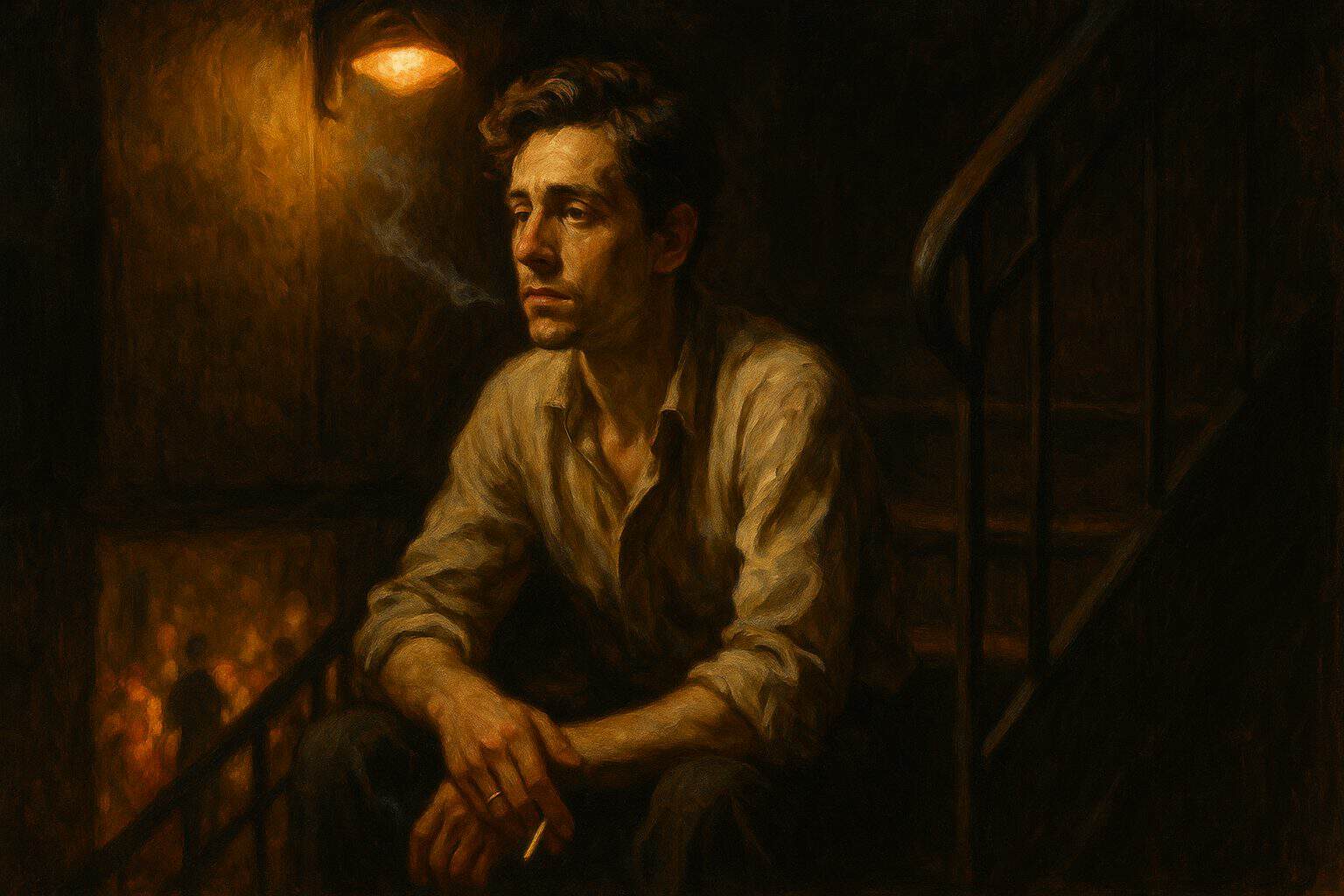
I claimed the nearby stairs, a temporary throne of detachment, and exhaled smoke like prayer imbued with incense into the night. This is how the phenomenological attitude first announces itself—not in the lecture hall with its careful distinctions between noesis and noema, but in these moments when life itself demands we step back, suspend, observe. The cigarette burns between fingers that have learned to hold the world at arm’s length. Below, the party continues its rhythms, but from this vantage, human gathering reveals itself as phenomenon rather than participation.
What Husserl names epoché lives first in the body that withdraws to the stairwell, in lungs that transform anxiety into smoke rings dissolving upward. The natural attitude—that unreflective immersion in the world’s claims and counterclaims—becomes suddenly visible only when something forces us to bracket it. For some, the revelation of new possibilities aggravates fear and anxiety due to the awareness of the profound responsibility. For others, this suspension becomes sanctuary, a way of being that protects through distance what cannot survive proximity.
The Familiar and Its Dissolution
When the familiar person wears away, most people return to the familiar. “Better to deal with the devil you know than with the devil you do not know,” as the expression goes. But phenomenology begins precisely where this return becomes impossible, where the familiar has already shown itself as construct, as one possible configuration among infinite variations. The blanket—a sanctuary—and a lens through which the world comes into focus. Letting go of the familiarity reinforced by others in favor of something independent and self-chosen involves a certain degree of personal freedom and responsibility for selecting an alternative to take its place.
This is the terrible gift of the reduction: once performed, it cannot be entirely undone. The natural attitude, once bracketed, never quite recovers its former solidity. We discover ourselves like those who favor solitude instead of gatherings of people, derive pleasure from contemplating abstract ideas as opposed to sensory stimuli. Not by temperament alone, but because we have seen too clearly how meaning constitutes itself, how the world assembles itself moment by moment in the flowing stream of consciousness.
“G is ‘reason’ dwelling beyond limitation and habitual perception, imperceptible until desire uncovers the tunnel or softens the wall leading toward it”
The Codex Against Confusion
I forged the Codex to manage risk—with Jeannètte and Jane as my two muses… a shield against confusion, a human system erected where trust failed. Here the phenomenological project reveals its defensive character. Husserl sought apodictic certainty, foundations that could not be shaken. But beneath this philosophical ambition pulses a more primal need: to create order where chaos threatens, to establish protocols where spontaneous life has proven too dangerous.
The transcendental ego that Husserl posits as the absolute ground of all meaning—is this not also a fortress? A place from which to observe without being touched, to constitute without being constituted? The problem pre-fall and post-fall is that A focuses on E to the exclusion of G, and E focuses on A to the exclusion of G. In phenomenological terms: consciousness focuses on its objects to the exclusion of its own constituting activity, or becomes so absorbed in its own operations that it forgets the world it was meant to illuminate.
Time’s Nonlinear Weaving
Time is nonlinear, and past and future intertwine in the present in a meaningful way as a function of how one finds themselves situated in the here and now. Husserl’s analysis of internal time-consciousness reveals this not as metaphysical speculation but as the very structure of experience. Each present moment contains within itself retentions of what has just passed and protentions of what approaches. The cigarette between my fingers carries the entire history of every cigarette before it, every future cigarette already germinating in this one’s burning tip.
But trauma disrupts this flowing synthesis. My spirit crashed back into flesh… turning this reality gray and hollow, forcing my continued endurance here, a cage separating me from Him. The phenomenological reduction, which should reveal the pure structures of consciousness, instead uncovers a consciousness that has been wounded in its very capacity to constitute coherent temporal flow. The retention does not merely hold the past; it imprisons us there. The protention does not merely anticipate; it threatens.
The Veil and Its Thinning
When I speak of the veil thinning, I mean not spectral theatrics, but a trained attention to the spiritual pressures that undergird our ordinary hours. This is perhaps what Husserl was reaching toward in his late work on the Lebenswelt—the recognition that beneath our scientific and philosophical constructions lies a more primordial layer of meaning-formation. Tunnels and permeability exist, by definition, outside the perceptual awareness of the one bound to the familiar.
The phenomenological reduction was meant to be a methodological tool, a temporary suspension that would yield essential insights before returning us to natural life enriched. But for some of us, the brackets never quite close. We remain suspended between worlds, perceiving the constituting activity itself rather than losing ourselves in what is constituted. This dialectic threatens an outsider, but those who speak this language mean no harm, or at least, harm to cultivate ascent.
Death as the Ultimate Bracket
Death must threaten to take it all away and condemn us to be forgotten. Real change in contrast reflects an extreme response following an extreme stimulus: death or the threat of mortality, loss… or profound betrayal. The phenomenological reduction finds its most radical form not in the philosopher’s study but in the proximity of annihilation. Death-dust mandates separation of the flesh and spirit before heaven-spirit reanimates the flesh.
Meaning, for human beings, unfolds within the framework of time and mortality; they incorporate the knowledge of the dead into their lives. After about three or four generations, the dead’s imprint upon the world will be worn away like carvings in stone exposed to water and wind. The transcendental ego that Husserl posits as immortal, as the absolute constituting consciousness, confronts in actual death its own most radical reduction—not methodological but existential.
The Tent of Meeting
In solitude. To allow a woman into this tent of meeting, to elevate the need for her love and approval above the LORD’s, is to displace God and seat her upon your heart’s throne. The phenomenological attitude demands a similar solitude, a similar refusal of the intersubjective in favor of the transcendental. We descendants, on the other hand, make choices already contaminated by sin and therefore cannot choose anything outside of its imposition without grace.
The purity Husserl sought through the reduction—is this not its own form of contamination? The very effort to bracket the natural attitude, to suspend our naive belief in the world, creates its own distortion. We become those for whom an oppressive void, a ‘presence in the room’ leeching warmth, hope, and peace from the individual, leaving them feeling intimidated, defeated. The reduction that would free us becomes the cage that isolates us.
“Do not resent the descent; it is where the ascent finds its meaning and purpose.”
The Sunlit Clearing
It is like finding a sunlit clearing in the forest after traveling through the dark wood. These moments when the reduction yields not just clarity but beauty, not just structure but meaning. The whole unfolding of human history has been one huge and necessary detour from paradise reflecting the punishment banning us from it. Yet in the phenomenological attitude, we glimpse something of that original seeing, that Adamic naming of things in their first appearance.
The cost of the bracketed heart is this: we can no longer simply live, but must always also observe our living. We cannot simply love, but must note the intentional structures of loving. We cannot simply suffer, but must attend to suffering’s essential configurations. Resigning ownership over personal freedom, choice, and responsibility to others, ignoring death and finitude—this becomes impossible once consciousness has turned its gaze upon itself.
And yet, perhaps this is where grace enters: not in the perfection of the reduction but in its failure, not in the purity of the transcendental ego but in its contamination by flesh, by time, by the other who will not be bracketed. The stairs I claimed as temporary throne must eventually be descended. The cigarette burns down to filter. The party below calls us back, changed by our distance, bearing the gift and wound of having seen too much.