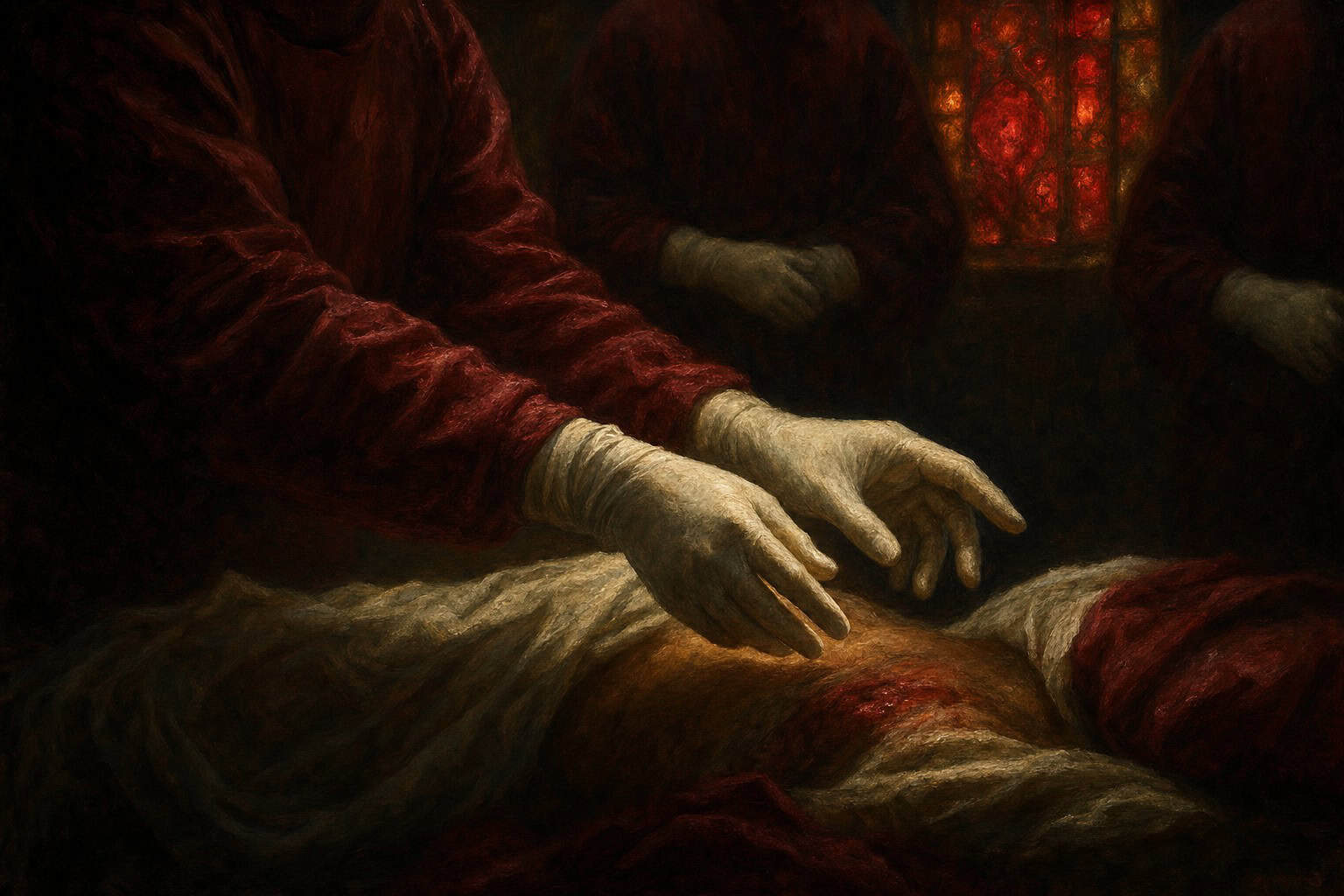
Under humming fluorescent light a white coat closes the distance everyone agreed to keep, and he learns that rescue does not always wait for you to be ready for it.
Gloved Hands Crossing the Line
Fluorescent light hums above as a white coat moves closer than it should. Latex gloves catch the glare when one doctor steps in, closing the gap that everyone else in the room has agreed to respect. No clipboard buffer, no small talk to soften the approach—just hands reaching, unhurried and sure, into the space where a patient has learned to keep people out. The other physicians hang back, bodies angled at a safe distance, eyes watching but not intervening. Their stillness throws this one motion into sharp relief: a pair of hands that ignore the choreography, that do not wait for a nod or a signed form of the heart. Years of practiced detachment, the quiet discipline of never needing anyone, break against that simple, steady advance. Skin under the gown tightens, breath catches, every nerve alert. The touch has not even landed yet, but the body already knows: something is crossing a line it never meant to surrender.
The Hunter’s Hunger in a Clinical Light
Under that same bright light, another hunger comes into focus—the one that never looks like hunger from the outside. The narrative widens just enough to expose a pattern: women who collect admirers like medals, always surrounded, never held. They move through rooms like this exam space, letting people orbit, drawing them close only to show a cold face when the door closes. It is not cruelty for sport but a way to outrun a void that opened long before any lover appeared. The chase is the drug; the moment someone is caught, the spell breaks, and the hollowness yawns wider. In the doctor’s forward motion, the narrator sees the mirror image of this hunting: not for conquest, but for a soul that keeps staging escapes. The same ache hums underneath—an old emptiness that refuses to be filled with attention, success, or even studied detachment. Recognition sharpens the air. This exam is no longer neutral ground; it is a stage where two different ways of fleeing the same abyss brush against each other.
A Body Split Between Two Zip Codes
As the doctor’s hands close in, another scene overlays the room like a dim second film. There is the body here on the table, and there is the body back home, shoulders bent over manual work, mouth closed around all the words learned at university. Three hundred and fifty miles feel like a clean cut: in one place, books and prayer and thought; in the other, sweat, tools, and the old family script that cannot make room for this new self. Returning home has meant leaving the mind behind, like locking an entire life in a dorm room and driving away. The body that stands in the childhood kitchen knows how to shrink, how to become useful and quiet. The body in the clinic has tried to live as if that split were normal, as if you can keep one part of you in hiding forever. When the doctor reaches without asking, he is not only touching flesh; he is touching the very seam where this division has been stitched. The muscles tense as if protecting a hidden room, but there is nowhere to stash the educated, praying, thinking self when someone insists on treating you as one piece.
Salvation seldom asks permission; sometimes grace simply steps forward while everyone else is still watching, and reaches for you before you are ready.
When Your Orbit Becomes Its Own Cage
The pressure in this passage lands hardest on whoever recognizes their own tactics in these scenes. Maybe you’ve learned to keep people close but never close enough, answering messages, accepting praise, letting affection hover while you withhold the real face. Or you’ve played the opposite part, circling someone unreachable, mistaking your own hunger for love as proof they must be worth the ache. You come home for holidays and feel the familiar split: the person you’ve become sitting in the back of your skull while your hands wash dishes and your mouth speaks the old, safe lines. It can feel noble to protect everyone from the truth of who you are now, to keep peace by carving yourself in half. This chapter quietly exposes that nobility as a lie. The distance you curate, the boundaries you polish, the performances you repeat—none of them heal the hollow center. They only keep it undisturbed, like a well everyone walks around but no one dares to draw from.
Learning to Breathe While the Stethoscope Listens
The question underneath this exam table is not whether God can love a life shaped by early darkness, but whether that life can bear being loved without first rewriting itself. The doctor’s uninvited nearness becomes a parable of divine style: mercy that does not hover politely outside, waiting for flawless consent forms and perfectly worded prayers. For someone whose inner world has always sounded like clashing notes, the first instinct is to flinch, to worry that surrender will erase the very music that has kept him alive. Yet the hands keep moving, not rough, not sentimental, simply sure. Consent, in this telling, is not a brave speech delivered in advance; it is the slow, shaking decision not to yank your body away while someone actually tends to it. The dissonant chords of childhood do not stop ringing in the background. They pulse under the skin, under the doctor’s palm, under each thin breath taken while the cold stethoscope presses against a chest that has learned to hide its own rhythm and now must decide whether to keep shrinking or let the lungs fill all the way.