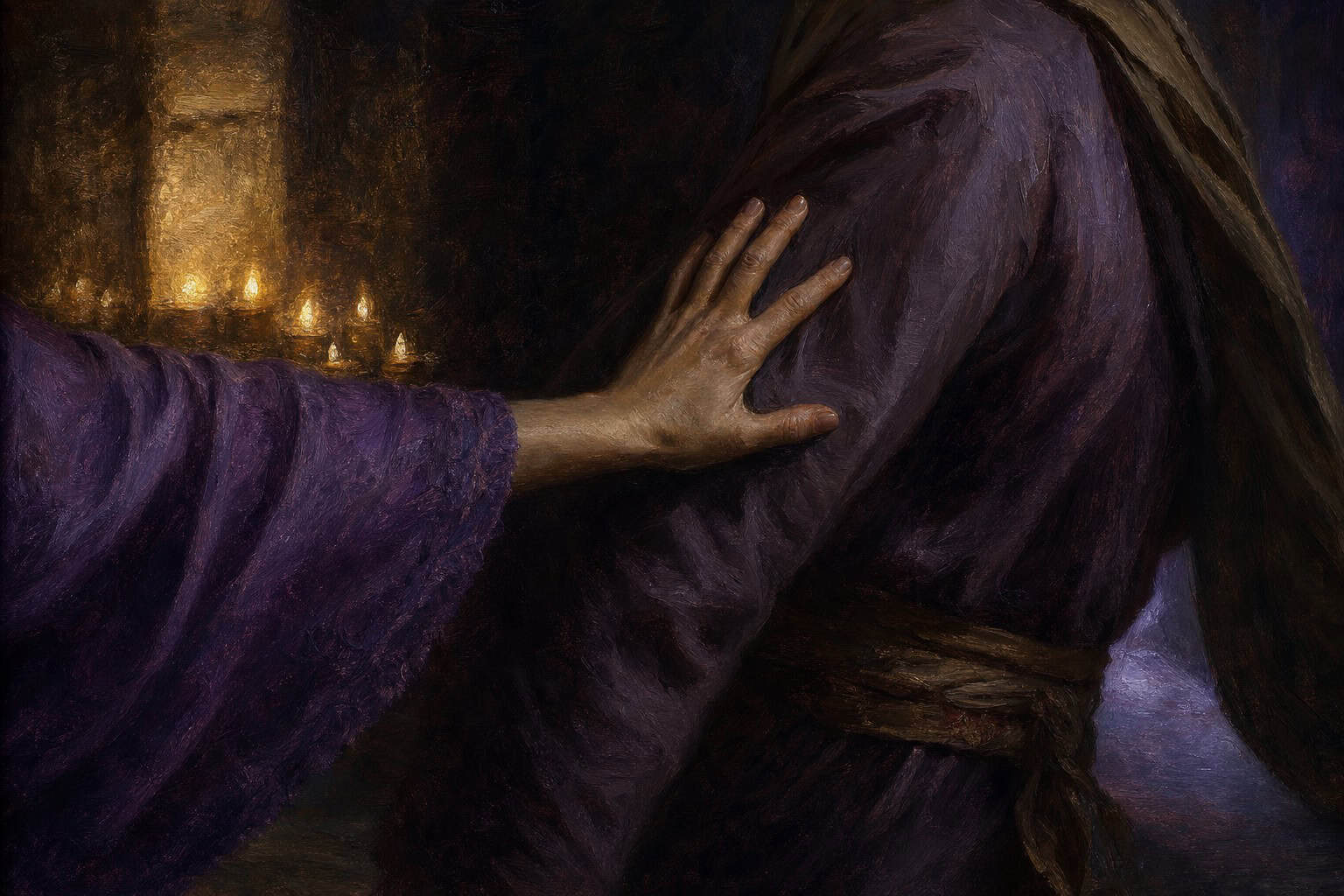
Her hand meets his chest, flat and warm and steady, stopping his whole momentum, and he learns that wanting and still keeping your hands open can cost more than any surrender.
A Single Palm Against a Rushing Body
His weight is already leaning forward when her hand finds his chest. Not a slap, not a shove—just warm skin, flat and steady, meeting his momentum. Breath catches in the narrow space between them as if the air itself has been braced. The narrator stands close enough to see the small tremor in Elizabeth’s fingers and the way Ryler’s shoulders lock, that instant when muscle remembers it could break through but doesn’t. This is not romance, not tenderness; it is a clean, embodied no. Her palm becomes the whole scene’s center of gravity, a small surface bearing an ocean’s pressure. Around that touch, words thin out. The narrator tracks every inch of distance that does not close, every inch that almost did. What might have become blur and collision instead hardens into outline: two bodies, one boundary, and a witness who knows how much history can live in the span between a hand and a ribcage.
When Effort Turns into Extraction
Watching Ryler lean, then stall against that palm, the narrator feels an old fatigue rise in his own bones. He remembers the work of it—trying to draw warmth from someone whose heart had already gone elsewhere, mistaking strain for devotion. In this scene, desire looks less like longing and more like dentistry without anesthesia: the jaw clenched, the grip too tight, the sense that something must be taken because nothing is being freely given. Ryler is not courting; he is laboring, pulling at a connection that refuses to live. The narrator recognizes the look in his eyes, that mix of charm and panic people wear when they cannot admit the well is dry. Elizabeth’s refusal cuts through the pretense. She will not lend her body to this extraction, will not pretend that more effort could turn labor back into love. Her hand on his chest exposes the transaction underneath the tenderness, the way grasping need dresses itself up as romance.
The Old Idol Wearing a New Face
Later, when Ryler jerks away at the mere hint of hearing about Elizabeth, the narrator is not surprised. The same body that pushed into her space now flees from her name. He has seen this before—in mirrors, in memories where a single mention could send his stomach into a spin. Ryler’s refusal to hear is its own confession: this woman has become more than woman, a private altar built out of nerves and fantasy. To know how she truly feels would threaten the whole fragile shrine. So he bolts, and in that retreat the narrator sees his own past devotion to a lowercase god, the way he once staked peace on one person’s mood, one text, one look. It is a bitter recognition. The idol he thought he had toppled stands again in another man’s posture, another man’s flinch. The ghost of that worship has simply changed hosts, but its hunger is exactly the same.
The discipline of restraint can exhaust a man more than any indulgence, for it costs everything to want and still keep your hands open.
Learning to Stop Before You Shatter
Anyone who has stayed too long at a dead relationship will feel the weight in this scene. The lean of Ryler’s body and the stillness of Elizabeth’s hand replay the hours spent begging in subtler ways: one more call, one more explanation, one more night trying to convince someone to want what they do not want. Her refusal is not cruel; it is the mercy most of us never give ourselves—the mercy of stopping. For the reader, her palm on his chest becomes an instruction more than a symbol. You can halt your own momentum. You can name your limits without needing the other person to approve them. The narrator’s recognition of himself in Ryler is another mercy, a reminder that seeing your old desperation in someone else does not mean you have failed; it means you have changed. Holiness, in this cramped encounter, looks less like sweetness and more like the courage to disappoint someone rather than lie with your body.
Standing Still with Empty Hands
When the moment passes, nothing grand has happened and yet everything feels heavier. Elizabeth has not surrendered, Ryler has not converted, the narrator has not intervened. Three people share air thick with what will not be given. The refused advance and the aborted conversation leave a strange ache, like a muscle holding a weight it used to drop without thinking. Somewhere under that ache lies the harder question: if you stop trying to pull love from unwilling hands, where will you take your hunger? The narrator senses that divine love is being offered as more than idea here, yet he also feels the pull of the old music—the rush of being wanted, the drama of pursuit and withdrawal. He stands between the altar of a woman’s body and the quiet promise of a God who does not play at scarcity. No easy answer comes. Only the feel of his own pulse, steady and unsatisfied, as if waiting to learn a new rhythm it has not yet chosen to keep.