By candlelight she nods and laughs on cue, casting him in a role he never wrote, and loves the man of her own invention so hard that the real one stands untouched beside her.
Her Eyes Cast Him Like a Role
Candlelight throws soft shadows across his face while he talks about a meeting at work, the traffic on the way, some small irritation with a colleague. She nods, smiles, even laughs at the right beat, but inside she is busy with another task. Her gaze is not receiving him; it is drafting him, fitting his moving mouth to a script written long before they met. The tilt of his head becomes evidence of sensitivity she needs him to have. The way he cuts his steak becomes proof of a strength she once hung on her father’s shoulders. Small details are stolen, edited, sewn together until the companion at her table lines up with the outline she carries in her chest. The dominant fact of the moment is not his actual story but her quiet labor of invention. What she loves so fiercely is not the man before her, but the role she has cast him in, a character whose lines he has never read.
Skin Against Skin, and the Uncrossable Gap
Later, in the dark, their legs knot and unknot under the sheets, breath humid between them. His hand traces the familiar path along her spine; her fingers curl around his shoulder as if anchoring herself to a known shore. Yet as their bodies lock closer, something slips further away. The closer the contact, the sharper the awareness that his inner life is sealed from her, not out of malice but by design. She cannot feel what memories flare behind the way he sighs, cannot climb into the private storm that tightens his jaw. The scene insists on a hard truth: flesh can press so near that heat mingles, and still the minds enclosed in bone remain worlds apart. The embrace that should quiet loneliness instead exposes it, like a light turned on in a room one thought was full. Their bodies touch; their solitude does not.
The First Bite and the Pact of Mutual Ruin
Beneath this bed and table, an older scene runs like a second film: a man watching a woman hold forbidden fruit, her eyes already changed. He is not tricked. He studies the cost with a cold clarity—life with God alone, or life with her in shared disaster. His jaw tightens, not in confusion but consent, and teeth meet flesh. That ancient bite echoes now when one lover quietly bends their conscience to match the other’s habits, when sobriety is traded for shared bottles, when prayer time thins so evenings can stay comfortable. The passage does not treat this as romance but as a vow of mutual ruin disguised as loyalty. To stay behind while the beloved walks toward a cliff feels like betrayal; to follow feels like love. In the press of their bodies, a pact is signed: better to fall together than stand apart, better to lose God than lose each other. The sedative of the flesh makes this choice feel almost merciful.
When love becomes invention rather than discovery, we spend years embracing a phantom of our own making while the real person stands untouched beside us.
Holding a Body While Starving for a Soul
For anyone who has laid beside a spouse or partner and felt more alone than in an empty apartment, this scene is not theory but recognition. The passage names that bitter taste when you realize the person who texts you all day, who knows your coffee order, has never once really seen you—and that you have not truly seen them either. Screens and touches keep panic down, like pills taken on schedule, while the self underneath withers for lack of honest encounter. This is where the spiritual question cuts through: if love is only soothing one another’s terror of abandonment, what becomes of the soul’s call to stand before God as someone, not just as someone’s? The text presses an uncomfortable point: clinging to another as anesthesia against solitude can cost both people their own faces. The reader is left to feel the weight of their own habits of touch, how often they are sacrament, and how often they are just a way to fall asleep without thinking.
An Empty Stage, Lines Learned by Heart
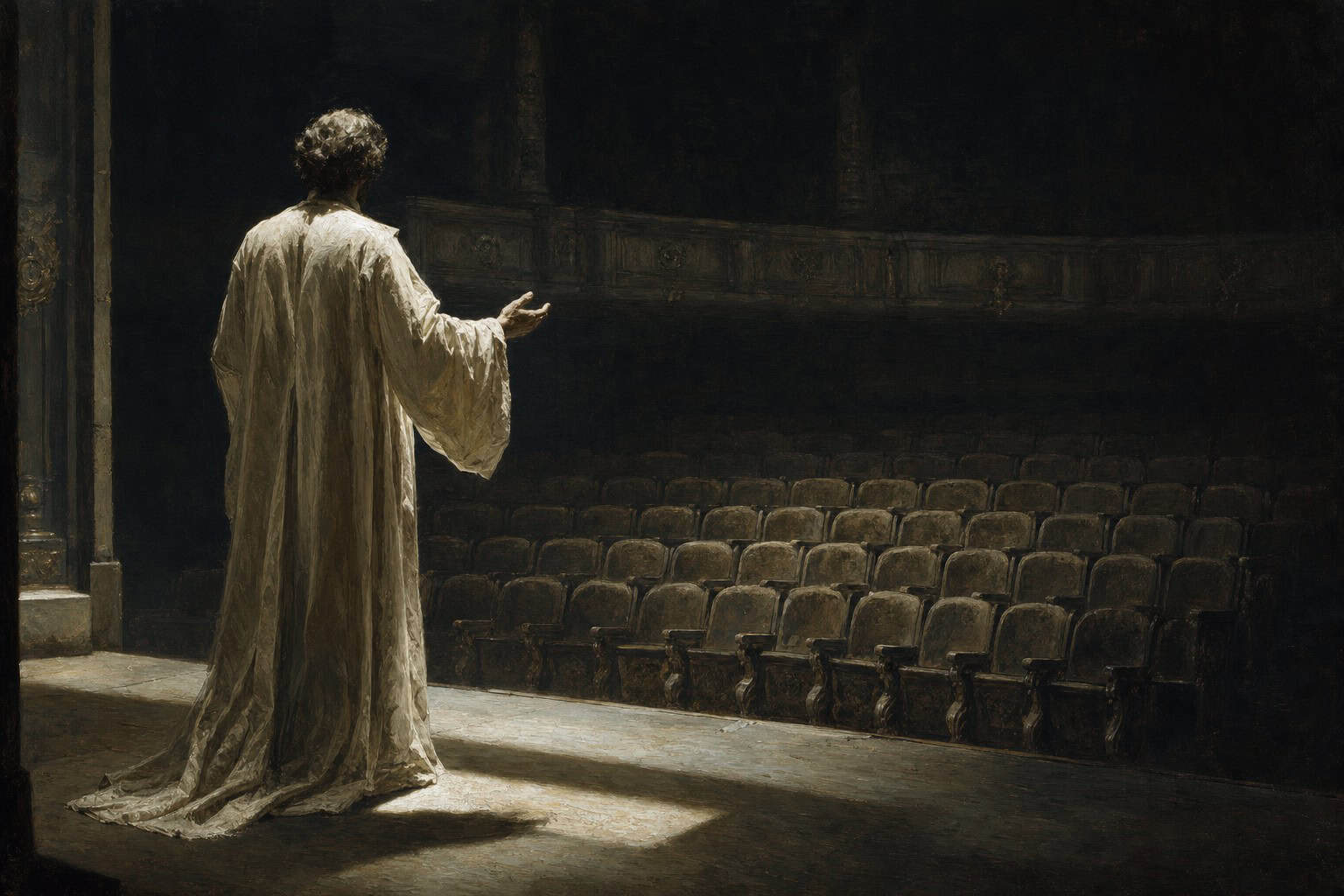
When death or betrayal rips one actor from this arrangement, the surviving heart doesn’t fall silent; it keeps performing. The same invented partner stands now not across a table but in the mind’s balcony, a perfect listener who will never interrupt. Jokes are still composed during commutes, stories still rehearsed in the shower, small irritations mentally addressed to the one whose body is gone or whose real self never matched the role. The theater of the inner world grows more polished even as the seats remain bare. In this passage, that empty stage is not mocked; it is exposed as the natural outcome of loving a phantom. The question is not yet how to stop performing, or how God might enter the script. The pages simply tremble in the actor’s hands, ink smudged by fingers that do not know what to do without their audience, while the spotlight burns on with no one to applaud.