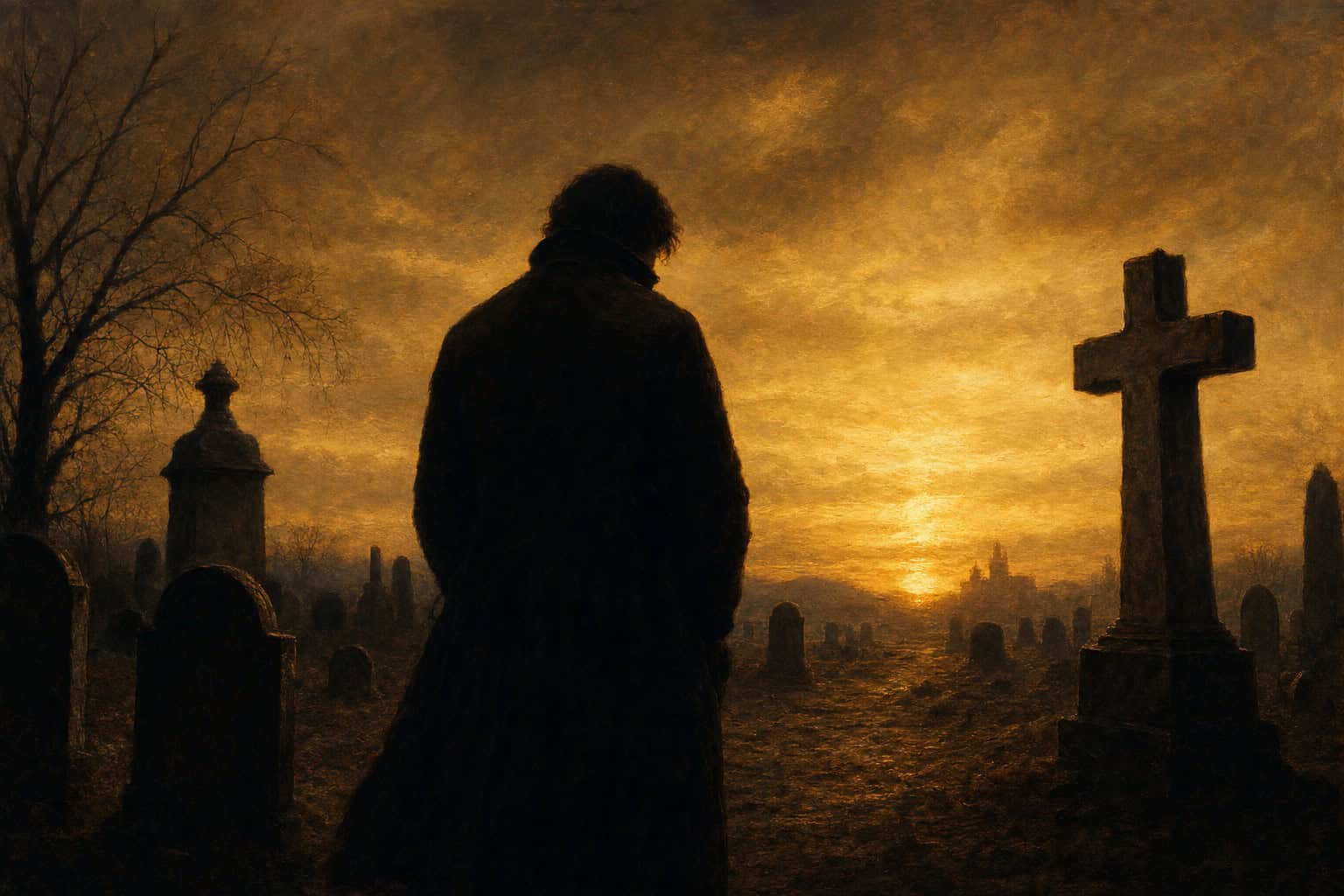
Headstones line the edge of his imagination like a silent jury while his body clings to another’s in the dark, as if survival were a doctrine the flesh alone still believed.
Sweat on Skin Beside the Graveyard
Gravestones line the edge of his imagination like a crowd of mute witnesses while his body knots itself to another’s in the dark. The scent is not lilies and incense but sweat, detergent, stale breath; the weight of another chest pressing his ribs back into his own life. Somewhere, a cemetery keeps its quiet count of the dead, yet here, on this mattress, the flesh argues back. Every thrust feels like throwing a lit match at the cold stone names, a refusal to surrender to their stillness. He is not chasing thrill so much as proof: if his lungs heave, if his muscles ache, if his pulse hammers inside another person’s heat, then he has not yet joined the rows under the grass. In this passage, sex is not romance or conquest but a kind of shouted creed without words. The body, marked for burial since childhood, insists on being heard before the soil closes over it.
When Pleasure Turns Into a Lawsuit Against Death
Underneath the rhythm and the breath, an accusation forms: you will not erase me yet. What began years earlier as ordinary curiosity or adolescent escape has hardened into something sharper, almost liturgical in its repetition. Each encounter functions like paperwork filed against the grave’s claim, a frantic legal brief written in nerve endings and friction. He recognizes, with a terrible honesty, that this is no longer about wanting someone; it is about not wanting to vanish. The living body becomes evidence presented to an invisible court—see, I move, I respond, I make another person gasp; therefore I exist. This is the reckoning the passage will not allow him to dodge: that his so-called vice is carrying a theology, that his flesh has been arguing with mortality long before his mind could name its fear. To admit this is to feel the bed tilt toward the cemetery fence, every pleasure bracketed by the thought of dirt and stone.
The Tight Fist Around the Throat of Desire
Recognition arrives late, like a hand closing around his own, but it does not bring relief. Once he sees that his body is using sex as a flare against the night of annihilation, the act itself begins to tremble under its assigned weight. How many times can a person push back the tomb with skin alone? The pressure mounts: orgasms become too small for the terror they are meant to answer, partners too fragile to bear the freight of his unspoken cries. At the same time, a different awareness stalks the edges of his thoughts: that this constant reaching for proof may itself be a chain, a bondage dressed as freedom. Caught between cemetery silence and the panting noise of the bed, he feels something in him coil tighter, unwilling to surrender the only protest it knows, yet unable to ignore how thin that protest sounds against the long patience of death. The passage leaves him on that edge, every nerve lit, no verdict yet rendered.
Sometimes only death brings a soul into focus, and the body answers grief with its own desperate theology of survival.
Your Body’s Quiet Argument with the Headstone
You might not walk among graves at night, yet the same argument lives under your skin. Maybe it shows up in the way you cling a second too long in bed, or in the hours you scroll for one more face, one more message that proves you still register on someone’s screen. Perhaps it hides in workaholic hours, the late-night drink, the extra rep at the gym—any concrete act that says, without words, I am still here, I still count. This passage names that movement without mocking it. It suggests that compulsion is often built from terror, that what looks like simple lust or drive may be a frightened soul turning its own body into a chapel of protest. To see that is not to excuse the damage we cause but to understand its fuel. Once you recognize your own gestures as arguments against a headstone with your name already penciled in, it becomes harder to treat them as harmless pastimes.
A Handful of Dirt and a Pulse in the Wrist
What this moment begins to uncover is not a neat lesson but a split heart: one hand reaching for the living God, the other clawing at the earth to prove he has not yet been swallowed. The buried childhood violation, the demonic whisper that his existence is a mistake, all of it throbs beneath the surface of these bedsheets. If death seems to see him more clearly than the living ever did, no wonder his body keeps trying to out-shout the grave with every gasp. Somewhere beyond this scene waits the question of whether flesh can become more than a weapon, whether the very place that houses this defiance can ever learn to consent to a love that does not need to be proven. For now, the passage leaves him holding both realities at once: a fist closed around a clump of imagined cemetery dirt, and the other hand pressed against his own racing pulse, counting each beat as a small, stubborn uprising.