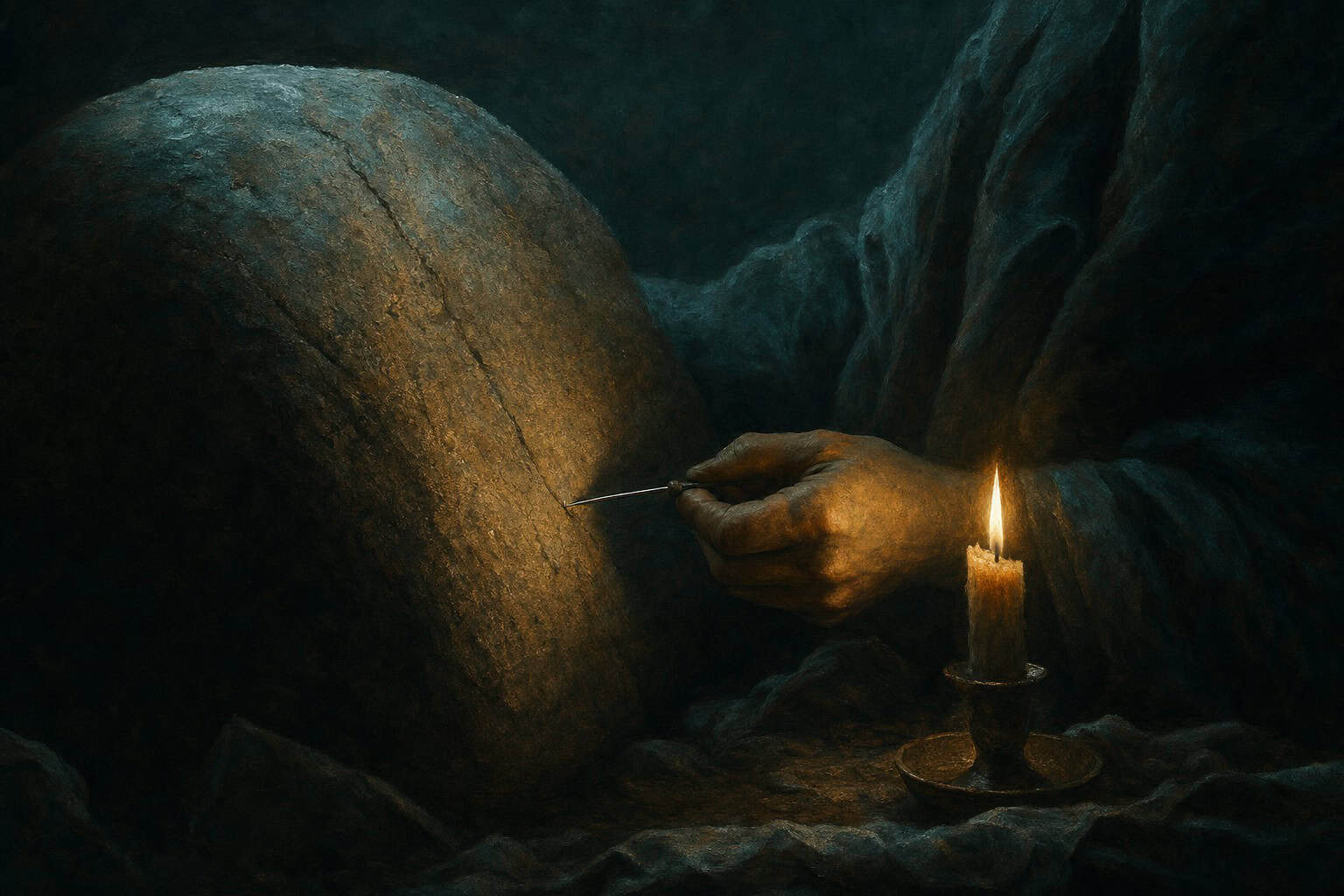
He stands inside his own head watching people swing their convictions like clubs, and raises his careful reason against their grief the way a man raises a needle against a mountain.
A Needle Raised Against the Avalanche
He is not in a laboratory or a chapel here, but in the cramped interior of his own head, watching people swing their feelings like clubs. Their convictions land heavy and wet, full of tears and trembling, and he feels the sting of each blow even from a distance. He names his disgust plainly, almost tasting it, as if emotion were a sticky film coating the air. In contrast he holds up his instrument: a thin, sharp line of thought, a needle meant to pierce through confusion without spilling blood. He trusts that clean puncture, the neat entry of a well-formed argument into a swollen claim. Yet as he imagines this needle at work, another image pushes in: emotion as a sheer, towering mass, an avalanche of snow and stone waiting above him. Against that moving wall, his needle feels absurd. He is not mocking emotion from safety; he is confessing how small his preferred weapon is when the mountain finally lets go and comes down.
Cells Marching Toward Their Own Funeral
Alongside this battle between needle and mountain runs a quieter, colder thread: the body’s slow march toward its own end. He looks at himself not as a special soul but as a colony of cells following orders written in bone-deep code. Desire, attraction, even the dream of a shared life can be mapped to chemicals whispering through blood, molecules locking and unlocking like small steel jaws. He lets that view stand in all its starkness: we pair off because our bodies want to keep going a little longer through copies. At the same time, he cannot ignore the other part of him drafting blueprints, writing meanings, reaching for a story in which love is more than hormones. He stands there with two tools in hand—a microscope that shows thinning membranes and fraying telomeres, and a candle lit before something he dares to call soul. The strain between those tools hums inside this passage, a low electric buzz he cannot switch off.
When Flesh Reaches for a Soul-Shaped Match
Out of this tension he sketches the figure of an ideal partner, and the sketch is revealing. The body wants response: skin that wakes under touch, breath that stumbles, that old animal recognition flooding the limbs. But he will not let the drawing stop there. He demands that the same person ignite his mind, answer the questions that haunt him in the dark, share a hunger that points beyond mere survival. In that demand, his fracture shows. He is trying to solve an inner split by locating its cure in another human frame. The language of blade and stone enters here, but not as romance; it feels like work, pressure, scraping. Two people pressed together not just in bed but in being, each one changing the other’s edge. The hope glows inside the image, fierce and stubborn. So does the fear that the same grinding that sharpens might also wear them both down to useless metal dust.
Reason makes a poor weapon against grief; we wield it like a needle against a mountain that has no intention of moving.
Living With a Needle in Your Pocket
Anyone who has ever hidden behind clever words will recognize the posture here. You watch a room swell with feeling and your jaw tightens; you reach instinctively for an explanation, a joke, a theory that will thin the air. That is the needle in your pocket, small and cold and reliable. It has probably saved you more than once from being swept into other people’s storms, from being used as a prop in dramas you did not consent to enter. Yet in the quiet afterward, especially in the wake of loss or aching loneliness, that same needle feels like a poor companion. Logical clarity does nothing for the empty side of the bed, the unanswered text, the sense that your own life is sliding toward its endpoint. This passage does not scold you for carrying the needle. It simply turns it in the light, inviting you to notice how often you grip it out of fear, and how rarely you let your aching flesh admit it longs for more than clean lines and correct conclusions.
The Mountain That Refuses to Be Measured
Nothing in this scene promises a final truce between the marching cells, the hungry flesh, and the soaring phrases of spirit and meaning. The narrator does not lay down his needle; he does not suddenly trust the avalanche of feeling, or pretend that desire can be cleaned of its biochemistry. He stays in the bind, eyes open, naming both the pull of the lab report and the ache for a love that feels like a sign rather than an accident. The image that endures is simple and stubborn: a slight human figure at the base of a massive rise, instrument in hand, tracing small, precise lines against rock that keeps going out of sight. Whether that mountain is emotion, mortality, or God is not settled here. What matters is that he keeps showing up with his fragile tool, pricking at stone, listening to the echo of each tiny impact while snow gathers quietly on his shoulders.