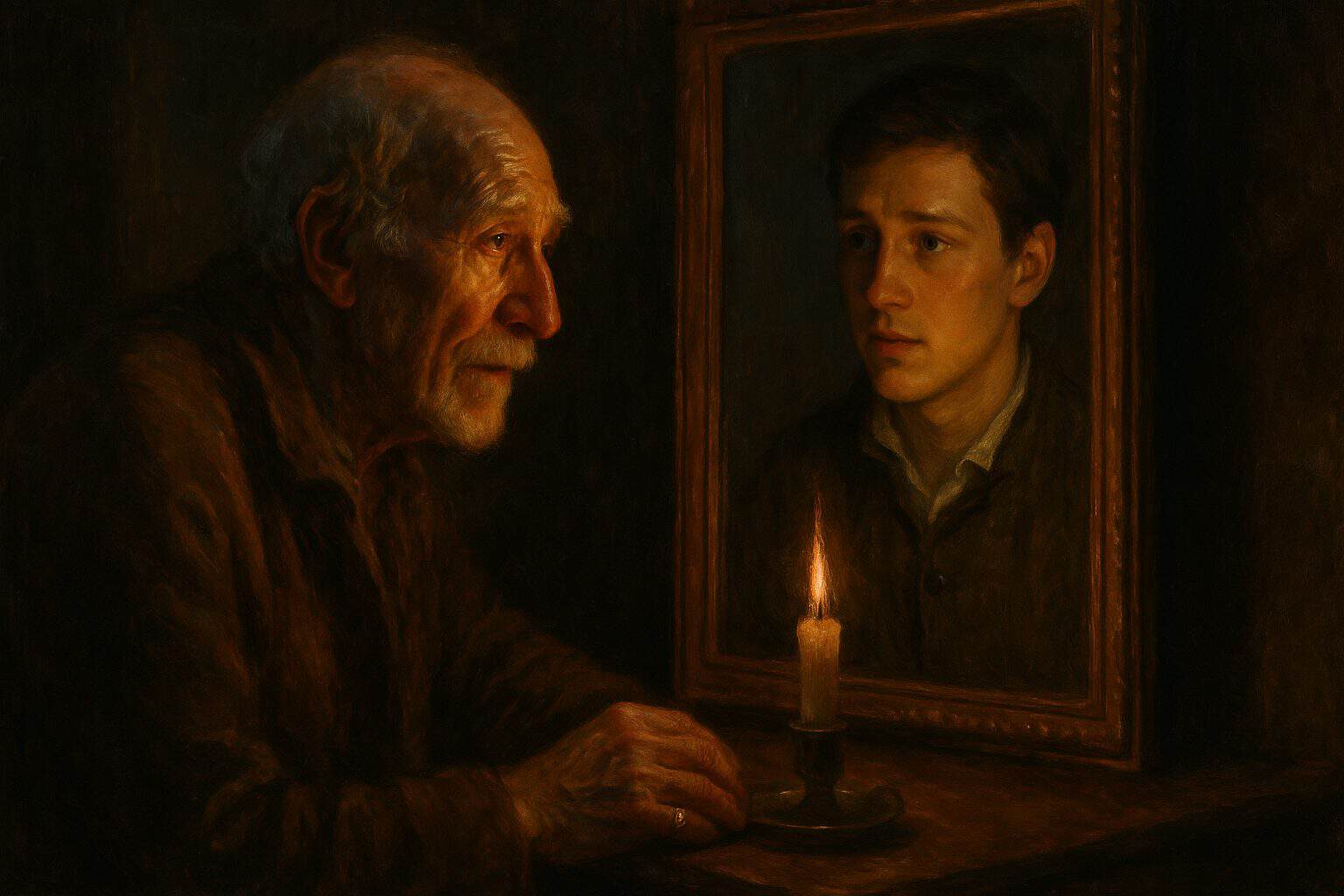
How the self discovers itself scattered across time like light through a prism
The Composite
“These reflections make me feel like a naïve fool and an old man all at once,” Anthony writes in Fractions of the Soul, and in this single line surfaces the strange doubling that haunts both memoirs. Not the simple fact of memory—that we recall earlier versions of ourselves—but something more uncanny: the way past selves persist alongside present ones, each regarding the other with a mixture of recognition and estrangement.
The phenomenon announces itself first as contradiction. “I have always been a composite of contradictions,” he continues, but the word composite reveals more than paradox. A composite photograph layers multiple exposures on a single plate. The faces blur and sharpen simultaneously. Features from different moments occupy the same space. This is how the self appears when time collapses—not as a sequence of replaced versions but as a palimpsest where every age writes over and through the others.
In Confessions to the Empty Chair, placing past selves in that vacant seat, patterns emerge “the original pain obscured.” The empty chair holds not absence but presence—too much presence. The university student who became “a secret self, a phantom locked 350 miles away behind memory’s closed door.” The darker, more cynical man who emerged from certain trials. The one who “hid my past with practiced ease, honed the skill of splitting flesh from feeling.” Each self sits there, solid as any living person, refusing to dissolve into mere memory.
The Gradual Awareness
“Even I became aware of my purpose gradually, over time, across many relationships after looking back and reflecting on the interactions I had.”
Purpose reveals itself not in the moment but in the accumulation, the way a photograph develops slowly in chemical bath. The self that lived those interactions couldn’t see what the reflecting self now perceives. Yet both selves are equally real, equally present. The younger one moves through relationships with a purpose he cannot name. The older one names what the younger enacted blindly. Between them stretches not empty time but dense duration, thick with becoming.
This temporal thickness appears most vividly in moments of sudden recognition. “I am so stupid,” breaks through the measured prose like a child’s voice interrupting adult conversation. Not “I was stupid”—the past tense that would safely contain foolishness in history. The present tense collapses temporal distance. The fool and the sage occupy the same body, speak through the same mouth.
Jeannètte understands this collapsing. “An older Jeannètte will, I suspect, recast our time as youthful naïveté—that familiar polish people apply to past relationships for a new audience.” The future self already haunts the present, preparing its revisions. She knows herself as multiple—the one living the relationship, the one who will remember it, the one who will transform it in the telling. Each version equally Jeannètte, none more true than the others.
The Replicant Pattern
The memoirs reveal a more disturbing phenomenon: past selves don’t simply persist—they replicate, seeking new bodies to inhabit. “The replicant will find ways to entice the man from the previous relationship… even as another replicant shares a bed with someone else.” The pattern that couldn’t complete itself in one relationship searches for another stage, another cast.
This isn’t metaphor but lived experience. The same configurations appear with different faces. “As was the first, so the second—cold as a statue. I was to absorb the cost. I was to keep quiet.” The repetition feels uncanny because it reveals time’s spiral structure—not a line but a helix where the same patterns return at different elevations.
Anthony recognizes this spiral in his own development: “Human beings evolve different improved iterations of themselves over time, keeping certain adaptations to stimulus and circumstance.” The word iterations belongs to mathematics, to programming—domains where the same function runs repeatedly with modified variables. Each iteration contains all previous ones, compressed into its starting conditions.
The Spectral Echo
“These fleeting moments, these spectral echoes of my soul, transmuted into lasting form, etched in ink and awaiting a future reckoning.” Writing transforms the ephemeral into the permanent, but what gets preserved isn’t the past—it’s the haunting. The younger self becomes spectral not through death but through inscription. Fixed in words, it achieves a different kind of persistence, awaiting the future self who will read and be read by it.
The memoir itself becomes a séance where multiple selves gather. The one who lived the experience. The one who writes it. The one who will read it. The reader who recognizes their own multiplicity in these pages. Each self equally present, equally ghost.
“There comes a point in each person’s life when they can no longer blame others for personal decisions, a time when things left unchanged are, in fact, chosen.”
This point—this kairos rather than chronos—marks not maturation but recognition. The self discovers it has been choosing all along, even when it thought itself purely reactive. The younger self who seemed driven by circumstance reveals itself as agent. The older self who claims agency discovers its own unconscious patterns.
The Developmental Paradox
“Years passed. Her options thinned as mine expanded.” Time works differently on different people, at different rates. While Anthony’s social adaptation, “once my greatest liability, became second nature,” others remain frozen, unable to evolve those “different improved iterations.” The temporal self exists in relation to other temporal selves, each aging according to their own inner clock.
The child who appears in “DOB: May 13, 1977… Newborn 1977-1978 0-1” isn’t simply remembered but present. That newborn exists simultaneously with the man who chronicles him, who feels him as “a bruise I felt long before I could name it.” The bruise precedes the wound—effect before cause—because in lived time, meaning travels backward as well as forward.
“I had changed. Darker. More cynical. More withdrawn, introverted. Saddened.” The litany of transformations doesn’t describe replacement but accumulation. The darker self doesn’t erase the lighter one—both persist, creating the composite, the contradiction that feels like foolishness and wisdom at once.
The Translation Work
“It would take me decades to translate the trauma…into a coherent theory.” Translation implies two languages existing simultaneously—the raw tongue of experience and the refined syntax of comprehension. But the decades themselves become part of the translation. Time doesn’t simply pass while understanding develops; time is the medium through which trauma becomes theory.
“I was unaware then of any literature that chronicled suffering like mine… the blemishes in my lens unaware of themselves.” The blemishes see eventually, become self-aware, but they remain blemishes. Clarity doesn’t replace distortion—both ways of seeing persist, creating depth perception across time.
The sharpening work reveals this persistence: “I remember spending time with certain blades, pouring all that I am into the effort of sharpening them only to have them misunderstand our relationship.” The blade metaphor cuts both ways. The self that sharpens and the self that gets sharpened. The misunderstanding isn’t corrected by time but incorporated into the relationship’s meaning.
The Programmatic Break
“There comes a point in a person’s life where they either continue to propagate the programming received from their parents or they choose to do something different.” Yet the choice doesn’t delete the programming. The coded self and the choosing self coexist, one running background processes while the other writes new functions.
Anthony knew “that she would eventually reinterpret our journey together after arriving at the destination of my design.” This foreknowledge doesn’t come from prophecy but from recognizing how his own younger selves had reinterpreted, how the older Jeannètte would polish the past. The pattern is visible because he has lived it from both sides—as the one who reinterprets and the one who gets reinterpreted.
The Tapestry Self
“Individuality weaves the threads from each of these divergent roles into a singular tapestry, the self.” But the weaving never completes. New threads appear—not just new experiences but new discoveries of old patterns. The tapestry reveals itself as Penelope’s work, woven by day, unraveled by night, never finished because completion would mean death.
“The man I was at university became a secret self,” but secrets have their own persistence. They don’t disappear but go underground, shaping the surface through their very hiddenness. The secret self meets the public self in dreams, in writing, in the empty chair where all versions gather.
The Pedagogical Encounter
“Offering my own story as an example to demonstrate the possibility of finding light in darkness, to put her on the path of emotional and spiritual enlightenment”—here the multiple selves achieve their purpose. Not through integration but through demonstration. The wounded self and the healed self, the dark and the light, stand together as proof that transformation happens without erasure.
The “Playlist, Chapter 13: New Creation” marks this demonstration. New creation doesn’t replace old creation but emerges from it, carrying forward every previous iteration. The playlist itself—songs arranged in sequence—performs the temporal gathering where past and present voices harmonize without becoming one.
The Phenomenological Return
In these memoirs, Anthony Adoré doesn’t simply remember younger selves—he encounters them as living presences. They speak through his contradictions, act through his patterns, suffer through his recognitions. The composite nature he names isn’t a problem to be solved but the very structure of selfhood across time.
The man who kept meeting his younger self discovers that these meetings never stopped, never could stop. Every moment contains every previous moment, not as memory but as living presence. The fool and the old man, the naïve and the wise, the wounded and the healed—all equally present, all equally real, all equally Anthony.
The empty chair fills with this crowd of selves, each regarding the others with that mixture of recognition and estrangement that marks our deepest encounters with ourselves. Time doesn’t heal or reveal—it accumulates, creating the dense duration where all our selves persist, contradict, and somehow cohere into the mystery we call I.