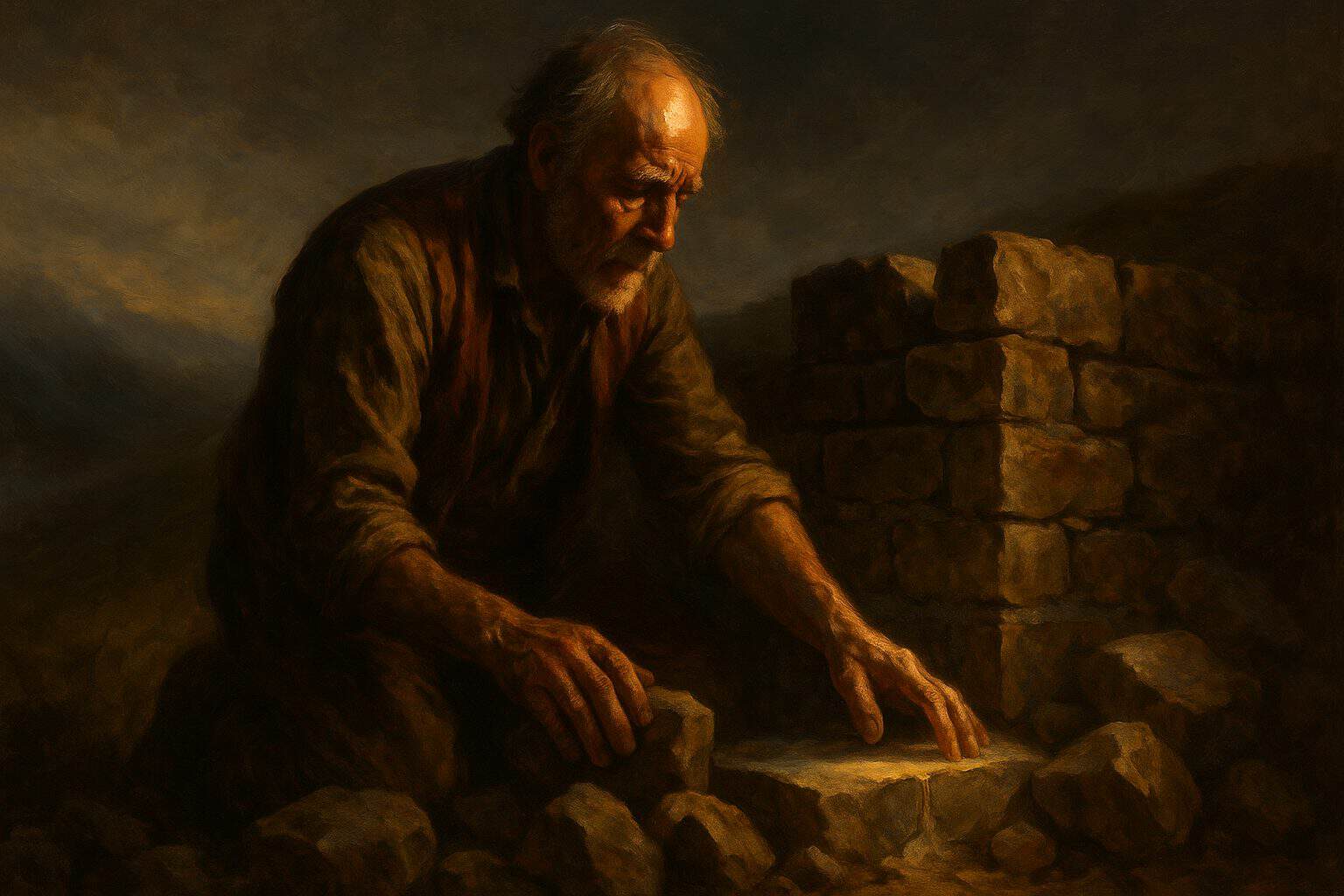
How the weight of what we never chose becomes the ground from which we choose everything.
The Already of Arrival
We do not begin. We find ourselves already begun, already in motion, already entangled in a world that precedes our consent and exceeds our comprehension. This finding—not a discovery we make but a discovery we are—marks the first and most persistent structure of human existence. Before we think, before we choose, before we understand, we are delivered over to a situation not of our making.
The phenomenology is immediate: you wake not into emptiness but into a room already furnished with meaning. The sunlight through the window carries the particular quality of this latitude, this season, this hour that you never selected. The language forming in your throat as you speak your first morning words was given to you before you could refuse it. Even the body that hosts your consciousness—its height, its vulnerabilities, its encoded tendencies—arrived as an inheritance you cannot return.
Anthony Adore captures this structure with devastating precision: “The wreckage of my relationship with Jeannètte pushed me to do more than reflect; it forced me to build a system.” Notice: not “I chose to build” but “forced to build.” The wreckage was not planned, the pushing not invited. Yet from this unchosen ground, something new must emerge. This is the paradox of thrownness—we build our most essential structures from materials we never selected, on ground we never surveyed.
The Weight of the Given
What does it mean to be thrown? Not simply to arrive somewhere unexpected, but to arrive already carrying the weight of what brought you there. Time itself conspires in this structure—”past and future intertwine in the present in a meaningful way as a function of how one finds themselves situated in the here and now.” We are not points moving through linear time but temporal knots where what has been and what might be tangle inextricably in what is.
Consider how this weight manifests in lived experience. You meet someone new, but you meet them through eyes already educated by every previous encounter, every betrayal and tenderness that came before. Adore knows this intimately: “What Lilith had used to damage me, Jeannètte now used to heal me. If Lilith made it possible for me to hate, Jeannètte made it possible for me to love.” The very same structures—intimacy, vulnerability, trust—carry opposite possibilities depending on the sediment of experience through which they flow.
This is not merely psychological but ontological. We exist as this accumulation, this sedimentation of experience that we neither fully choose nor fully escape. “Experience carves out their presence in the world”—not decorates, not influences, but carves, as water carves canyon walls, creating the very channels through which future experience must flow.
Falling Into the Everyday
Yet something curious happens to this thrown weight: we forget it. We fall into patterns that obscure the radical contingency of our situation. This falling—Verfallen in Heidegger’s precise term—is not a moral failure but a structural tendency. We drift into the comfort of the familiar, the already-interpreted, the socially given.
“Keeping an ex-lover or an intimate friend around after their relationship ran its course serves to offer one more option, a known option, a backup option.” See how the falling operates: not through dramatic betrayal but through the gentle gravity of the known. We choose the familiar not because it serves us but because it spares us the anxiety of genuine possibility.
Adore recognizes this structure in his own life: “The emotional architecture of our connection had collapsed, but the physical structure remained, and I resolved to inhabit its ruins like a squatter.” A squatter—someone who dwells where they have no genuine claim, maintaining a presence that has outlived its purpose. This is falling in its most concrete form: continuing to inhabit structures whose meaning has departed, because the alternative—stepping into the open—feels like stepping into void.
“Both death and love either open up new possibilities to do something different and believe in something different or they will remind one to play it safe.”
The everyday offers its own narcotic. We can live entire lives in this fallen state, what the tradition calls “average everydayness”—not suffering dramatically but never quite awakening to what we might become. The falling protects us from the burden of our freedom, from the weight of our mortality, from the call of our ownmost possibilities.
The Summons in the Silence
But something interrupts. Always, eventually, something interrupts. Death arrives—our own approaching or another’s accomplished. Love breaks through our defenses. Crisis shatters our routines. In these moments, we hear what Heidegger calls der Ruf—the call.
“Additionally, death itself offers a profound stimulus to individuals sedimented in average everydayness, enabling them to ‘wake up.'” This waking is not gradual but sudden, not comfortable but anxious. The call comes not from outside but from the depths of our own being, from that part of us that knows we are not living as we might, as we must.
Adore experienced this call through loss and failure: “His orientation toward time, embodiment, and others shifted after he personally encountered death. As a result, he now considers what was once very important as less important while what was once casually ignored and dismissed as trivial and annoying as indispensable.” The call reorders everything. What seemed solid reveals itself as vapor; what seemed peripheral emerges as essential.
The phenomenology of being called is unmistakable: a sudden awareness of the gap between who you are and who you might be, between the life you’re living and the life that’s possible. It arrives as anxiety—not fear of something specific but anxiety about existence itself, about the weight of having to be, having to choose, having to become.
Conscience and the Guilty
The call awakens conscience—not moral conscience in the narrow sense but existential conscience, the awareness that we are always already guilty of not being who we most essentially are. This guilt is not about specific failings but about the structural impossibility of fully coinciding with ourselves.
“I took care of her as a husband would a wife… No amount of ‘caregiving’ husband behavior from me filled the cup of her genuine desire.” Here is guilt in its existential register: not the guilt of doing wrong but the guilt of being unable to be what the situation demands, what the other needs, what love requires. We are always already in debt to possibilities we haven’t realized, to others we haven’t fully met, to ourselves we haven’t become.
This guilty conscience is not pathological but revelatory. It shows us that we are more than what we have made of ourselves, that possibility exceeds actuality, that the call to authentic existence is always sounding beneath the noise of everyday absorption.
Resolve and the Second Beginning
What follows the call, if we have ears to hear it, is what Heidegger names Entschlossenheit—resolve or resoluteness. Not a decision about something specific but a fundamental shift in how we exist, how we take up our thrownness and falling, how we project ourselves toward possibility.
Adore’s creation of the Codex represents such resolve: “I forged the Codex to manage risk—with Jeannètte and Jane as my two muses… a shield against confusion, a human system erected where trust failed.” Notice: this is not escape from thrownness but creative appropriation of it. The very failures that threw him into confusion become the material for a new structure, a new way of being.
“The wisdom of the dead becomes the wisdom of the living.”
Resolve doesn’t overcome thrownness but authenticates it. We remain thrown, remain finite, remain guilty—but now we exist these structures knowingly, choosingly, authentically. “Continuing the relationship for its physical benefits, despite the clear emotional liabilities, was a calculated choice.” Even our compromises, when chosen with full awareness, participate in authentic existence.
The Temporal Ecstasy of Existence
All of this—thrownness, falling, calling, resolve—unfolds in and as time. Not clock time, not linear time, but existential time where past, present, and future interpenetrate. We exist as this temporal stretching, this ecstatic standing-out into the three dimensions of time simultaneously.
“Fractions gave me the eyes to see the structure beneath the surface. Confessions gave me a voice to name the cost of living.” See how the past (Fractions) doesn’t simply precede but gives eyes to the present, while the present (Confessions) names what was always already there in what came before. Time circles back on itself, each moment reinterpreting every other.
The future presses into the present as possibility, as what we project ourselves toward. “Being fruitful both precedes and is a necessary condition for multiplying. Truth, love, wisdom, and clarity as intentional objects must precede the act.” The future structures the present not as what will be but as what calls us to become.
Death as Horizon
Ultimately, this entire structure—thrownness, falling, call, resolve—unfolds within the horizon of mortality. “Meaning, for human beings, unfolds within the framework of time and mortality; they incorporate the knowledge of the dead into their lives.” Death is not an event that ends life but the horizon that gives life its urgency, its weight, its possibility.
“Either death will come along and take someone close to us or we fall in love with someone with whom we are receptive to their being in the world.” Death and love emerge as the two great awakeners, the experiences that shatter average everydayness and call us to authentic existence. Both reveal the preciousness of what is by disclosing its finitude.
We exist as Being-toward-death, not morbidly but structurally. Every project, every relationship, every moment carries the taste of its own ending. This is not cause for despair but for awakening. “We could talk about how the heart and soul yearn to have their existence acknowledged before death closes the door.” The door will close—this is certain. The only question is whether we will have truly existed before it does.
The Clearing in the Forest
“It is like finding a sunlit clearing in the forest after traveling through the dark wood.” This image captures something essential: authentic existence is not a permanent achievement but a recurring event, a breaking-through into openness that must be won again and again.
We are thrown into the forest—we don’t choose our starting point, the density of the trees, the darkness of the canopy. We fall into following established paths, walking where others have walked, losing ourselves in the collective journey. But sometimes—through crisis, through love, through proximity to death—we stumble into clearings where light breaks through, where we can see the sky, where genuine possibility reveals itself.
These clearings don’t last. We must continue through the forest. But having found one clearing, we know others exist. Having heard the call once, we remain attuned to its frequency. Having experienced resolve, we carry its possibility even in our falling.
The Upward Glance
“Because I ‘looked up’ toward higher things, the greatest expression of care I could offer was encouraging others to lift their heads and elevate their eyes too.” This upward glance is not escape from thrownness but its transfiguration. We remain earthbound, remain finite, remain thrown—but we exist these conditions in relation to what transcends them.
The vertical dimension opens within the horizontal. The eternal breaks through in time. The infinite appears in the finite—not as its negation but as its deepest possibility. We are thrown, fallen, and called all at once, existing as the tension between what we are and what calls us beyond ourselves.
This is the human situation: to be delivered over to an existence we didn’t choose, to fall into patterns that obscure our possibilities, and yet to hear, always and again, the call to become who we most essentially are. We cannot escape this structure—it is the very form of human existence. But we can exist it authentically or inauthentically, awarely or blindly, resolutely or in flight.
The choice—the only choice that matters—is whether we will hear the call that sounds in the silence of our own being, whether we will answer it with resolve, whether we will take up our thrownness as the ground of our ownmost possibility. We are thrown, fallen, and called. The question is whether we will rise to meet what calls us.