How the anonymous crowd lives in us before we live in ourselves
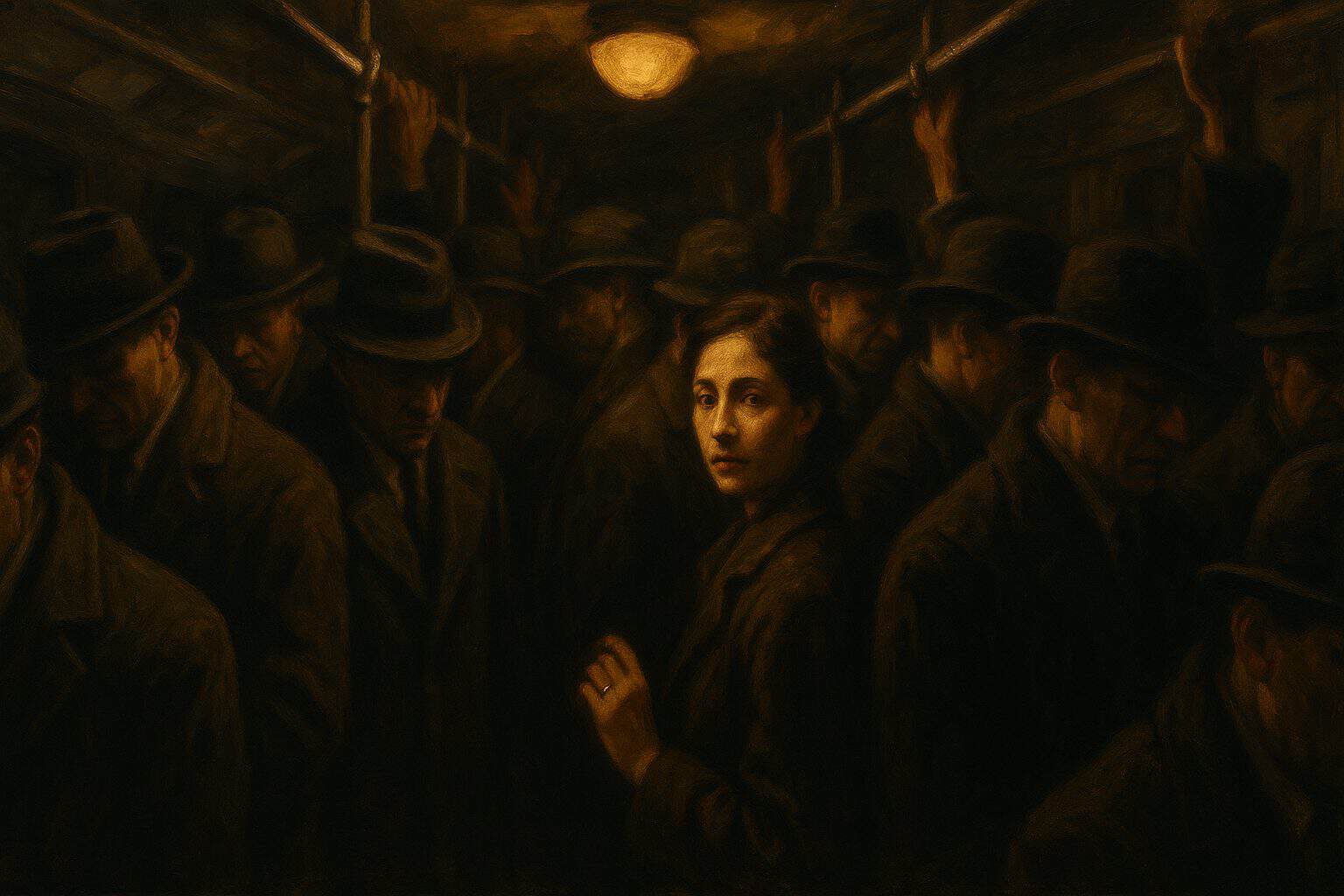
The morning commute presses bodies together in the subway car. No one speaks, yet everyone knows precisely where to stand, how much space to leave, when to shift for the opening doors. A choreography without a choreographer unfolds—each passenger moving according to rules no one articulated, expectations no one voiced. The train lurches forward and we sway in unison, our bodies already knowing the rhythm before our minds register the motion.
This is how the They announces itself: not as a theory about social conformity but as the lived weight of anonymous existence pressing into every gesture, every choice, every moment of what we call our day.
The Anonymous Thickness
Watch how a teenager enters the school cafeteria. Before any conscious decision registers, the body has already begun its navigation—steering toward this table, away from that one, the shoulders adjusting their angle according to invisible hierarchies that saturate the space like humidity. The clothing chosen that morning now reveals itself as a complex negotiation with an unnamed tribunal that judges without speaking, approves without acknowledging, rejects without explanation. As Adoré observes in Confessions to the Empty Chair, “Their behavior, clothing, musical taste, and language reflected one another with disturbing fidelity. Within each clique, boys and girls mirrored each other.”
But this mirroring runs deeper than imitation. Stand in any public space and notice how your own body has already assumed its public bearing—the face composed into its social mask, the voice modulated to its acceptable register, the entire corporeal presence shaped by an invisible mold that pre-exists your arrival. Merleau-Ponty’s insight into the pre-personal life of the body illuminates this: before I choose my posture, my body has already taken up the posture of the They. Before I decide how to speak, my voice has already found the tone that belongs to no one and everyone.
The Comfort of Dissolution
There is a peculiar relief in disappearing into the They. Adoré captures this precisely: “The city swallowed my edges and handed me anonymity… Amidst the sea of faces, all my concerns and feelings shrank.”
Feel the weight lift when you join the crowd flowing through the shopping district, each person pursuing the same vague project of acquisition, entertainment, distraction. No one asks who you are. No one demands you account for yourself. The terrible burden of being this particular person with this particular history dissolves into the general movement of bodies through space. You become anyone, which is to say, no one.
The They offers this narcotic comfort everywhere: in the predetermined rhythms of small talk that spare us from actual encounter, in the ready-made opinions that save us from the labor of thinking, in the scripted emotions that excuse us from feeling our own depths. “Most of the time,” Adoré observes, “they spend their time ‘alone’ setting up their next social engagement or relationship.” Even solitude becomes colonized by the They—our quiet moments filled with the phantom presence of others, our silence structured by imagined conversations, our privacy haunted by the public world we never actually leave.
“Moments of silence and solitude at night are not spent in pensive reflection, writing their inner voice, exploring the construction of their soul.”
The Architecture of Evasion
Notice how the They constructs elaborate architectures of evasion around the fundamental facts of existence. Death, that absolute singularity that belongs irreducibly to each one, gets transformed into a general event that happens to “people.” We speak of “passing away,” of “loss,” of “tragedy”—each euphemism another brick in the wall between ourselves and the raw fact that “When old age comes and death finally takes them, no one in society can offer themselves in their place. Each person dies alone.”
The They cannot bear this aloneness, so it multiplies connections, proliferates relationships, generates endless social obligations that promise to fill the unfillable hollow at the core of finite existence. Yet as Adoré recognizes, “This is the woman who lives for the hunt, driven by a profound internal hollowness.” The They hunts perpetually because stillness would mean confronting what cannot be shared, cannot be delegated, cannot be dissolved into the anonymous public.
Watch how quickly conversation veers away when someone speaks too honestly about their own mortality, their own absolute solitude, their own unrepeatable particularity. The They has an immune system that attacks whatever threatens to particularize, to isolate, to individuate. It offers a thousand distractions from the one thing that matters: that you will die your own death, alone, and no amount of social connection can accompany you across that threshold.
The Paradox of Individuation
Yet here emerges the strange paradox that structures human existence: individuality itself is born from this very matrix it must eventually transcend. As Adoré notes in Fractions of the Soul, “Children learn to speak in their parent’s tongue and depend upon their parents for survival and education. Individuality is born from sociality.”
Before we can say “I,” we must first have been immersed in the “we.” Before we can stand apart, we must first have been dissolved. The They is not simply an external force of conformity but the primordial soup from which selfhood eventually crystallizes. Every gesture toward authentic individuality carries within it the trace of the anonymous existence it negates.
This is why the movement toward genuine selfhood feels like betrayal. “A relationship with me means casting others into the fire,” Adoré writes, “not for safekeeping until later, but as a step toward owning authentic individuality in solitude.” The They experiences every act of genuine individuation as violence, as rejection, as a wound in the fabric of anonymous existence.
The Hidden Tapestry
But something else is at work here, something the They cannot see. In the very midst of anonymous existence, a secret process unfolds. “The individual then calls each of their involvements back home to themselves… transcribing the legion of their social entanglements with their singular body.” Each encounter with another, even when it occurs under the dominion of the They, leaves its mark. Each social role, however conventional, becomes material for an interior alchemy.
“Fractions of herself reveal themselves through each of her unique involvements with others, and she finds her voice across an interior landscape.”
The self emerges not through simple rejection of the They but through a mysterious gathering of all these dispersed fragments into a unity that transcends their sum. “Individuality weaves the threads from each of these divergent roles into a singular tapestry, the self.” The They provides the threads, but the weaving—that solitary, invisible labor—belongs to no one but the individual.
The Threshold of Solitude
“Feelings and thoughts from these involvements follow the individual to solitude’s door where he or she either invites them in or leaves them standing outside.” This threshold marks the boundary between the They and authentic selfhood. On one side lies the public world with its ready-made meanings, its comfortable anonymity, its evasion of ultimate questions. On the other side lies the terrible and beautiful burden of being this one, unrepeatable existence.
Most never cross this threshold. They hover at the doorway, one foot in solitude, one foot in the crowd, never fully committing to either. They bring their phones into their solitude, their distractions into their silence, their others into their aloneness. The They follows them even into their most private moments, structuring their inner life according to its anonymous patterns.
But for those who do cross over, who genuinely enter solitude and face what waits there, a transformation occurs. “There has been, and always will be, a solitary side of me—one I never show to anyone, not even to those closest to me.” This is not the loneliness of isolation but the solitude of individuation—the place where one discovers oneself as irreducibly singular, unrepeatable, alone in the deepest sense that makes genuine encounter with another possible.
The Living and the Dead
In perhaps the strangest revelation, Adoré recognizes himself as “the dead among the living.” The They belongs to those who flee from death, who maintain themselves in the illusion of indefinite continuance. But once one has genuinely confronted finitude—”to live life, death must be ignored. But to live abundantly, death must be confronted”—one can no longer fully participate in the They’s elaborate denial.
Yet this position of being dead among the living opens unexpected possibilities. “Even though the dead cannot speak for themselves, our voice can unite with theirs and they can speak through our interpretations.” The one who has died to the They becomes capable of speaking for all those who cannot speak—the literally dead, yes, but also the metaphorically dead, all those who remain trapped in anonymous existence without knowing it.
The Empty Chair
In the end, the movement from the They toward authentic selfhood reveals itself as fundamentally relational, but in a mode the They cannot comprehend. “The ‘you’ I address is not a single person; the occupants of the ’empty chair’ constantly shift… And always, God sits in the empty chair.”
The They offers the comfort of never being alone because one is never truly with another—always buffered by roles, scripts, conventions. Authentic existence accepts absolute aloneness as the condition for genuine encounter. Only the one who has faced their own irreducible solitude can meet another in theirs. Only the one who has died to the They can be fully present to another particular existence.
The empty chair remains empty not because no one comes but because everyone comes—each in their unrepeatable particularity, each as themselves rather than as representatives of the anonymous public. And beneath all these shifting occupants, that deepest presence that is no thing and no one, the absolute Other who grounds the possibility of any encounter at all.
The Return
Yet even those who have crossed the threshold must return to the world of the They. We buy groceries, ride subways, engage in small talk. We wear the clothes that signal our place, speak the language that makes us intelligible, participate in the rituals that bind society together. But something has changed.
Moving through the anonymous crowd, we carry within us that secret solitude that cannot be dissolved. Speaking the common language, we preserve that silence where our own voice was born. Participating in public existence, we remember that “Finitude begins and ends with solitude. We are born alone. We die alone.”
This is neither withdrawal nor rejection but a kind of holy subterfuge—living in the They while no longer being of it, participating in anonymous existence while preserving that irreducible core that belongs to no one but ourselves and, perhaps, to God. The They continues its ancient work of averaging, leveling, dissolving. But here and there, hidden in its midst, move those who have remembered how to be alone, and therefore, paradoxically, how to be truly with others.
The morning commute continues. Bodies press together in the subway car. The choreography without a choreographer unfolds as it always has. But now, perhaps, we notice what we’re doing. We feel the weight of anonymous existence, the comfort it offers, the price it exacts. And in that noticing, for just a moment, we step outside the They, even while our body continues its practiced movements, even while our face maintains its public composure.
In that moment, something else becomes possible—not escape from the They, which is neither possible nor desirable, but a kind of conscious participation that preserves difference within sameness, solitude within community, the irreducible particular within the anonymous universal. The They remains what it has always been. But we are no longer only what it makes of us.