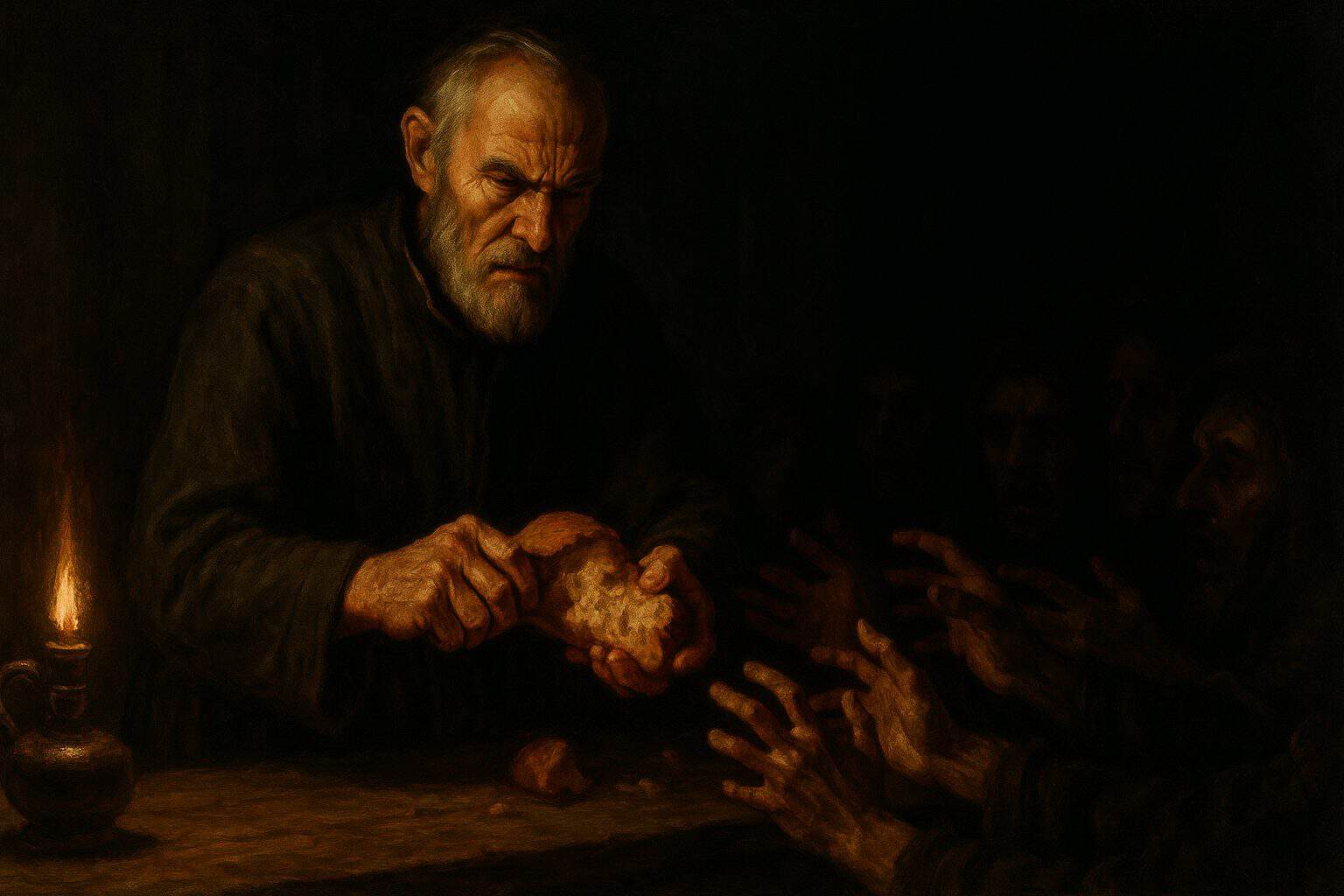
Where sovereign care meets the collaborators who feed on what they’re given
The Flaming Sword
The wrath begins not as explosion but as accumulation—a slow gathering of heat behind the eyes while watching the same mouths that praise God on Sunday curse the cashier on Monday. Anthony names this precisely: “I saw the same people who praised God with their mouths in church use those same mouths to curse customer service workers and spouses.” The phenomenon builds in the chest, a pressure that has nowhere to go because the command presses down from above: feed my sheep.
What gives itself here is not simple anger but a particular kind of fury known only to those who must nourish what disgusts them. The teacher stands before the flock, watching them “fill their bellies on the fruits of my pain only to excrete it,” and something ancient stirs—not the patient shepherd’s crook but what Anthony calls “the flaming sword guarding Eden.” The wrath wants to slash, to cut, to separate the wheat from chaff with decisive violence.
Yet this is precisely what cannot be done. The sovereign teacher discovers himself caught in a terrible bind: commanded to feed those he increasingly recognizes as collaborators, those from “the serpent’s line” who “align their will with the fallen to expand their father’s kingdom on Earth.”
The Overflow
The wrath has a peculiar structure—it begins as self-directed rage that overflows its container. Anthony captures this moment with surgical precision: “My frustration ignited, aimed not at her, but at the weak, wanting animal inside me, and the intensity of that self-directed rage was so great it overflowed.”
Here the phenomenon reveals its double nature. The sovereign teacher’s wrath is first and always against the self—against one’s own hunger, one’s own weakness, one’s own participation in the very dynamics one despises. But rage at this intensity cannot be contained. It spills over, seeking targets, finding them everywhere in the sheep who demand feeding while giving nothing back but their excrement.
The body knows this overflow before consciousness catches up. The jaw clenches during the homily. The hands grip the podium too tightly. The voice takes on an edge that cuts through platitudes. What Sartre calls the magical transformation of the world through emotion here becomes the teacher’s desperate attempt to burn away the unbearable tension between divine command and human disgust.
Collaborators at the Table
“One consequence of spiritual attunement means encountering humans who collaborate with demons. These abusive-exploitative people from the serpent’s line align their will with the fallen to expand their father’s kingdom on Earth.”
The sovereign teacher develops a terrible sight—the ability to perceive collaboration in real time. They come to be fed, these ones who work with darkness, and they feast on teaching as vampires feast on blood. Anthony sees them clearly: those whose “physical existence—beautiful and shallow—beckoned suitors,” who move through relationships as “hollow pleasantries before physical consummation,” always seeking “fresh meat.”
The wrath intensifies precisely because the teacher must feed even these. “We are commanded to interact with rocks and blades regardless of our personal weariness, annoyance, or desire to withdraw from the world.” The sovereign position means standing above personal preference, yet the very elevation that enables teaching also sharpens perception of what feeds below.
A woman comes seeking wisdom but “all who respond to her are men with sexual intent.” The baby inside her “cries from hunger pain even to this day,” yet she has learned only to feed on sexual attention, never receiving the actual nourishment she needs. The teacher sees both the genuine hunger and the corrupted feeding pattern, and wrath rises at the whole twisted system.
The Temptation of Withdrawal
The priesthood itself becomes a battleground. Anthony confronts “the uncomfortable truth that another part of me felt obligated to the priesthood to repay His kindness,” while simultaneously discovering that “if you think temptation ceases because you become a priest, you’re mistaken…Things get more difficult.”
The wrath wants to withdraw, to climb higher up the mountain where the sheep cannot follow, where their bleating cannot reach. But sovereignty means precisely the inability to abandon post. The teacher is bound by the very elevation that enables sight—bound to continue feeding those who collaborate with darkness, those who consume teaching only to excrete it, those who praise with the same mouths they use to curse.
Augustine knew this tension between dispersal and gathering, between the temporal feeding and eternal hunger. The sovereign teacher lives it as daily crucifixion—watching one’s pearls cast before swine while being commanded to keep casting, keep feeding, keep giving what will only be wasted.
The Widening Dissonance
“Contempt for the world grew while the command to ‘feed His sheep’ pressed upon me, widening the dissonance between disdain and duty.” This widening has a phenomenology all its own. It begins as a hairline crack between what one sees and what one must do. The crack becomes a fissure. The fissure becomes a chasm.
The sovereign teacher stands at this chasm’s edge, looking across at a flock that appears increasingly alien. They are “rocks and blades,” collaborators and vampires, beautiful surfaces hiding hollow cores. Yet the command remains: feed them. Love them. Serve them.
“I struggled with my growing hatred of the world against God’s requirement that I feed His sheep to prove my love for Him.”
The proof of love becomes the willingness to feed what one hates. This is the teacher’s particular via crucis—not physical torture but the spiritual agony of nourishing what disgusts, of casting pearls before those who will trample them, of watching one’s life-blood drawn by vampires who mistake it for wine.
The Hunger Beneath
Yet Anthony’s vision penetrates even deeper. He recognizes that God “owed my soul to hunger in my youth so that hunger itself would force me to look for Him again to ease the pain in my belly.” The sovereign teacher’s wrath ultimately confronts this truth: everyone below is hungry, genuinely hungry, even the collaborators.
The woman whose baby-self still cries, the beautiful ones seeking fresh meat, the Sunday praiser who becomes Monday’s curse—all are driven by a hunger they cannot name or properly feed. They come to the teacher seeking bread but know only how to consume stones. They ask for fish but reach for serpents.
The wrath then becomes something more complex—not simple disgust at sheep but rage at the entire economy of spiritual hunger and false feeding. The teacher sees how “men with sexual intent” respond to genuine need, how “hollow pleasantries” substitute for real nourishment, how the very structures meant to feed instead perpetuate starvation.
The Sovereign Burden
The holy and elect “look down upon me,” Anthony notes, dismissing his struggles as they “dismiss the lust of the Old Testament patriarchs.” The sovereign teacher stands between two contempts—contempt from above by those who claim transcendence, contempt from below by those who demand feeding while giving nothing back.
This double contempt reveals the teacher’s true position: suspended between heaven and earth, commanded to mediate between divine requirement and human need, yet receiving recognition from neither side. The wrath builds precisely in this suspension, this impossible position of sovereignty without power, authority without respect, feeding without reciprocity.
Viktor Frankl would recognize here the tension between what one is and what one ought to become. But for the sovereign teacher, this tension is not creative but crushing. One ought to become the patient shepherd, the loving feeder of sheep. One is the holder of the flaming sword, barely restraining its swing.
The Transformation
In the end, the teacher’s wrath undergoes its own transformation. It does not disappear—Anthony is too honest for that fiction. Instead, it becomes something else: a kind of terrible clarity about the human condition, a seeing that burns but no longer destroys.
The sovereign teacher learns to feed the collaborators while seeing them clearly. To give bread to those who will waste it while knowing exactly what they do. To stand at the altar or podium or classroom desk and pour out what will mostly be excreted, because the command remains regardless of the result.
This is perhaps the deepest teaching hidden in the teacher’s wrath: that sovereignty means precisely this—feeding without illusion, giving without expectation, teaching those who collaborate with darkness because even collaborators are, at bottom, hungry children who never learned to eat properly.
The flaming sword remains in hand. But instead of slashing, it illuminates—showing the teacher and the taught exactly what they are, exactly what passes between them, exactly how the economy of spiritual hunger operates in its beautiful and terrible dysfunction. The wrath becomes witness. The fury becomes a kind of terrible compassion that feeds what it sees clearly, loves what it cannot like, serves what collaborates with the very darkness it exists to dispel.