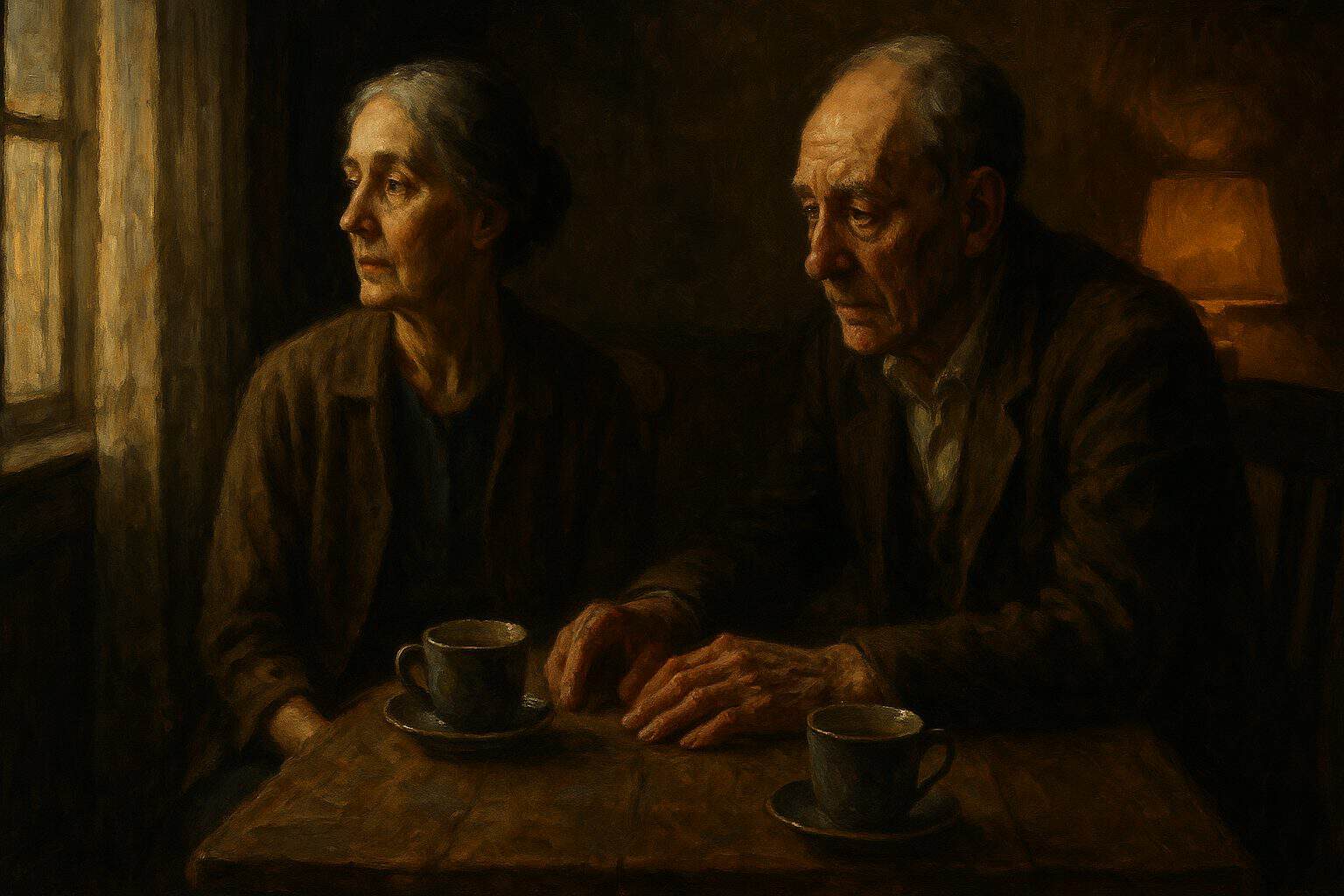
How presence becomes absence through the imperceptible degrees of withdrawal.
The phenomenon announces itself first as a quality of light—not the sudden darkness of eclipse, but the gradual dimming that steals over a late afternoon room. You sit across from someone you’ve known for years, and though they occupy the same chair, fill the same space, something essential has begun its retreat. The body remains; the soul has started packing.
The Architecture of Withdrawal
In the beginning, withdrawal wears the mask of presence. The person sits before you, responds to questions, maintains the choreography of connection. Yet small tells—a word that slips, a pause too long, a flicker in their eyes—puncture the narrative and bleed a deeper truth. These are not dramatic gestures of departure but the quiet loosening of threads that once held two lives in shared orbit.
The phenomenology of fading begins in the eyes. Where once their gaze would rest upon you with the weight of genuine seeing, now it skims across your surface like a stone skipped over water. You become, in Sartre’s language, an object among objects—no longer the particular you who once commanded singular attention, but a figure in the periphery of their already-elsewhere consciousness. “My smile was a polite, brittle thing, a thin sheet of glass over eyes that were perpetually counting the space Jeannètte left.” The smile performs connection while the eyes confess distance.
This is not the violent rupture of argument or betrayal. Those at least maintain the dignity of engagement, the recognition that what exists between two people matters enough to destroy. The slow fade operates through a more terrible kindness—the gradual evacuation of meaning from gestures that continue their empty performance. The morning greeting still comes, but hollow now, like an echo in an abandoned house.
The Paradox of Proximate Distance
“I cannot step into her mind; that sanctuary is closed to me. But I can trace the silhouette she cast against my life.”
The fading other becomes more present in their absence than they ever were in their presence. “She sat opposite me—not in a room, but as a ghost I could not exorcise, living behind my eyes.” This is the cruel mathematics of withdrawal: the more they recede, the more space they occupy in consciousness. Every room holds their absence; every conversation echoes with what they would have said.
Merleau-Ponty understood how the body carries the phantom presence of what it has lost—the amputee who still feels the missing limb, the bereaved who set two plates at dinner from habit. But here the amputation happens while the limb remains attached. The person you love sits beside you, and yet “the strings of attachment that once bonded one to the other droop to the ground like a limp broken string detached from a distant kite.”
The phenomenon reveals itself most acutely in shared spaces that have become solitary. You inhabit the same room but different worlds. Their body occupies the couch while their being has already departed for territories you cannot follow. “From my usual station on the periphery, a shadow in plain sight, I watched their lives unfold”—but now you watch from the periphery of what was once shared center, exiled from the very life you helped construct.
The Grammar of Erasure
Language becomes the first casualty of the fade. Where once words carried the full freight of shared meaning—private jokes, referenced memories, the shorthand of intimacy—now they thin to mere information transfer. The conversation continues but the communion has ended. “I threaded honesty through jokes and prayed no one tugged the stitch and unraveled me completely.” But the other no longer possesses the interest to tug any threads, to unravel any depths. You become a surface to be managed, not a depth to be explored.
The data accumulates with terrible precision: “dates missed; calls ignored; the long, silent hours of her absence.” Each absence small enough to excuse, their accumulation devastating enough to confirm what the heart already knows but cannot yet speak. The fade operates through this grammar of omission—not what is said but what is no longer said, not what is done but what is no longer bothered with.
Augustine knew this territory, the way desire requires an object outside itself to actualize its purpose. But what happens when the object of desire begins its slow dissolve while maintaining the pretense of presence? “Desire is not meant to be an end in itself… but instead requires an object outside of itself, ‘knowing,’ to pursue in order to actualize its purpose.” The tragedy of the fade is that desire continues to reach toward what has already departed, grasping at the afterimage of connection.
The Phenomenology of Preemptive Grief
“Part of me died; love – now pretend. / She who knew me best… my friend… stayed not. / The end.”
Before the final leaving comes the slow dying. “Speeding away from his apartment, I did not feel the heat of rage as intensely as I once did. Instead, I saw the death of something within me.” This is not the clean break of decisive ending but the gradual necrosis of connection—tissue dying cell by cell while the body maintains its form.
The self begins its own fade in response, “reaching hesitantly toward emotion, only to retract, abandoning it before it could inevitably abandon me. Preemptive exclusion. Defense mechanism.” We become archaeologists of our own hearts, carefully cataloguing what once lived there, preparing the museum of memory before the life has fully departed.
The phenomenon manifests somatically—a tightening in the chest when their name appears on the phone, the involuntary bracing against hope when they suggest meeting. The body knows before the mind admits. It has been practicing absence, rehearsing aloneness, preparing for the vacancy that approaches with such terrible courtesy.
The Witness Who Cannot See
“If your only method of perception is through the limits of the flesh… then all you will be able to see is the flesh… How you look shapes what you see.” The slow fade challenges our very capacity to witness, for how do you see an absence in the making? How do you document the gradual evacuation of spirit from form?
The fading other presents a terrible epistemological problem—they remain visible while becoming increasingly unknowable. “When a person chooses this rather than that… they are disclosing volumes of information about themselves to those able to see it. And I see it.” But what you see in the slow fade is precisely the choice not to disclose, the turning away that maintains the appearance of facing forward.
“Erasure stung worse than hate because hate still points at you. I stood where I used to stand and counted the empty.” This counting of absence becomes its own phenomenology—measuring the growing distance between bodies that remain in proximity, cataloguing the silence where words once lived, noting the spaces where attention once rested.
The Threshold of Recognition
There comes a moment—not dramatic, often barely noticed when it occurs—when you recognize the fade for what it is. Not a phase, not a mood, not a temporary withdrawal, but the beginning of an ending that has already begun. “As was demonstrated through the disappearance of my student, my companion, earlier”—the demonstration complete before the lesson is understood.
This recognition does not bring clarity but a different kind of confusion. For the fading other continues to perform the minimum gestures of connection, maintaining the shell while the substance departs. “She is both the person standing in front and behind the mirror, herself and her replicant, and her shadow and its source.” Which version do you address? The one who stands before you or the one who has already left?
The phenomenon reveals itself fully in the failure of confrontation. You gather courage, form words, create the space for truth—and encounter only pleasant deflection, the terrible kindness of someone who will not fight because fighting would imply investment. “Most of the time, my prediction of not being understood comes true. The evidence rests in your absence, dear observer.”
The Afterwards That Begins Before
The slow fade initiates a peculiar temporality—you begin grieving while the person still sits across from you, start healing from a wound still being inflicted, commence the afterwards while stuck in a during that won’t declare itself done. “If you gaze upon me resting in my coffin with eyes of the flesh, all you will see is the flesh of my hollow corpse—but I am not there.” But here the corpse still breathes, still speaks, still maintains the courtesy of presence while the essential self has departed.
“Opening myself to you in this way gives you the opportunity to see what I cannot, allowing me to correct blemishes in my lens…” But the fading other no longer offers this gift of mutual seeing. They have withdrawn the permission to know and be known, leaving only the performance of acquaintance where intimacy once lived.
The self who experiences the slow fade undergoes its own transformation—not dramatic metamorphosis but gradual adaptation to absence. Like eyes adjusting to darkness, the heart learns to expect less light. Love transforms into something else—not hate, which would at least maintain the energy of connection, but a terrible tenderness for what was and can no longer be.
The Wisdom of Dissolution
The slow fade teaches what sudden rupture cannot: how presence becomes absence through degrees so fine they cannot be marked, how a self can evacuate while the body remains, how we can lose someone who never leaves. It reveals the terrible truth that some endings begin long before they end, that some departures happen while everyone remains in place.
“Emotion carved itself upon their face, and though few to no words were spoken, you ‘understood’ the feeling animating the behavior.” But in the slow fade, emotion stops carving itself anywhere legible. The face becomes a pleasant mask, the behavior empties of animation, the understanding finds no purchase.
What remains is not nothing—that would be simpler. What remains is the shell of something, the form without the life, the gesture without the meaning. And you, the witness to this slow dissolution, must learn the hardest truth: that love sometimes means letting someone fade, that respect sometimes means not pursuing what has chosen to retreat, that dignity sometimes means standing still while everything you cherished walks away without walking anywhere at all.
The slow fade of a self is not an event but a process, not a violence but a courtesy, not a declaration but a whisper growing quieter until even the silence forgets it was once sound. It teaches us that presence is not a given but a gift, that attention is not automatic but chosen, that the self we love can depart while the body we recognize remains, performing the minimum courtesies of connection while the soul has already found its elsewhere.
In this space between presence and absence, between the still-here and the already-gone, we discover the most difficult truth of human connection: that we can lose someone slowly, imperceptibly, while they remain in sight, and that this losing, because it cannot be mourned cleanly, becomes a grief we carry not as event but as atmosphere—the permanent twilight of a sun that sets so slowly we cannot mark the moment day becomes night.