When the familiar suddenly shows its other face, we glimpse the world’s essential strangeness.
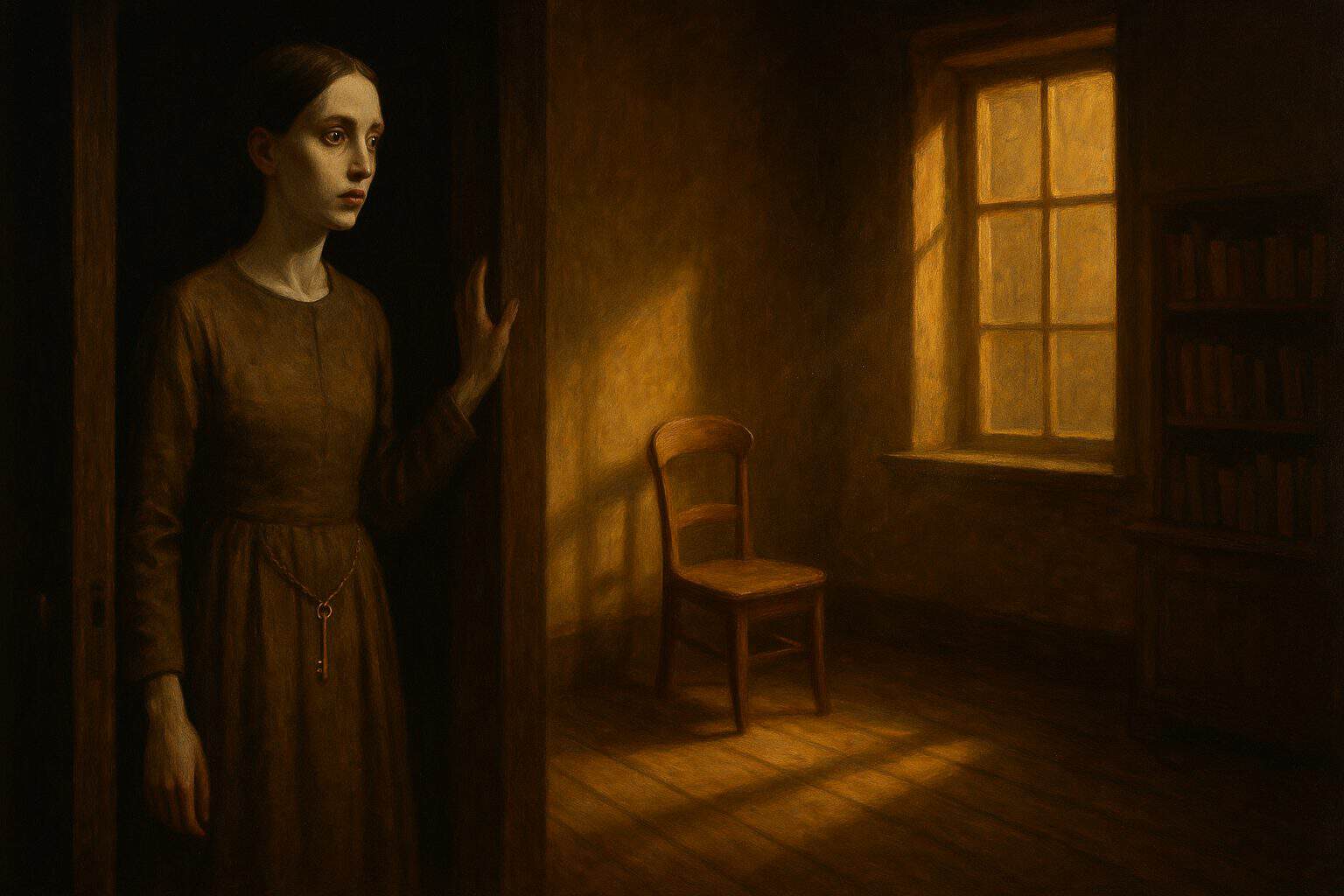
The afternoon light falls through the window at its usual angle, illuminating the same dust motes that have always danced in this air. The chair sits where it has always sat. The books on the shelf maintain their patient order. Yet something has shifted—not in the room’s physical arrangement but in its very presence. The space that wrapped around you like a second skin now holds itself at a distance. The walls that once whispered comfort speak a foreign tongue.
This is the room that turns strange.
The Sanctuary’s Double Life
Every inhabited space carries within itself the potential for this reversal. We build our sanctuaries carefully, layer by layer, until they become—as the memoir tells us—”a safety blanket—a sanctuary—and a lens through which the world comes into focus.” The familiar room is never merely a container for our bodies but the very medium through which we encounter reality. Through its windows we see not just the street outside but the world as it makes sense. Through its walls we feel not just physical shelter but existential orientation.
The room knows us. It holds the impression of our daily passages like soft earth holds footprints. The kitchen counter bears the invisible mark of ten thousand morning coffees. The bedroom walls have absorbed years of whispered prayers and troubled dreams. Even in Rome, miles from home, we carry these spaces with us—”the empty chair traveled with me, a silent confidant beneath Italian stars.” The familiar room extends beyond its physical boundaries, becoming a portable horizon of meaning.
Yet precisely this intimacy contains the seed of estrangement. The very furniture that grounds us can suddenly announce what is missing: “From his point of view, the furniture itself reminded him of her absence every time he walked through the door.” The sanctuary reveals itself as simultaneously shelter and prison, lens and blindfold.
The Moment of Turning
It begins subtly—”the sudden weight in the air before an unseen arrival; the inexplicable clarity that cuts through mundane noise.” Perhaps you’ve been away and return to find “everything here reminded me of all that was—the sights, the smells—like nothing had changed during my absence.” But you have changed. The room’s stubborn sameness now appears not as continuity but as a kind of death, a refusal to acknowledge the time that has passed through you.
Or perhaps the turning comes without warning, in the midst of an ordinary Tuesday. You look up from your book and the walls seem to lean differently. The light through the window carries an alien quality, as if filtered through different air. The room hasn’t moved, yet everything has shifted. What Heidegger called Unheimlichkeit—uncanniness, literally “not-being-at-home”—breaks through the surface of the everyday.
“Tunnels and permeability exist, by definition, outside the perceptual awareness of the one bound to the familiar.”
The room that turns strange reveals what was always true: that our sanctuary is porous, shot through with passages we never noticed. The familiar is not a solid foundation but a carefully maintained illusion, a consensual blindness to the world’s fundamental strangeness. When this illusion cracks, we discover ourselves suddenly homeless in our own home.
The Weight of Other Presences
In the strange room, we become aware of populations we never noticed. “As an observer, you must develop new eyes to see the legions of ghosts influencing the living and new ears to hear their echo.” The space that seemed to belong solely to us reveals itself as multiply inhabited. Previous tenants have left their psychic residue. The dead continue their conversations in corners we cannot quite see.
The chair where your grandmother sat every evening still holds something of her posture. The doorway where difficult words were spoken remains charged with their weight. These presences are not supernatural visitations but the room’s memory made palpable—what Merleau-Ponty might call the “pre-personal life” that inhabits every human space. The room remembers what we forget, and in its turning strange, it offers these memories back to us transformed.
Even cosmic witnesses emerge: “I spoke to the moon and stars in my mind, imagining them as witnesses; how many like me have they seen and heard across the ages?” The room’s window becomes a portal not just to the street but to the vast indifference of the universe. The ceiling that sheltered us dissolves, and we find ourselves observed by ancient lights that have watched countless rooms turn strange, countless humans discover their essential homelessness.
The Threshold of Decision
The room that turns strange presents us with a terrible freedom. We can refuse its revelation, working desperately to restore the familiar—rearranging furniture, establishing new routines, filling the silence with noise. “Most will choose to surrender autonomy and responsibility in order to find comfort in the familiar.” We pull the sanctuary back around us like a blanket, choosing blindness over sight.
But the room has shown us something that cannot be entirely forgotten. “Can you return to the prison of the familiar to wrap yourself, once again, in the threads and tapestries of the past, knowing that there is more to life?” The question haunts the restored familiarity. Every comfortable evening now carries within it the memory of strangeness, the knowledge that this sanctuary is provisional, that its walls are permeable, that its comfort comes at a cost.
“Your closeness allowed you to perceive nuances imperceptible from a greater distance.”
Some choose to remain in the strange room, to make friends with its alienation. They discover that estrangement offers its own gifts—a peculiar clarity, a freedom from the tyranny of the familiar. The room that no longer shelters also no longer confines. Its strangeness becomes a doorway to a larger world, one where “memories of Eden decorate the interior landscape of all who feel abandoned, alienated, betrayed, contemplative, curious.”
The Architecture of Loneliness
At the heart of the room that turns strange lies a primordial loneliness—”Adam’s loneliness was pure, without evil, and that it was something woven into the human soul by God.” This is not the loneliness of being without others but the loneliness of being at all, of finding oneself a separate existence in a world of separate existences. The familiar room usually masks this fundamental solitude, wrapping us in the illusion of belonging. When it turns strange, it strips this comfort away, returning us to our essential aloneness.
Yet this loneliness is not simply privation. It is the space within which genuine encounter becomes possible. Only when we recognize our fundamental separation can we truly meet another. Only when the room turns strange can we see it—and ourselves—clearly. The estrangement that initially appears as loss reveals itself as the condition for authentic seeing.
“The night still received me as an old friend, offering the familiar comforts of her understanding stars, her silent moon, and her empty chapel.” Perhaps the truly familiar is not the room we construct but the strangeness itself—the vast night that receives all wanderers, the cosmic loneliness that connects us to every human who has ever lived. Perhaps coming home means accepting our essential homelessness.
The Room Transformed
The room that turns strange never quite returns to its former state. Even if we succeed in restoring familiarity, we now know it as restoration, as achievement rather than given. The sanctuary reveals itself as something we continuously create rather than simply inhabit. Every familiar room now carries within it the potential for strangeness, just as every strange room carries the seed of potential sanctuary.
This is the gift of the turning: it teaches us to inhabit space differently. We learn to dwell lightly, to hold our sanctuaries with open hands. We discover that home is not a fixed location but a practice, a continuous negotiation between familiarity and strangeness, shelter and exposure, the known and the unknown.
The room that turns strange initiates us into a fundamental truth about human existence: we are always both at home and in exile, always constructing meaning in spaces that exceed our constructions, always seeking sanctuary in a world that remains essentially, beautifully, terrifyingly strange. The turning room is every room, eventually. The strange space is every space, fundamentally. And in accepting this, we find not despair but a different kind of peace—the peace of those who have learned to be at home in their not-being-at-home, who have discovered that the room’s strangeness is not its betrayal but its deepest truth.