When time itself becomes the weight that presses consciousness against its own limits
The Clock’s Prisoner
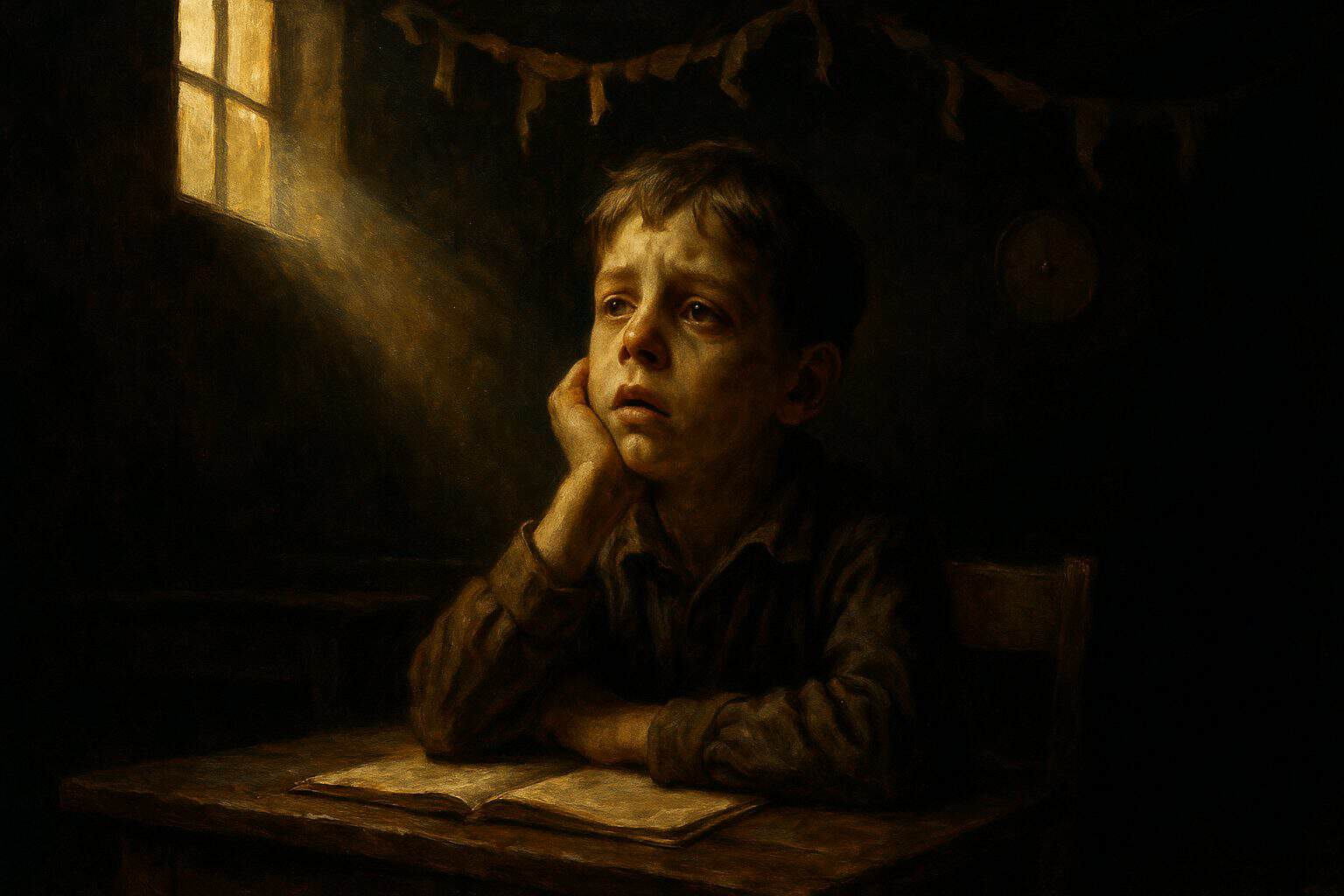
There is a moment—perhaps you have lived it—when time ceases to be the invisible medium through which life flows and becomes instead a visible wall. The child stares at decorations hanging from a classroom ceiling, “a prisoner of the clock’s slow march,” and discovers what adults have learned to forget: that time does not move the same for everyone. In this arrested gaze, something essential about human despair reveals itself—not as an emotion we have but as a way time itself can close around consciousness like a fist.
The phenomenon announces itself first through the body. The chest tightens. Breath becomes shallow, deliberate, counted. The eyes fix on some arbitrary point—ceiling tiles, a crack in the wall, the second hand of a clock—as if steadiness of gaze could steady the vertiginous sense that the future has somehow already happened, already failed to arrive. The present moment stretches like pulled taffy, becoming both unbearably long and impossibly thin.
The Machine That Cannot Unmake
In Confessions to the Empty Chair, Anthony describes a peculiar temporal knot: “In effect, his wife’s death made the machine and therefore the machine cannot be used to unmake her death.” Here despair reveals itself not as simple grief but as consciousness caught in its own recursive loop. The very structures we create to navigate loss become monuments to that loss. Time becomes a machine we ourselves have built, and we discover we cannot use our own creation to undo what created it.
“We perceive existence with our limits, through our limits, and because of our limits.”
This is how despair colonizes time—not by destroying the future but by making it arrive already exhausted. The consciousness that attempts to perceive itself through itself with itself both overlooks and compounds the flaws woven into itself. We become archaeologists of our own ruins, sifting through moments that haven’t happened yet for evidence of failures already accomplished.
The Tunnel and the Wall
Anthony writes of desire uncovering tunnels, softening walls that lead toward what he calls “G”—reason dwelling beyond limitation and habitual perception. But in the phenomenon of despair-crossed-with-time, these same structures reverse their function. The tunnel becomes not a passage but an endless recession. The wall softens not to permit passage but to absorb every effort at transcendence.
Watch how it happens: A person receives news—a diagnosis, a departure, a small cruelty that confirms a larger pattern. In that instant, past and future collapse into the present “in a meaningful way as a function of how one finds themselves situated in the here and now.” But this meaning is inverted. Where hope would see possibility branching outward, despair sees all branches already traced to their withered ends.
The phenomenology here is precise: consciousness doesn’t lose the future; it gains it—gains it as already spent, already traversed, already found wanting. Sartre’s pour-soi, that nothingness that nihilates being, here nihilates its own nihilation. The freedom to project possibilities becomes the curse of seeing all projections as variations on a single theme of insufficiency.
Flesh Seeing Only Flesh
“If your only method of perception is through the limits of the flesh… then all you will be able to see is the flesh.” In temporal despair, this limitation becomes absolute. The horizon that normally recedes as we approach it suddenly snaps into place like a photograph. We see our entire life at once, and seeing it all at once, see it as already over.
This is not the memento mori of wisdom literature, which uses death’s certainty to vivify life’s preciousness. This is consciousness using its own finitude as a lens that can only focus on finitude. “How you look shapes what you see,” and despair is a way of looking that shapes time itself into a closed circuit.
The person in this state might still move through days, fulfill obligations, even laugh at appropriate moments. But beneath these performances runs an underground river of temporal exhaustion. They walk through their life like someone touring a museum of their own existence—everything already behind glass, already captioned, already explained.
The Divergent Threads
“Individuality weaves the threads from each of these divergent roles into a singular tapestry, the self.” But what happens when time itself becomes one of these threads, and despair the loom? The tapestry begins to show a peculiar pattern: every thread, no matter how it enters the weaving, emerges bearing the same color.
“Finitude begins and ends with solitude. We are born alone. We die alone. During the time in between, we either embrace solitude and loneliness or we run…”
In temporal despair, this running becomes impossible—not because we lack energy but because we have already seen where every path leads. We become MacQuarrie’s ex-sistent beings, standing out into possibilities, but experiencing this standing-out as a kind of paralysis. Every possibility presents itself as already attempted, already failed.
The Permeable Moment
Yet Anthony’s phenomenology suggests something else might be happening in these depths. “Change might have been there all along in the tunnel or in the permeable; however, both went unnoticed without an effort to the contrary.” The very experience of time closing might itself be the pressure that creates new permeability.
Consider: despair makes time visible precisely by making it unbearable. The person who stares at the ceiling, prisoner of the clock’s slow march, has discovered something others miss—that time is not a given but a construction, not a container but a relation. In making time oppressive, despair paradoxically reveals time’s plasticity.
This is not consolation—the phenomenon resists such easy resolution. Rather, it is to notice that despair’s temporal structure contains its own fissures. The future that presents itself as closed is still presenting itself. The consciousness that sees all possibilities as exhausted is still seeing. Even in the depths of temporal despair, time continues to give itself, and in giving itself, remains open to being received differently.
Where It Goes When It’s Gone
“Where does it go when it’s gone; I still care, but I must move on; I walk alone; To find my path never shown.” These lines from Fractions of the Soul capture something essential about despair’s relationship with time—it is always about something that is simultaneously absolutely present and absolutely absent.
The future that closes is not the chronological future—that continues its mechanical unfolding. Rather, it is what Frankl might call the noological future, the dimension of meaning-possibility. When this closes, we experience the strange phenomenon of living in time while being existentially outside it. We continue to age, to move through days and seasons, but without the sense that this movement carries us toward anything not already contained in the present moment’s despair.
Augustine knew this phenomenon—the soul’s dispersal among temporal things while yearning for gathering into the eternal. But in temporal despair, this gathering seems impossible because eternity itself appears empty. We are not dispersed because we lack focus but because focus itself reveals only more dispersion.
The Evolution of Souls
Anthony writes of those “not interested in the evolution of their souls,” comparing them to roosters chasing hens, “driven by instinct.” But temporal despair represents a different phenomenon—souls intensely interested in their own evolution but unable to believe in it. They see the path, understand the requirements, recognize the call, but experience all of this as if through thick glass—visible but unreachable.
“Biological reality and material causality are accepted as facticity and set the horizon within which meaning, openness, consciousness, and perception appear.” In temporal despair, this horizon doesn’t expand or contract—it crystallizes. The person continues to exist within biological reality, continues to be subject to material causality, but experiences these as the only dimensions of existence. The horizon beyond the horizon, what Anthony calls “G,” becomes a rumor of a rumor.
The Lens Unaware of Itself
“Most people are unaware of their lens, as it does not itself stand out in the forefront of consciousness as a thing to be examined.” But temporal despair forces a terrible awareness—not of the lens but of being trapped behind it. We see that we see through limitations, but this seeing doesn’t liberate; it merely adds another layer to the limitation.
This is Merleau-Ponty’s dialectic between the pre-personal life of the body and personal acts of assumption and transformation, but frozen at the moment of recognition. We see the dialectic but cannot enter it. We understand transformation conceptually but experience it as impossible existentially.
The person in this state might read Anthony’s words about desire requiring “an object outside of itself, ‘knowing,’ to pursue in order to actualize its purpose” and understand them perfectly while feeling that understanding itself has become the trap. They know about knowing but cannot know. They desire desire but cannot desire.
The Hour’s Arrival
What makes temporal despair distinct from other forms of suffering is its relationship with the present moment. Depression empties the present; anxiety floods it with future fears; grief fills it with past losses. But temporal despair does something else—it makes the present moment simultaneously eternal and without duration. Every moment becomes the hour the future closes, and this hour never passes because it is not in time but is rather a way time gives itself to consciousness.
Yet perhaps this very extremity carries its own reversal. When time becomes so thoroughly problematic that it can no longer be taken for granted, when the future becomes so closed that its closure itself becomes visible, something new might become possible. Not hope—that would be too simple a negation. Rather, a kind of temporal epoché, a suspension of time’s taken-for-granted flow that might allow consciousness to discover time differently.
Anthony’s memoirs suggest this possibility without promising it. The path toward “G” demands “ever more clarity in understanding, interpreting, and communicating in proportion to the distance traveled toward it inward and upward.” Perhaps temporal despair, in all its crushing weight, is itself a kind of traveling—not forward through chronological time but inward through time’s essence, downward through its foundations, until consciousness discovers not a way out of time but a way of being in time that doesn’t require the future to be open in order to be bearable.
The hour the future closes might also be the hour when something else—not future, not past, not even present in the ordinary sense—begins to make itself known. Not as consolation, not as escape, but as the deepest structure of temporality itself: that time gives itself, and in giving itself, remains gift even when consciousness can only receive it as burden.