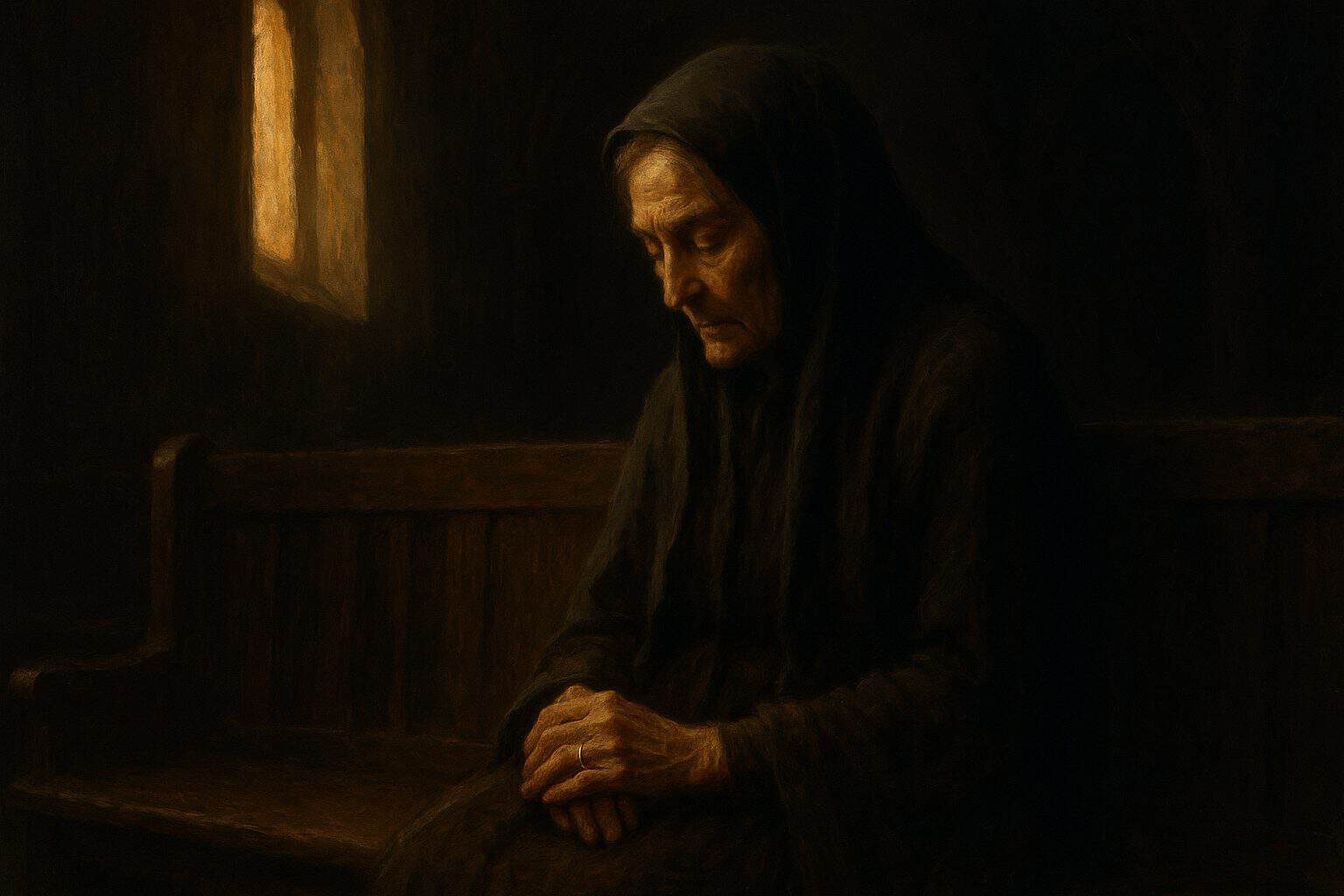
How presence announces itself through withdrawal, and the divine touches us in the very space of absence
The Chapel’s Roar
There is a particular quality to the silence of an empty chapel at dusk. Not the mere absence of sound—for the building creaks, candles flicker, somewhere a door settles into its frame—but a positive presence that presses against the eardrums. “I begged for a word and met only the throb of my pulse. I learned how loud silence can roar.” The one who enters seeking consolation finds instead this strange amplitude: silence not as void but as fullness, overwhelming precisely in what it withholds.
The late afternoon light slants through stained glass, painting abstract geometries across worn pews. Each footstep echoes longer than it should, as if the space itself were listening. You came here carrying something—a grief, a question, a weight that demanded divine address. You lower yourself onto wood polished smooth by countless other seekers. The genuflection comes automatically, muscle memory of reverence, though what you feel is closer to accusation. Here, in this consecrated space where He promised to be especially present, the absence feels most acute.
“I sat amidst the shadows, my throat thick with prayers that had turned to dust.”
The prayer forms on your lips but catches there. Not because you’ve forgotten the words—they rise with practiced ease—but because suddenly their destination seems uncertain. To whom do you speak in this resonant emptiness? The crucifix hangs above the altar, bronze Christ frozen in his final agony, but even this familiar form seems suddenly strange, more absence than presence, the gap between representation and reality yawning wide.
The Phenomenology of Divine Silence
What shows itself in this moment is not simply the failure of expected comfort. Something more primordial emerges: the structure of presence itself as it gives itself through withdrawal. The divine silence is “multifaceted”—sometimes “hard grace that forces us to seek,” other times “sacred space He provides.” But before it can be interpreted as either grace or abandonment, it must first be lived as this immediate weight, this peculiar density of the unresponding.
The body knows this absence with visceral precision. The chest tightens. Breathing becomes conscious, effortful. You shift on the pew, seeking some position that might ease the pressure, but the discomfort isn’t physical. It’s the lived experience of address without answer, the phenomenological structure of the cry that meets no echo. “Even though the dead cannot speak for themselves, our voice can unite with theirs”—and here in the chapel’s silence, you discover yourself among the speechless dead, your voice joining that vast chorus of unanswered prayers that seems to hang in the very air.
Merleau-Ponty understood how the body opens us to the world before any conscious thought, how we are our bodily engagement with things. In the chapel’s silence, this bodily opening becomes palpable as vulnerability. You are exposed, laid bare not to a gaze but to an absence of gaze, and this absence has its own terrible weight. The genuflection that began as habit becomes something else: a bodily acknowledgment of this exposure, a gesture that holds open the space where presence might arrive.
The Empty Chair’s Migration
“Even in Rome, miles from home, the empty chair traveled with me, a silent confidant beneath Italian stars.” The structure of absence proves portable, following us beyond consecrated spaces into the quotidian world. In the hotel room, at the café table, walking the ancient streets—always this space alongside, this addressee who both is and is not there.
The phenomenology of the empty chair reveals something essential about human consciousness: we are beings who constitute ourselves through address. “My mind and spirit do this instinctively, with one part of me acting as the speaker and another part as the listener.” But this internal dialogue always implies a third position—the one to whom even our self-address is ultimately directed. “The ‘you’ I address is not a single person; the occupants of the ’empty chair’ constantly shift… And always, God sits in the empty chair.”
This is not metaphor but lived structure. Watch yourself in solitude, particularly in those moments when the day’s noise subsides. You find yourself speaking—not necessarily aloud, though sometimes that too—to an implied presence. You explain, you confess, you argue. The absent beloved, the estranged friend, the lost parent—”She sat opposite me—not in a room, but as a ghost I could not exorcise, living behind my eyes.” But beneath all these particular absences lurks a more fundamental one, the primordial Other to whom all our others ultimately refer.
Night Knowledge
“Moments of silence and solitude at night are not spent in pensive reflection, writing their inner voice, exploring the construction of their soul.” Instead, something else emerges in the darkness—not the romantic solitude of self-discovery but an “oppressive void, a ‘presence in the room’ leeching warmth, hope, and peace from the individual, leaving them feeling intimidated, defeated.”
The phenomenology of night differs qualitatively from day solitude. In daylight, absence maintains clear borders—the empty chair is empty, the silent chapel is silent. But darkness blurs these boundaries. The absence becomes ambient, atmospheric. You lie in bed and feel it pressing down, not weight but weightlessness itself become oppressive. “The rest of the night was a long, cold education in silence.”
Yet precisely here, in this most acute experience of divine withdrawal, something shifts. “The Idol of Solitude broke when I finally realized the silence I fled to was, in fact, the one Presence I had been seeking all along.” The Stimmung of night—that fundamental attunement Heidegger named as our most primordial way of being in the world—reveals absence and presence as more intimately related than daylight logic suggests.
Augustine knew this night knowledge. His Confessions track the soul’s discovery that what it fled was what it sought, that the restlessness driving it through created things was itself the touch of the Creator. “I still loved God, yet I pushed Him away. Did I love Him? He did nothing but watch me reel and die.” This is not contradiction but the lived paradox of divine nearness—nearest precisely when most hidden, touching us through the very experience of distance.
The Witness in Withdrawal
“She processed my words and glimpsed who and what I am. And when she saw me, she did not flee.” Human recognition offers a parable for divine presence. In being truly seen by another—not our performance, not our mask, but the raw fact of what we are—we experience a presence that doesn’t eliminate our solitude but transforms it.
The phenomenology of being witnessed reveals that presence need not mean proximity, that the most profound companionship might come through distance properly maintained. “Feelings and thoughts from these involvements follow the individual to solitude’s door where he or she either invites them in or leaves them standing outside.” The other who truly sees us continues to accompany us even in their absence, perhaps especially in their absence, where their witness can resonate without the static of immediate interaction.
“Their children will never learn to listen to those whispers of the divine that occur only during loneliness and isolation.”
This suggests that divine presence might operate according to a similar logic—not filling our solitude but sanctifying it, not eliminating absence but revealing it as the space where genuine encounter becomes possible. The God who is nearest in the dark is not the God who banishes darkness but the one who dwells within it, whose presence is given precisely as this quality of absence that differs from mere emptiness.
The Carnal Mystery
Merleau-Ponty spoke of the flesh as that elemental being that is neither subject nor object but the common tissue from which both emerge. In the lived experience of divine absence, we discover something analogous in the spiritual order—a fundamental flesh of existence where the distinction between presence and absence, seeking and finding, hasn’t yet crystallized into opposition.
“The solitude of an empty church, the nocturnal wanderings through Deep Ellum—these still comfort me.” Not despite their emptiness but because of it. These spaces hold open a particular possibility, maintain a tension that fullness would resolve too quickly. They are threshold spaces, and the threshold—that liminal zone between inside and outside, presence and absence—might be where the divine prefers to dwell.
John of the Cross mapped this terrain with terrible precision. The dark night of the soul is not God’s absence but a presence too pure for our ordinary faculties to perceive. Like eyes accustomed to darkness being blinded by sudden light, the soul experiences divine nearness as devastating absence. “I could not feel Him anymore; was it all a dream? … One would expect that I would be happier after His visit, but I was not: my sadness amplified.”
The Community of Absence
“Others chased their own happiness, too absorbed in themselves to notice my sorrow. I discerned this dissonance—I was the dead among the living.” Yet this very experience of being unseen by the living creates another kind of communion—with all those who have known this particular species of absence, this presence-through-withdrawal that marks the divine signature.
Walking through the city at night, passing lit windows behind which others pursue their evening routines, you feel simultaneously excluded and included—excluded from their immediate warmth, included in the larger community of all who have walked such streets, carrying their unwitnessed sorrows. “Take this unified song into the quiet. Let it resonate. Let it strengthen you for the long walk ahead.”
The phenomenology of shared absence differs from shared presence. In presence, we must negotiate boundaries, manage proximities, perform our being-with. In absence, a different communion emerges—immediate, unmediated, requiring no negotiation because it operates below the threshold of encounter. The God who is nearest in the dark might be nearest precisely because darkness dissolves the boundaries that daylight maintains, allows a more primitive communion than presence permits.
The Enduring Address
“Both he and she existed per se, in a physical sense, but they did not yet exist for each other.” This describes not only human lovers before their meeting but perhaps the fundamental situation of the soul before God—existing, undeniably real, yet somehow not yet existing for the divine Other, or experiencing the divine as not yet existing for us.
The movement from existing per se to existing for another requires a particular kind of space—not the space of assured presence but the space of possible encounter, where presence and absence interweave in generative tension. “I endured a more intimate death—the silent collapse of my heart… Where once I had felt His embrace as a boy, now I felt only His absence.” Yet this absence is still a relation, perhaps the most intimate relation possible—the relation of the heart that has known presence and now must sustain itself on memory and hope.
The God who is nearest in the dark names not a theological doctrine but a lived structure of experience—the discovery that divine presence gives itself not as the elimination of absence but as absence’s transformation into address. The empty chapel, the vacant chair, the night’s oppressive silence—these become spaces of a presence too subtle for daylight apprehension, a nearness that requires darkness to be perceived.
In the end, “the sudden weight in the air before an unseen arrival; the inexplicable clarity that cuts through mundane noise”—these atmospheric shifts, these Stimmungen that attune us to what hovers just beyond perception’s edge, might be the primary mode of divine presence in ordinary life. Not the dramatic theophany but the subtle alteration in absence’s quality, the way silence sometimes shifts from empty to full, from dead to pregnant, from mere absence to vigilant withholding.
The God who is nearest in the dark is nearest not despite the dark but through it, in it, as it. The darkness is not obstacle but medium, not barrier but the very space of approach. And we who seek this God must learn the patience of darkness, the discipline of absence, the terrible freedom of the address that generates its own addressee through the very act of speaking into the silence that roars.