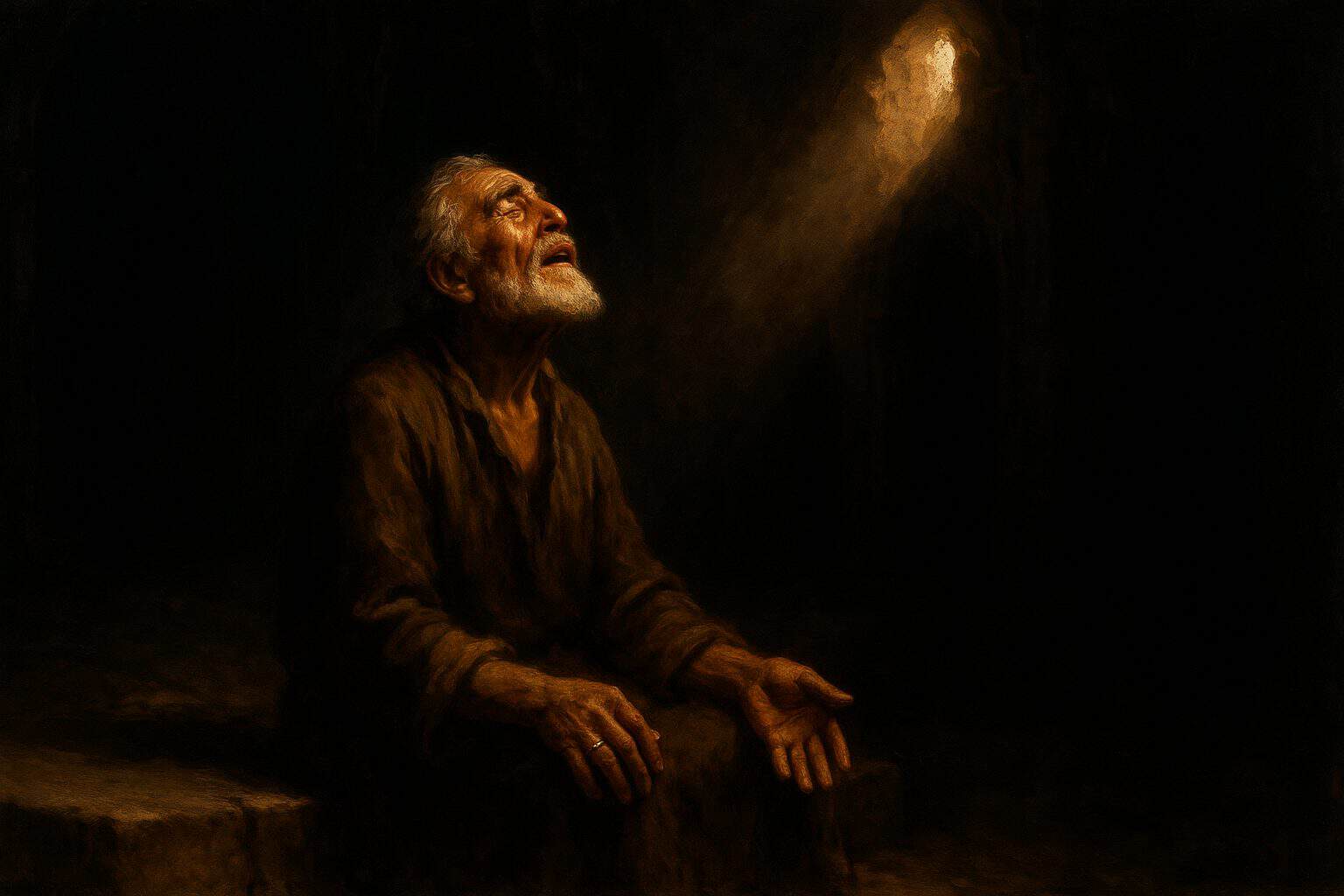
Where the soul discovers that descent itself becomes ascent
The darkness arrives not as enemy but as severe mercy. In the memoir’s witness—”Holiness, I learned, is not the erasing of the darkness, but its forced integration and redemption under His sovereignty”—we touch a structure that governs all genuine spiritual transformation. The darkness does not vanish; it becomes the very medium through which grace operates, the resistant material that divine light must penetrate and transform.
The Architecture of Descent
The empty church at night. The wanderings through Deep Ellum’s streets. These nocturnal passages mark more than biographical detail—they disclose how grace moves through darkness rather than around it. The solitary figure in the vacant sanctuary experiences what crowds and daylight cannot provide: the stripping away of all mediations until only the essential encounter remains.
“The closer one is to God, the easier it is for them to see sin. The further in darkness one is from God, the easier it is for them to see light.”
This paradox structures the entire phenomenology of spiritual descent. In the false brightness of our constructed worlds, divine light appears as merely one option among many. But when shame and failure strip away these artificial illuminations, “a single speck of His light became impossible to ignore.” The darkness becomes the condition for true seeing.
The Shadow’s Knowledge
“They could not deceive me; I knew the darkness they concealed, for it hid within me as well.” This recognition marks a threshold—not the darkness as abstract concept but as lived reality dwelling within. We carry “faint memories of a time before the fall, now blurred through the veil of death and sin,” yet these memories do not exempt us from the shadow. Rather, they intensify our awareness of what we have lost and what still claims us.
The memoir speaks of following “Your Spirit through the shadow of death”—not around it, not over it, but through it. This preposition matters absolutely. The way through requires what modernity most resists: actual passage through the valley, the acceptance that “grief shared honestly on the road opens the eyes to recognize the sacred Companion who keeps pace.”
The Wound as Window
“I do not reopen the wounds; I let the higher air move through them.” Here appears a phenomenology of redemptive suffering that neither denies nor dramatizes pain. The wounds remain—they are not erased, not healed in the conventional sense. Instead, they become apertures through which something else moves. The “higher air” suggests a pneumatology of transformation where spirit works precisely through what has been broken open.
This differs radically from therapeutic culture’s promise to heal all wounds, to restore us to some imagined wholeness. The Catholic imagination that Bishop Barron articulates knows that some wounds become permanent features of the landscape—but transformed, like Christ’s own wounds, into sources of recognition and grace. Thomas needed to place his fingers in those wounds; they had become the very proof of resurrection.
The Dialectic of Ascent and Descent
“He draws me upward for consolation and consecration; He sends me downward for mission, encounter, and purification.”
This double movement structures all authentic spiritual life. We do not simply ascend toward light; we are sent back down into darkness, carrying what we have received. The upward movement provides vision and strength; the downward movement provides application and testing. Neither is complete without the other.
“Most do not accept the darkness within themselves mixing with the light,” the memoir observes. This refusal to accept the mixing—the desire for pure light without shadow—becomes itself a form of darkness. The authentic spiritual life requires what John of the Cross knew: that divine darkness and created light interpenetrate in ways that confound our neat categories.
The Throne of Desolation
The memoir warns against allowing another human “into this tent of meeting,” elevating their approval “above the LORD’s.” This displacement creates what Scripture calls “the abomination that causes desolation”—not merely sin but the specific sin of misplaced ultimacy. When we seat another upon the heart’s throne, we create a devastation that only darkness can reveal.
Yet even this desolation serves grace. “Where before, in the false light of human affection, God’s voice remained merely one among many, here in the darkness of my shame, a single speck of His light became impossible to ignore.” The very extremity of our idolatry becomes the condition for recognizing what we have displaced. The darkness strips away all competing lights until only the true light remains visible.
The Pedagogy of Suffering
“But this is the way He grows the faithful: with sadness, loneliness, solitude, hardship, rejection, misunderstanding, conflict, and frustration.” This catalog reads like a curriculum of darkness, each element a required course in spiritual maturation. Not optional suffering that might be avoided with better choices, but necessary passages through which grace operates its transformation.
The memoir insists these experiences “hollow out space within you, creating a deeper capacity to receive God’s unexpected comfort.” The hollowing precedes the filling. The emptying enables the reception. Without the darkness creating this interior space, we remain too full of ourselves to receive what grace would give.
Memory as Sanctuary
“I clutched the memory of His divine embrace, sequestering it deep within myself, filing it away in the expanding, private inventory of my innermost thoughts.” Here memory becomes not mere recollection but active resistance to darkness. The remembered encounter with divine presence becomes a hidden light carried through subsequent darknesses.
This “private inventory” suggests an interior architecture where grace deposits its gifts for future need. We do not always experience divine presence directly, but we can access its memory, can return to those moments when light broke through. These memories become resources, provisions for the journey through darkness that inevitably follows illumination.
The Language Found in Darkness
“I did not have this language at the time. Back then, I only knew the hollow afterglow.” The darkness provides its own vocabulary, its own grammar of understanding. What we cannot name in the moment of experience becomes articulable only in retrospect, only after we have passed through and can look back with different eyes.
The confession left “in the chair, not as a closed account, but as witness to a process that continues” acknowledges that the darkness keeps teaching, keeps revealing. We never graduate from this school. The “lessons of darkness against blacker darkness” continue to yield “fruit pulled from the icy abyss.”
The Purified Body-Soul
“Ours is not to remain a disembodied soul in heaven but a reunited and purified body-soul in the New Jerusalem.” This eschatological vision reframes our present darkness. We are not seeking escape from materiality into pure spirit, but the transformation of our entire being—body and soul together—through the refining fire of present suffering.
The darkness we endure now participates in this purification. It is not meaningless suffering but preparatory transformation. Every descent through darkness removes another layer of what cannot enter the New Jerusalem, reveals another aspect of what must be transformed before that final reunion of purified body and soul.
The Unmarked Threshold
“Stickman crossed the threshold and marked me with his flame, calling for grace to pursue me unasked as darkness claimed its ground.” Some darkness comes unbidden, crosses thresholds we did not know existed, marks us with flames we did not kindle. This involuntary initiation into darkness often proves the most transformative—precisely because we did not choose it, cannot control it, must simply endure it.
Grace pursues “unasked” while “darkness claimed its ground.” Both movements happen simultaneously—grace pursuing and darkness claiming. This double action creates the tension within which transformation occurs. We are caught between two forces, and in that pressure, something new emerges.
The Offering of Story
The memoir speaks of “offering my own story as an example to demonstrate the possibility of finding light in darkness.” This offering is not self-aggrandizement but service—the willingness to make one’s darkness available for another’s illumination. The story becomes gift, the personal darkness becomes universal light.
Yet the offering must be genuine—not darkness sanitized or theologized into abstraction, but darkness as actually lived, as actually endured. Only this honest accounting can “put her on the path of emotional and spiritual enlightenment.” Only real darkness can teach about real light.
The Continuing Ascent
“The ascent moves forward by consent,” the memoir concludes. Not by achievement, not by understanding, but by simple consent to what darkness and grace together are working within us. This consent must be renewed continuously—each new darkness requires fresh consent, each grace demands new acceptance.
The revelation comes not through argument with the past but through letting “the ascent test it.” We do not need to relitigate our darkness, to understand it completely, to justify or condemn it. We need only to continue ascending, letting each new height reveal what the darkness meant, what grace was doing when we could not see.
In this continuing ascent through darkness, we discover what Bishop Barron’s theological vision illuminates: that the Paschal Mystery—the dying and rising of Christ—establishes the permanent pattern of spiritual transformation. We die to false lights to discover true light. We descend through darkness to find that grace has been there all along, working its slow redemption, forcing the integration of shadow and light under divine sovereignty.
The darkness remains. But it no longer has the final word.