How solitude reveals we are never alone with ourselves
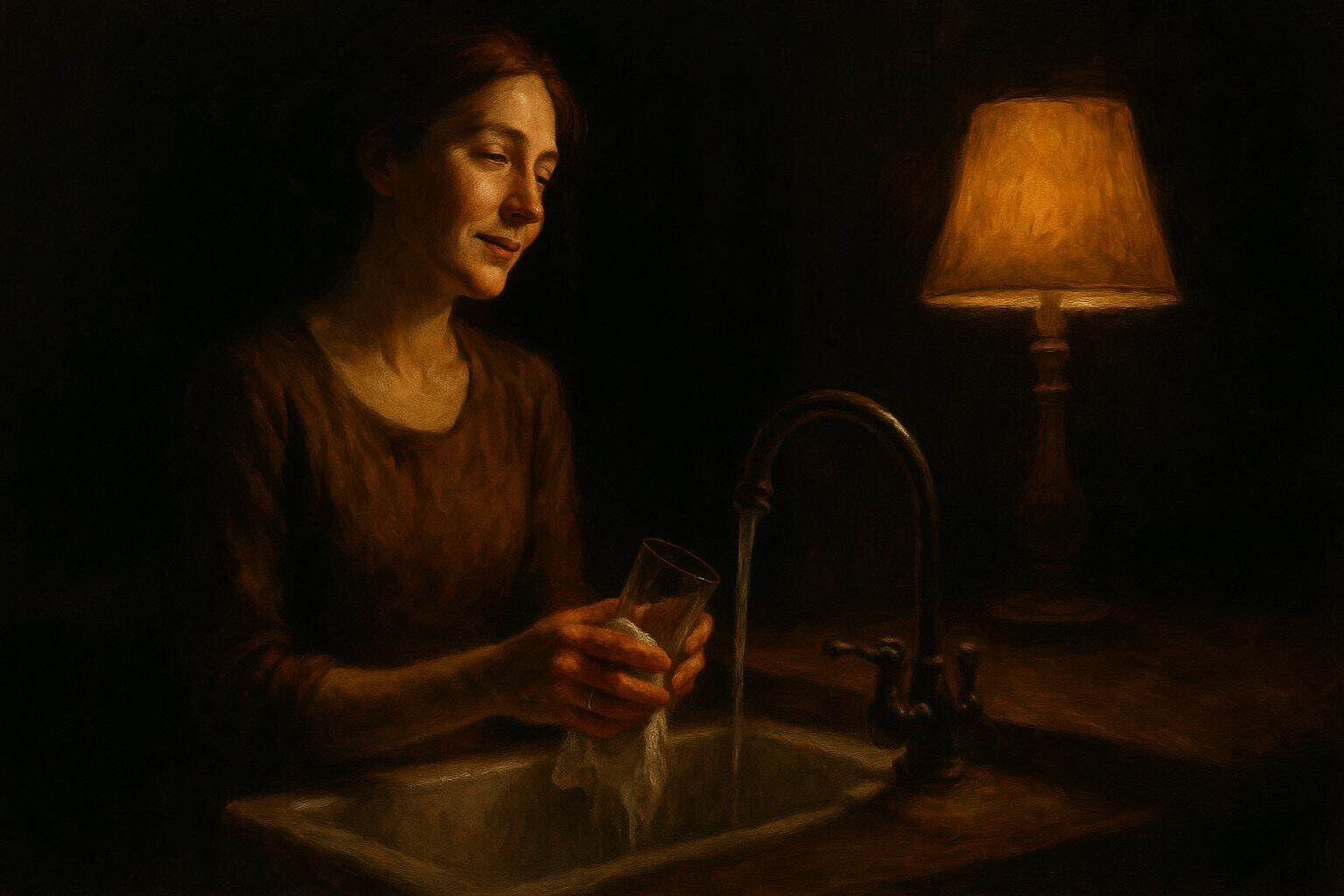
The moment arrives without announcement. Perhaps washing dishes, the warm water running over your hands, when suddenly you become aware of them—all the voices that inhabit you. Not hallucinations, not pathology, but the ordinary crowd that populates every human interior. Your mother’s worried tone when you reach for the expensive olive oil. Your first lover’s laugh at the way you still dry glasses. The colleague who would raise an eyebrow at this domestic scene. They are all here, have always been here, will always be here. Even in the most profound solitude, especially then, you discover what Adore names with terrible precision: the individual must call “each of their involvements back home to themselves… transcribing the legion of their social entanglements with their singular body.”
The Myth of the Empty Room
We tell ourselves stories about solitude. That when we close the door, we are finally alone. That privacy means singularity. That in those quiet hours before dawn or late at night, we encounter ourselves purely, without mediation. But lived experience betrays this myth immediately. Sit in an empty room and watch what happens. The space fills. Not with ghosts but with the living presence of everyone who has ever mattered, everyone who might matter, everyone whose opinion has carved even the smallest groove in your consciousness.
The phenomenon shows itself most clearly in those moments we believe ourselves most alone. Writing in a journal, you pause mid-sentence—not because you’ve lost the thought but because you’ve suddenly heard how it would sound to someone else. Which someone? The crowd offers candidates: the friend who would understand too well, the parent who would worry, the stranger who might someday read these words. Even our most private acts carry this strange publicity. We perform for an audience that is both absent and utterly present, both imaginary and more real than the walls around us.
“Feelings and thoughts from these involvements follow the individual to solitude’s door where he or she either invites them in or leaves them standing outside.”
But this is the revelation: we cannot leave them outside. They are already in. They constitute the very structure of what we call “inside.”
The Tribunal of the Everyday
Consider how you dress when no one will see you. The old sweater you reach for—but then hesitate. Why? No one is coming over. You’re not going out. Yet still you feel the weight of evaluation. Not judgment exactly, but something more subtle: the sense of being seen even in your unseenness. Merleau-Ponty understood this—how consciousness is never pure interiority but always already opened onto a world, always already intertwined with others through the very structure of perception itself.
The phenomenon intensifies in moments of decision. Alone in the grocery store, choosing between two bottles of wine. The cheaper one is perfectly fine, you tell yourself. But as your hand moves toward it, you feel them—the wine-knowledgeable friend, the date you’re hoping to have someday, the version of yourself you’re trying to become. The decision happens not in some pure space of individual will but in this crowded field of real and potential others.
This is not weakness or conformity. This is the human condition itself. As Adore observes, we exist first “per se, in a physical sense,” but we only become real through existing “for each other.” The crowd inside us is not an invasion of our authenticity but its very condition. We become individuals precisely through this multiplicity, weaving “the threads from each of these divergent roles into a singular tapestry, the self.”
The Mirror’s Secret
Stand before a mirror in solitude and watch what happens. You see yourself, yes, but more: you see yourself being seen. Even alone, especially alone, you become “both the person standing in front and behind the mirror,” yourself and your witness, “her shadow and its source.” The phenomenon of self-consciousness reveals itself as fundamentally social even in its most private moments.
This doubling pervades our entire existence. In solitude, we split: the one who lives and the one who watches the living. The one who feels and the one who evaluates the feeling. The one who thinks and the one who judges the thought. But this watcher, this evaluator, this judge—who are they? They are the internalized others, the crowd made intimate, the social world collapsed into the space of a single consciousness.
Augustine knew this in his Confessions—how even in the most private dialogue with God, he remained aware of his readers, his critics, his community. The confession that seems most solitary becomes the most populated act. “The ‘you’ I address is not a single person; the occupants of the ’empty chair’ constantly shift… And always, God sits in the empty chair.” But even God, in this phenomenology, arrives through the medium of all the others who have taught us to recognize the divine, who have shown us how to pray, who have modeled what faith looks like.
The Paradox of Authentic Solitude
Here emerges the strangest truth: genuine solitude requires not the absence of others but their full acknowledgment. Those who flee to solitude to escape the crowd only find it waiting for them, now grown monstrous in the dark. But those who enter solitude knowing they carry everyone with them—they discover something else.
Watch what happens when someone truly accepts their internal crowd. They stop performing for it. Not because the others disappear but because their presence becomes acknowledged, even welcomed. The mother’s worried voice about the olive oil—yes, she’s here. The ex-lover’s laugh—here too. The imagined future critic—present. But now they become not judges but companions in the strange journey of being human.
This is what Adore means by the “confidence in loneliness and pride in solitude.” Not the achievement of some pure isolation but the capacity to be alone with the crowd inside us, to let all these voices speak without being tyrannized by any single one. The individual who has achieved this can “transcribe the legion of their social entanglements with their singular body” without losing themselves in the transcription.
The Economy of Presence
The crowd inside us operates according to strange laws. Some voices grow stronger in solitude, others fade. Some appear only at certain hours, in certain moods, in certain spaces. The friend you haven’t spoken to in years suddenly dominates your internal dialogue while making coffee. The parent long dead still judges your financial decisions. The child you once were occasionally seizes control, usually at the worst possible moment.
But notice: we are not passive in this economy. We make choices, conscious and unconscious, about whom to invite deeper, whom to hold at bay. Some receive what Adore calls “physical benefits”—their internalized presence shapes our bodily habits, our gestures, our ways of moving through space. Others remain purely verbal, existing only as commentary. We “send nude pictures and videos… to some and not others,” even when these others exist only in the privacy of our imagination.
This selectivity reveals something crucial: the crowd inside us is not random but carefully, if unconsciously, curated. We are the doorkeepers of our own interior, even when we don’t realize we’re standing at the door.
The Resistance
Yet something in us resists this crowd. Adore speaks of it directly: “There has been, and always will be, a solitary side of me—one I never show to anyone, not even to those closest to me.” This is not another member of the crowd but something else—a depth that remains incommunicable, that cannot be shared even if we wanted to share it.
This resistance manifests in various ways. The sudden need to be alone, really alone, that sends us walking at strange hours. The secret we keep not because it’s shameful but because speaking it would somehow violate its nature. The private relationship with the divine that remains “secret,” where “my love for God has always been private, my relationship with Him personal.”
What is this irreducible privacy? Perhaps it’s what Sartre called the for-itself—that nothingness at the heart of consciousness that cannot be filled by any content, not even the crowd of others. Or perhaps it’s what the mystics know: that place where the soul touches something beyond all social construction, all human relationship, all the voices that usually fill our heads.
“A relationship with me means casting others into the fire, not for safekeeping until later, but as a step toward owning authentic individuality in solitude.”
The Dance of Revelation and Concealment
Living with the crowd inside us becomes a constant negotiation between revelation and concealment. We show different faces to different internalized others, just as we do in external social life. But the internal performance is stranger, more fluid. We can be multiple people simultaneously in the privacy of our own consciousness, shifting between roles with a speed impossible in actual social interaction.
Watch yourself preparing for a difficult conversation. You rehearse, but notice what the rehearsal involves: you play both parts, yourself and the other. You anticipate their objections, their tone, their facial expressions. You adjust your own words in response to these imagined reactions. The conversation happens first in this internal theater, with you playing all the roles.
But when the actual conversation arrives, it never follows the script. The real other always surprises, always exceeds our internalization of them. This gap between the internal crowd and the external others reveals something essential: the crowd inside us consists not of actual others but of our own consciousness shaped by its encounters with them. We carry not people but the impressions they’ve made, the ways they’ve formed us, the selves we’ve become in response to them.
The Burden and the Gift
“Most will choose to surrender autonomy and responsibility in order to find comfort in the familiar,” Adore observes. This surrender often happens not to external others but to the internalized crowd. We become what we imagine they want us to be, forgetting that these imagined wants are our own creations.
The burden of the crowd can become crushing. Every decision filtered through multiple imagined reactions. Every spontaneous impulse checked against internalized expectations. Every moment of potential freedom collapsed back into the familiar patterns of who we’ve been told we are, who we’ve learned to be.
But the crowd is also a gift. Through these internalized others, we carry the wisdom of our entire social world. The mother’s voice that warns about the expensive olive oil also carries generations of knowledge about scarcity and abundance. The friend’s imagined laughter holds years of shared joy. Even the critical voices, properly heard, offer perspectives we couldn’t achieve alone.
The Ultimate Solitude
“Finitude begins and ends with solitude. We are born alone. We die alone.” This is Adore’s stark reminder of what frames all our crowded solitude. At the boundaries of existence, the crowd falls silent. No internalized other can accompany us through birth or death. These passages we make absolutely alone.
Yet even this ultimate solitude carries its own strange companionship. The dying person, consciousness fading, may find the internal crowd gathering one last time—faces from across a lifetime appearing in the dimming theater of consciousness. The newborn, scientists tell us, carries cellular memory, biological inheritance, the accumulated wisdom of the species encoded in every fiber. We are alone but never alone, singular but always multiple.
“When old age comes and death finally takes them, no one in society can offer themselves in their place. Each person dies alone.” But dying alone doesn’t mean dying empty. We die full of everyone we’ve ever known, ever loved, ever been. The crowd inside us may be the only thing we can take with us—or perhaps it’s what we finally leave behind.
The Practice of Populated Solitude
How then shall we live with this crowd inside us? Not by trying to empty the inner room—that’s impossible and probably undesirable. Not by surrendering to the tyranny of internalized opinions—that way lies the death of authentic existence. But through what might be called a practice of populated solitude.
This practice begins with recognition. Simply noticing the crowd, acknowledging its presence, identifying its voices. Who speaks when you condemn yourself? Whose approval do you seek in your private achievements? Which internalized gaze makes you stand straighter, even when alone?
Then comes discrimination. Learning to distinguish between voices that enliven and voices that deaden. Between internalized others who call us toward our best selves and those who keep us trapped in old patterns. Between the crowd that supports authentic becoming and the crowd that demands conformity to dead images.
Finally, integration. Not choosing between solitude and sociality but recognizing they are the same phenomenon viewed from different angles. We are social beings even in our aloneness, solitary individuals even in our deepest connections. The crowd inside us is not an obstacle to authentic existence but its very medium.
The Sacred Crowd
In the end, perhaps the crowd inside us points toward something beyond both solitude and sociality. If “God sits in the empty chair,” as Adore suggests, then even our most populated inner space opens onto transcendence. The crowd becomes not just psychological but metaphysical, not just human but sacred.
This is what the contemplatives have always known: that true solitude is not emptiness but fullness, not isolation but communion. The desert fathers fled to the wilderness not to escape others but to find them more truly. In the silence of their cells, they discovered the whole human family living in their hearts.
We need not flee to any desert. The crowd is already here, inside us, waiting to be acknowledged, understood, integrated. In learning to live with this internal multitude, we learn what it means to be human—irreducibly singular yet constitutionally multiple, alone yet never alone, one yet many.
The dishes are done. The warm water has stopped running. But the crowd remains, will always remain. This is not a burden to be escaped but the very structure of human consciousness, the way we are built, the gift and challenge of being human. In recognizing the crowd inside us, we recognize ourselves—not as isolated individuals but as living nodes in the vast network of human existence, carrying all of it, all of them, all of us, in the strange solitude of a single heart.