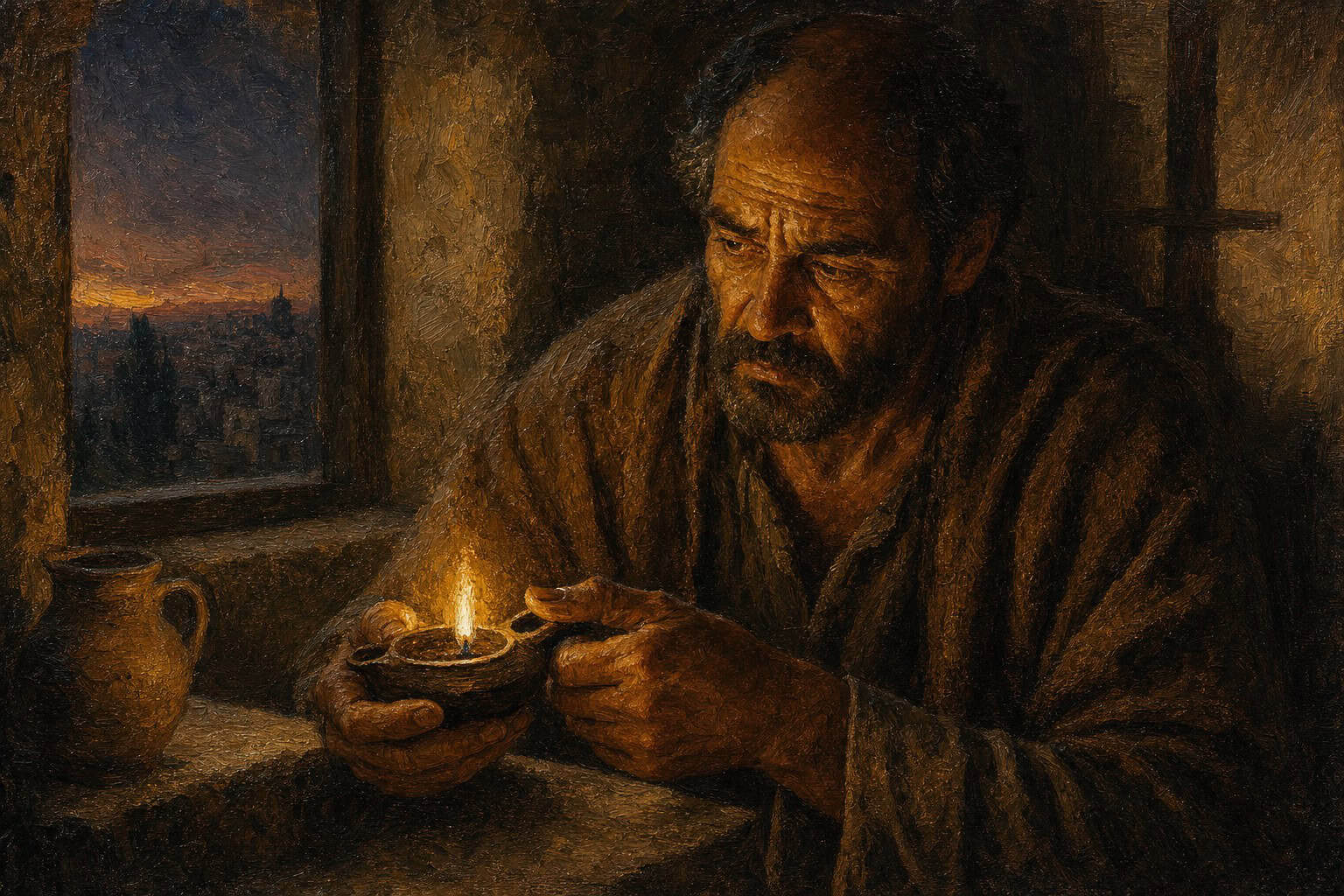
Why a man screams alone in a parked car, and the older wound underneath. A spoiler-safe reflection through Confessions to the Empty Chair.
A Fist Against the Cooling Wheel
You have heard it, or you have made it yourself. A man sits in a car that is not moving. The engine ticks as it cools under the hood. His hands lock at ten and two until the knuckles go white and the tendons stand up on the backs of his hands. Then a sound tears out of him that has no words in it at all. It is not crying, though tears may come with it, hot and unwanted. It is not rage aimed at anyone in the seat beside him, because the passenger seat is empty and the belt hangs slack. It starts low in the gut and rips up through the chest, and it leaves the throat sanded raw and the windows fogged with breath. Outside the glass the parking lot runs on ordinary business: a cart rattling, someone loading groceries, none of it touching the small sealed world where a man is coming apart. That is why you typed it into a search bar. You want someone to tell you what breaks in a person to force that sound out. The car is the last room a man owns outright. Four doors that lock from the inside, glass that shows him the whole world and keeps every inch of it out, an engine loud enough to swallow whatever climbs his throat. It is never really about the car. The car is only the small metal box where the pressure finally wins, the last private place where no one can see a face come apart. In Confessions to the Empty Chair, Anthony Adoré knows this rolling privacy. The steering wheel becomes a poor kind of altar, cold plastic under wet palms, and the noise a man makes there is the nearest thing he has to prayer once he stops believing anyone is on the other end. Notice the scream does not ask a question. It does not argue. It only bleeds. That is where this book meets you, inside the raw noise, before any explanation arrives, when the only honest thing left in the whole world is the sound itself and the shaking hands that made it. Sit inside that first sound with me before we go looking for what got sealed in, and when, and by whom.
The Raspberry Blown at a Terrified Child
The scream begins long before the car exists. It waits in the flesh for years. In the opening pages of the book, a boy of three lies in a new house at bedtime, the sheets cool, the dark unfamiliar. He has moved away from the place where the harm was first worked into him, and he believes, the way a child believes, that distance is the same as safety. Fear rises before he can name where it comes from. It starts in the stomach, in the skin, in the small hairs on the arms, long before the mind knows there is anything to fear. What he meets is not grand, and that is the whole horror of it. Not a towering figure of fire and majesty that a person could at least respect while fearing it. A small vaporous form, barely a foot tall, thin and lank, crosses into his room and lingers near the bed. It does not roar. It does not thunder. It mocks him, blows a wet and childish noise at a boy who cannot run and cannot understand and cannot call out. Darkness, when it sets out to defile a child, does not always come dressed as terror. Sometimes it comes dressed as a joke played on someone who has no way to get up and leave. This is the cruelty that later makes a man scream in a parked car and then feel a hot shame for having screamed, because he already knows how ridiculous it would sound if he tried to explain it. Evil that only frightened us we could at least describe to another person. Evil that humiliated us we cannot say aloud without hearing how insane it sounds coming out of our own mouth. The boy is branded not with a violent seizing of the body but with obsession, images that push into his waking and sleeping hours and will not leave. And notice how the body is the first to know. Before the mind assembles any story, the flesh registers the wrongness, the way the air in a room changes weight when something enters that should not be there. Desire and dread both live first in the skin. This is why the scream comes without words. The mouth sits downstream of the body, and the body has carried this since before the child had any language to hold it. The man in the lot is not being theatrical. He is being honest in the only tongue his body still trusts.
The Seam Where the Invisible Bleeds Through
The book makes a claim that will unsettle you, and it makes it without flinching. The boundary between the world we touch with our hands and the world we cannot see is not a solid wall. It is a thin, trembling seam, and for some people that seam gets torn open early, without consent, by hands that had no right to touch it. A ritual worked on a three-year-old thinned that veil, and it did not close again. The child did not ask for vision and did not want the thing that came through it. Yet from that tearing came a lifelong strangeness, a way of feeling joy and terror and beauty more sharply than the people around him, a raw openness in the flesh others do not carry. His skin seemed to read the room before his mind could. His nights held a weight that daylight never fully explained. Here the narrator says the hardest thing in the chapter, and here the scream in the car finally comes clear. Some wounds are not only damage. Some wounds are appointments. They conscript. They summon a person into a war he never enlisted for, and even the curse, looked at long enough, carries a hidden commission folded inside it. The scream is the sound of a body drafted before it could walk, handed a rifle it never asked to hold. That does not make the suffering lighter. It makes it heavier, because now the pain has a purpose the one who suffers it never agreed to serve, and cannot lay down. He longed, the way any body longs, for a life that felt like his own, unmarked, ordinary, at home in itself. Instead the flesh had been made a doorway by someone else’s will, and desire itself turned dangerous, because to want anything at all was to feel again how easily entered he had been. What did the small self do with the mockery when he understood no one would ever believe such a thing? He learned to be silent. He learned that speaking it would mark him as mad. And silence, once chosen out of fear, becomes a house a man lives in for decades, room after room, until the walls narrow to a windshield and the pressure has nowhere left to go.
The scream is not the wound; it is the body refusing to keep a secret the mouth cannot yet speak.
The Sentence That Sealed It
Years later the phone lights up in the cup holder, and it is Alex, the on-again, off-again girl he has known since the eighth grade. The self-named tomboy, the Firebird who kept a rotation of male orbiters spinning around her while she parked him in what he names the purgatory of the friend zone. In their youth she took his affection like spare change dug from a coat pocket, without counting it, and spent her real closeness on men more reckless, older or younger, never the quiet boy who waited. He calls her Ol’ Reliable, a nickname carrying a whole ledger of being wanted only when convenient. He reads it now as a slow vanishing, a self dissolving under another person’s eyes, seen exactly enough to stay in orbit and never enough to be kept. Now the accounts have turned. Her options thinned as his widened. He built a new life in a distant city, dropped the ballast of high school history, carried heartbreak and the slow, unglamorous grace of recovery. So her return should taste like a win. Instead it tastes like a test he already knows the answer to. Then she says the thing. She tells him not to use protection, claiming she does not think she can get pregnant. That single sentence detonates everything he has circled all evening. He hears in it not trust but a snare set in soft words, a line surely offered to other men, a lure baited with heightened sensation. Or worse, that she has measured him as controllable, weak enough that a pregnancy would leave her running his life after a short honeymoon. He calls himself a student of behavior, a scientist of the soul, and declares the data is in. This is the turn, and it is colder than the ache before it. The boy who once starved to be chosen now stands over the moment like a man in a lab coat. But watch what it costs him. In naming her surrender a snare, he confirms his own banishment. He has grown so fluent in reading manipulation that he can no longer receive an open hand as an open hand. Every offer looks like bait because his own reaching was slapped away too many times to count. He is right, and he is undone by being right. Real trust is careful, not careless; genuine surrender protects the beloved rather than gambling with him. When someone hands you their unguarded body as proof of feeling, they may be handing you a debt dressed as a gift, a leash dressed as an embrace.
What Gets Said After the Sound Dies Down
Seeing through her brings no rush of victory. It brings vertigo. The moment he can read the snare, he becomes fully answerable for whatever he does next, and that responsibility opens under him like a floorboard giving way. He cannot blame his own innocence anymore. His body, which spent years hungry for her, now has to sit with wanting no one who wants him only as a last resort. To read another person so accurately that you can never again be fooled is to build a life where no one can reach you either. He turns the lens hard on himself with the merciless honesty this book keeps demanding. He remembers scrubbing a roommate’s humid presence out of a shared room with bleach, chasing a sterile air because real human contact frightened him more than solitude. He remembers the mask of jokes and drink and performance he wore so no one could truly see him. Is his clear sight actual wisdom, or a wall built so high nothing tender could climb it? Did he hide his story to shield the people he loved, or the polished image of himself? Did he begin to prefer the sealed room, the small god of his own dark and private altar? He does not answer cleanly. The book refuses the easy exit. Grace here does not arrive to lift the man up and out of the car. If grace comes at all, it comes into the car, lowers itself into the empty passenger seat, and stays through the whole ugly length of the sound. Not rescue. Company. God present in the very coldness of his reading, near in the tears he lets no one witness, in the sealed cab where he went precisely to be unheard. Beneath everything runs a deeper homesickness he finally names: he was homesick for the One before whom a word can be spoken without strategy, without first measuring the listener for danger, the only ear that does not need to be read. Eventually the scream runs itself out. The throat is raw. The hands loosen one finger at a time. This is where the whole book begins, when the question shifts from why did this happen to me to what will I do with it now. He decides to speak, to spell the private groan into plain words, so the next terrified person finds a language they were sure did not exist. That is why Confessions to the Empty Chair exists at all. It will not soothe you on the cheap. It means to keep you company in the dark until the raw throat rests and the words, at last, arrive.