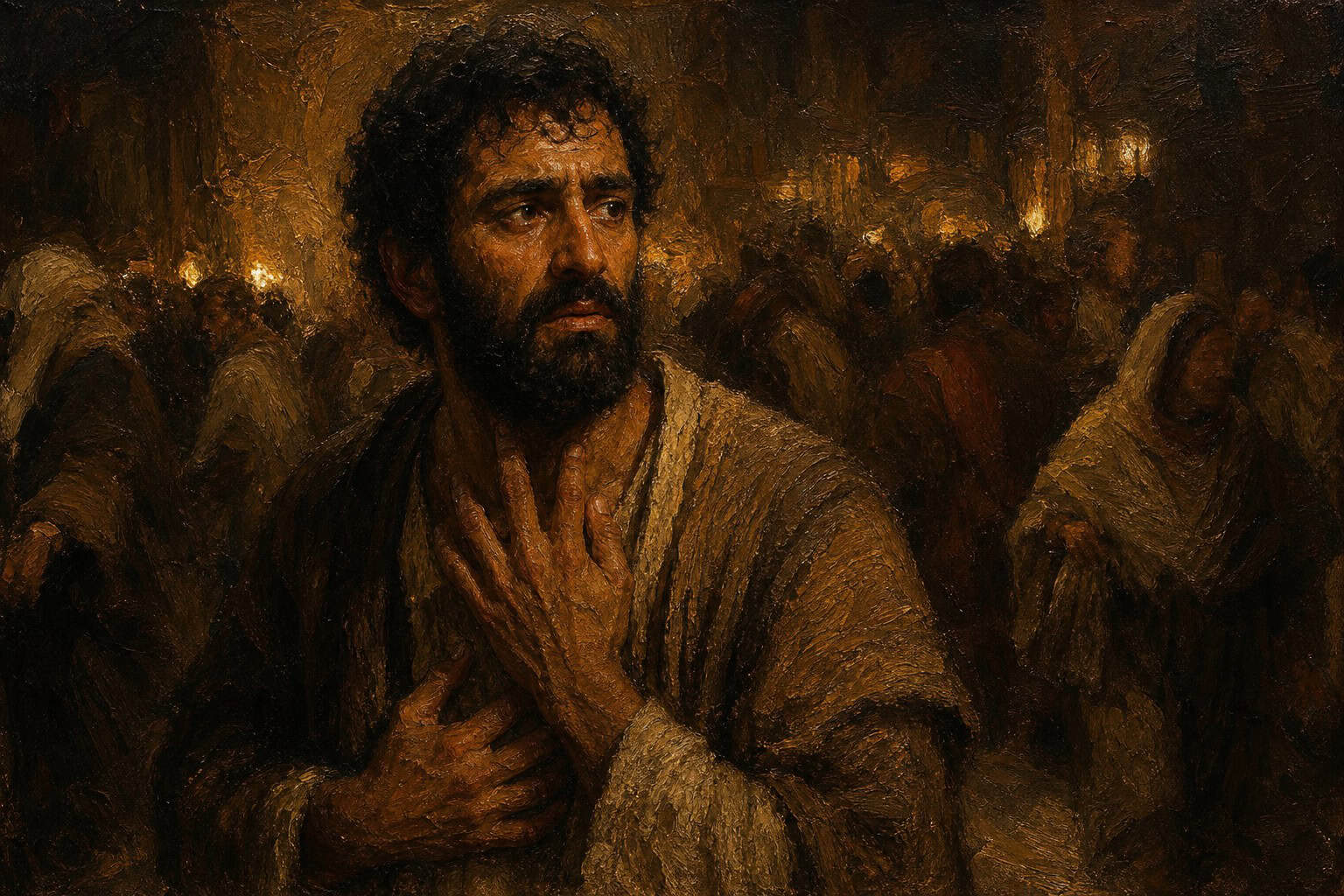
You lose yourself in a crowd because being someone specific hurts. A reflection on anonymity, shame, and the strange mercy of vanishing into the city.
Ten Thousand Bodies and No Name
Have you ever walked into a crowd on purpose, just to stop being yourself for an hour? You step off a curb into a moving mass of strangers and something in your chest goes loose. The pressure of being watched, of being known, of being the specific person with the specific record, lifts off you like a coat you didn’t know you were wearing. No one here knows your name. No one here has an opinion of your face. You are one body among ten thousand bodies, and the anonymity feels less like loneliness than like a cool cloth laid across a fever. I remember what this was for a younger version of myself in the pages of Confessions to the Empty Chair — walking into a downtown so large it dissolved the outline of who I was. The relief came fast and it came through the skin. My edges softened. The noise pressed in from every side and swallowed the sound of my own thinking. The crowd did not ask me to explain myself. It did not measure me. It did not remember what I had done or failed to do. It only moved, a great warm animal of strangers, and I moved inside it, and for a while I was no one in particular. That is the mercy a city offers a tired soul, and it is a real mercy — I will not pretend it isn’t. But it is also a trick played on a person who has grown sick of the weight of his own name. When you go looking for crowds, you are rarely looking to find yourself. You are looking to lose the unbearable specificity of being someone with wounds you cannot set down. The younger me did not understand this. He only felt the ice around his spirit begin to give a little, and he mistook the numbing for warmth. The intoxicating thing about a crowd is not connection. It is the permission to stop answering to your own eyes. And here is what I could not see then, standing in all that light and motion: I did not go downtown to belong to anyone. I went in to hide — not from the strangers, but from the one watcher who never left, the one inside my own chest who knew exactly what I had done and exactly what I still wanted. The crowd let me set him down for an hour. That is not nothing. A tired man deserves an hour. But it was not healing, and I want to be honest that I knew, even then, somewhere under the music, that the shame was only waiting. It sat patient in the dark, holding my name, ready to hand it back the moment the doors opened again.
The Comfort That Costs You Your Name
Look at what the relief actually asks of you. To be soothed by the crowd, you have to agree to become nobody. The comfort is real, but the price is printed in small letters at the bottom: you give up the self in order to escape the pain of the self. And a soul cannot vanish for long without something in it starting to spoil. I have come to see that the pleasure of anonymity carries a betrayal folded up inside it — a quiet decision to treat your own personhood as a burden instead of a gift. When the weight of being yourself grows heavy enough, disappearing feels like grace itself. But it is a counterfeit, because true grace does not erase you. It holds you. It knows your name and says it anyway. What the crowd handed me was the opposite of that. It handed me erasure and called it freedom. In that downtown I felt powerful, I felt validated, I felt alive — those exact words come back to me now with a bitter accuracy. I felt those things precisely because nobody there required me to be true. I could be anyone. I could touch the surface of the whole night and own none of it. And the thing about living on the surface is that it lets you pretend the depths are not down there at all. The mood of the entire night was set before a single thing happened. There was a felt tone of loosened responsibility, a low hum of permission running under the floor, an atmosphere in which the ordinary weight of choosing had been quietly suspended. I did not decide to feel free. I woke up already inside that freedom, colored by it, breathing it in with the smoke and the heat and the noise. That is the terrible thing about a mood — you do not pick it, you find yourself already standing in it, and it tints everything you then reach for. The older man reading this now wants to take the younger one by the shoulders, not roughly, and tell him: the comfort you are drinking down is the first betrayal of your own soul. You are teaching yourself that you can put yourself down whenever carrying you gets tiring. And that lesson does not stay behind in the city when the night ends. It comes home with you. It teaches you to vanish from the very people who love you, to sit in a room fully present in body and completely absent in name, to hand yourself over to whatever atmosphere will let you off the hook of being someone specific with a specific conscience answering for it.
The World Was Never Mine to Own
Here is the turn I could not make at eighteen. I walked into that crowd as if the whole moving world existed to relieve me — as if the city, the music, the strangers, the possibilities pressing close were all arranged there for my comfort, mine to move through and take and set back down whenever I liked. This is the deepest lie hidden inside the pleasure of anonymity, and it took me years to name it: not that I disappeared, but that I secretly believed everything else appeared for me. The vanishing was only the flattering face of a hunger to possess. If no one could see me, then no one could hold me to the fact that these were persons, not scenery — that the bodies moving near me carried names and wounds and whole histories I never once asked to know. I treated the world as mine because the crowd let me forget that it was not. And a world you believe you own is a world you have already stopped loving. The strange thing about grace is that it works the exact opposite way. It does not free you by dissolving your edges. It frees you by handing you back to yourself, on purpose, so that you can finally move toward another person without needing to swallow them whole. The world does not belong to you. That refusal is not a punishment. It is the only ground on which love can stand up and walk.
What I mistook for freedom in that crowd was really the loss of the very self that could have loved anyone at all. You cannot give what you have spent all night trying to escape. The comfort of being no one is the comfort of a soul that has quietly decided it would rather not exist than exist accountable. And God — this is what astonishes me now, this is the thing I turn over in my hands like a stone I keep finding in my pocket — God did not wait at the clean edge of that crowd for me to come back washed. He was in it. He was in the sweat and the noise and the false relief, walking close beside a boy who was hiding from himself, present in the exact place I had gone to disappear. Not lifting me out of it. Not yet. Just there, quiet, unhurried, refusing to leave the one who was working so hard to become no one. That is the thing I could not have believed if you had told me: the world was never mine, and neither, it turned out, was I. I belonged to Someone who would not let me vanish, even on the night when vanishing was the only thing I wanted, even when I would have traded my whole name to be rid of it.
The crowd does not welcome you; it forgives you the labor of being someone.
The Long Walk Back to the Dorm
The crowd always ends. The music cuts off, the doors swing open, and you are spat back out into the cold air, and the self you set down for a few hours is waiting for you exactly where you left it — heavier now, because you have just practiced abandoning it. In the pages of that book the night thins out into a walk back through empty streets, into whispered arrangements in a small room, into the ordinary machinery of decisions that follow you long after the anonymity has burned off your skin. And this is the fallout I want to be honest about: the relief of disappearing does not stay clean. It leaves a film on everything. Once you have tasted the freedom of being no one, being someone again feels like a demotion. The room shrinks. The people in it seem to want too much from you, because they want you to be specific — to choose, to stay, to mean what your body did on that floor. The mood curdles as it cools. What was intoxicating turns fascinating in the coldest possible sense, a thing studied from a great distance, as though I were watching my own life happen behind glass. That distance is the real wound the crowd left in me. I had learned to treat even the most intimate moments as data, as arrangements to be sorted, as problems to be managed rather than persons to be met and known. And so the pleasure of vanishing hardened slowly into the habit of holding everyone at arm’s length — a way of being present without being present, of being touched without being reached, of standing in a warm room with a cold place where my center should have been. The older man reading this sees the whole shape of it laid out now. The crowd did not cause this in me. The crowd only revealed and rewarded something already frozen there: a refusal to be seen and found wanting, a wish to cover myself and slip out from under my own gaze. Shame does not always look like a man hiding in the corner with his face to the wall. Sometimes it looks like disappearing into ten thousand people so that no single pair of eyes can pin you and hold you. Sometimes it looks like being the brightest thing in the room while your soul stands out in the alley, watching through the window, unwilling to be caught. I did not want to be found wanting, so I arranged, carefully, to not be found at all. And the loneliness that arrangement breeds is far worse than any crowd’s, because it does not stay downtown. It follows you into every room, every bed, every honest conversation, whispering the whole time that the real you must never, under any circumstances, be allowed to show its face.
What Waits Where the Crowd Cannot Follow
I have made my peace, slowly and against my will, with a harder mercy than the one the city offered me. Anonymity soothes the fever but it never once breaks it. What breaks it is the very thing I spent years fleeing — being seen, in full, in daylight, by eyes that already know the worst and do not look away from any of it. This is the terror and the medicine both, poured from the same cup. For a long time I believed that if I could just stay dissolved, just stay one body among many, I could outrun the reckoning forever. But you cannot love anyone from inside a crowd. You can only be jostled by it. Love needs edges. It needs a name spoken out loud. It needs you to stand still long enough to be found wanting and then to survive the finding without running. The gift I never saw coming is that God was already at this work in the exact places I went to escape Him. He did not require me to climb out of the dark before He would come near. He met me down inside it — not as a rescue that hauled me out scrubbed and blameless, but as a nearness that simply refused to let go of a boy who wanted to become no one at all. That is the quiet backbone of Confessions to the Empty Chair: not a man standing victorious over his shame with his foot on its neck, but a man discovering, one slow year at a time, that he had been accompanied the whole way down, that the One he was so busy hiding from had been walking at his shoulder in the crowd all along, patient, unbothered by the noise, impossible to shake off. The world does not belong to me. I do not even belong to me. And this, which once landed on me like a life sentence, turns out to be the one narrow way out of the loneliness of vanishing. If you know the strange comfort of losing yourself in a crowd — if you have felt your own edges go soft and mistaken the numbness for peace — then you already know the ache this book leans its whole weight against. It will not teach you to disappear more cleanly. It offers something worse and immeasurably better: the slow, unwelcome, unbelievable news that you were seen the entire time, and were not, in the end, left alone in your hiding. That the eyes you spent your whole life running from were the only ones with the power to give you your name back and mean it.