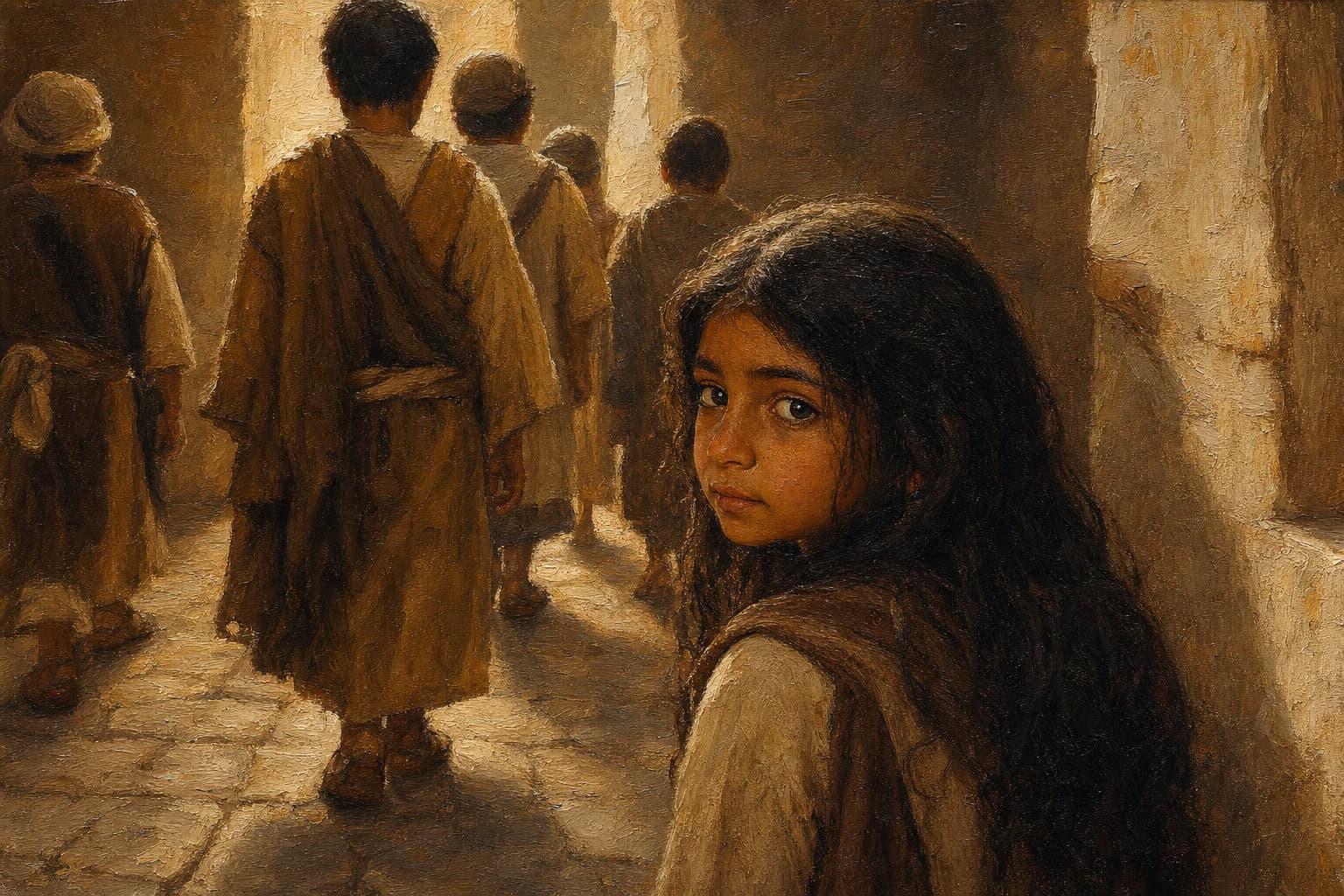
Living a double life? A boy on a gym floor, one duckling behind the flock, shows how the divided self begins long before you have words for it.
The Half-Mile Before Daylight
Have you ever kept perfect step with the people around you while knowing, in your chest, that you were somewhere else entirely? That is the question the boy in this chapter of Confessions to the Empty Chair carries onto a cold gymnasium floor. It is 1982. He is five, turning into a first-grader in a public school built decades before his birth, half a mile from the house that holds his growing family, a sister due in three months. His father wakes him before the sun is really up. The work van smells of the day’s labor already, and the man drops the boy off on his way to a job, then drives on. So the child arrives early, earlier than he needs to, deposited into a big room that is not yet full. Other kids drift in. They wait on the hard floor for a teacher to gather them the way a mother duck gathers her brood, and then to lead the little line off toward the classroom. The boy feels the floor’s cold coming up through him. He hears the shuffles, the small cries, the scrape of shoes, and he has already learned to want fewer of those sounds. Silence, by now, is his native tongue. He does not shout. He does not push into the middle of things. He waits. When the teacher finally forms the line and moves it down the hall, he does what he always does: he follows, he keeps the pace, and he sets himself just slightly behind—one duckling trailing the flock. Nobody assigns him that spot. He takes it, the way a body learns to favor one side after an injury it can no longer remember. The particulars are what break the heart here. The early hour. The borrowed light of a working man’s morning. The strictness of a building that ran on rules instead of feelings. He preferred the rules to the feelings. He liked that this place cried less than the daycare he had left behind. And in that preference lives the first quiet split: a boy who moves with everyone and belongs to no one. The tenderness this scene asks of us is not aimed at some strange child who lags behind. It is aimed at the small, careful self who had already decided that staying near but not among was the only safe way to be alive in a room full of others. That decision looks like nothing at all. It looks like a well-behaved boy holding his place in a line. It is, in truth, the opening seam of a life lived in two places at once, and he could not yet spell either one.
Fewer Sounds to Pierce the Shell
The tension gathers around a fact the narrator names plainly and then turns over with unease: he welcomed the new school because it was louder in rules and quieter in feeling. Ms. Betty’s daycare had crying. This place had order—more students, stricter instruction, a rigid way of teaching, and best of all, fewer sounds that could get past his guard. Read slowly, that preference is a wound. A child should not need armor against a first-grade classroom. But this child had come out of a home of unpredictable adults, sailing, as he later puts it, on the tides of their love and anger. The inconsistency had bred something deep and cold in him. He could not predict which face would meet him—the soft one or the hard one—and he had stopped trying. He had learned instead to read the weather of a room and to make himself small before it turned. So he built a shell. He went silent. He went efficient. He went self-contained. And here is where the double life truly begins to breathe. The shell was built to keep the chaos out. But a shell does not filter; it seals. What kept the noise from reaching him also kept him from reaching out. He became a boy who could stand in a line of children and feel the whole flock as weather passing over a stone—present to all of it, touched by none of it. The older man writing this refuses the easy story that he was simply shy, or simply gifted. He puts the harder question to himself: when did the protection curdle into hiding? When did the safe distance stop being a wall against danger and start being the very shape of his soul? A child draws the line between inside and outside early, and draws it hard—what is me, what is them, what do I let in, what do I push out so it can never reach me. He had drawn that line before he knew his own last name. The scene holds no villain in the room. The teacher is kind. The children are only children. The threat is in the air the boy brought with him, carried in his skin from the house he left that morning in the van. And that is the quiet horror of it: the double life needs no dramatic secret to keep. It needs only a child who has decided, without knowing he decided, that his real self must ride slightly behind, out of reach, where the tides of other people’s moods cannot capsize him. He kept pace. He kept apart. He sealed the door of himself and called the sealing peace, and no one in that bright, orderly building thought to ask what the quiet boy was so carefully keeping out—or in.
A Riddle in a Room Full of Children
Then comes the turn, and it arrives disguised as a compliment. Ms. Chavez, his first-grade teacher, notices him. He finishes his work with a speed that unsettles her—assignments done while the other children still labored, the boy left staring up at the decorations that hung from the ceiling, a small prisoner of a clock that would not move. He knew already that time did not run the same for everyone; his own ran fast and then stalled, leaving him marooned in the minutes. One day she asks whether he is bored. He hears the question as a kind of trap, or at least as a door that could displease her, and so he says no, though the truth was yes. He is already managing her feelings. Five years old, and already he softens his own reality to keep an adult from being upset. She gives him a special test, harder than the rest—what the district thought of as a measure of intelligence. He completes it. She keeps it. And then he catches the way she looks at him afterward, and the whole scene tilts on that look. She no longer sees a student. She sees a riddle. This is the climax, and it is a strange, cold coronation. He is about to be handpicked for a new academic program the district was building, lifted out of the ordinary flock and marked as exceptional. From the outside it is good news, the beginning of a story about a bright child recognized at last. From the inside it is something far more dangerous. The gift that sets him apart is the same force that guarantees he stays apart. To be seen as a puzzle is to not be held as a person. The very thing that might rescue him from the crowd also deepens his exile from it. And notice what he has already learned to do with being seen: he manages it. He shapes his answer. He performs the acceptable child while the real one watches from behind the eyes. The double life is now fully rehearsed. There is the boy the world selects and praises—efficient, precise, promising, the fast mind the teachers were told to look for. And there is the boy underneath, who lied to his teacher about being bored, who trails the flock on purpose, who has made silence his whole vocabulary and his whole defense. Selection is election, and it is exile, in the same breath. He is chosen. He is more alone than he has ever been. And no one in the room can tell the difference—least of all the good, watchful adults who were meant to see him and instead saw only how well he could be used.
The double life does not start with a lie you tell others; it starts with the silence you keep from yourself, keeping pace while your heart marches somewhere no one can see.
The Cost of Being Kept
What settles in after that look is not triumph but a deeper loneliness with better lighting. He carries the two selves forward now, and the split only widens as the years press on him. The narrator, writing from far down the road, does not let himself off easy. He interrogates the boy he was and the choices that boy made without knowing they were choices. Was the silence really only protection, or did he come to prefer it—to hide inside his own competence the way a snail folds into its shell, safe, admired, and utterly untouched? He remembers saying no to Ms. Chavez when the answer was yes, and he sits inside that small dishonesty as if it were the seed of something much larger. If you learn at five to hand people the version of yourself they can approve of, you may never stop handing it over. The praise becomes a currency, and the real self becomes the thing you spend it to protect. He does not wrap this in a lesson. He lets it stay raw and unfinished. The adults who should have seen the frightened child instead saw a fast mind and moved to put it to good use; their kindness and their blindness were the same gesture, offered in the same breath. And he wonders, with unflinching honesty, whether he trained them to it—whether the well-behaved, efficient, undemanding boy taught the grown-ups exactly how not to look too hard. This is the tenderness the chapter finally asks for, and it is not sentimental. It is the softening of a man toward the child he was taught to keep at arm’s length, the child he himself learned to distrust and manage. He was not cold. He was terrified. He was not calculating. He was surviving the only way a small body knows how. But the survival built a house with two rooms and no hallway between them, and he would live in that house for decades, moving from one room to the other and never letting anyone see the passage. Grace, in this book, rarely comes as rescue. It does not swoop down and undo the split or hand the boy an easy wholeness he did not earn and could not hold. What the older man begins to sense, looking back at the gym floor, is something quieter and stranger—that even in the sealed room of that morning, even in the small lie and the trailing step, something walked beside him. Not to fix it. Not yet to name it. Only to be near the child that no one else could reach, in the very place he had made unreachable.
The One Who Stayed a Half-Step Back
Where this leaves us is not resolution but recognition, and recognition is its own kind of mercy. If you typed the words double life into the dark and landed here, this chapter of Confessions to the Empty Chair offers you something better than a diagnosis: a companion. It shows you that the divided self does not begin with adultery or addiction or the dramatic secrets we usually mean by the phrase. It begins with a small body on a hard floor, keeping pace and standing apart, learning that the safest place to keep your true heart is slightly out of reach. It begins with a shell that started as protection and hardened into an address, the only place the boy knew how to live. The narrator does not pretend to have escaped it. He is still turning the riddle over, still asking who those teachers really were to him, still forgiving himself and refusing to forgive himself inside the same paragraph, still uncertain whether the gift that lifted him was a blessing or a beautifully wrapped banishment. That refusal to tidy it is exactly why the book earns your trust. It will not tell you that being seen fixes being alone, because sometimes being seen is only a more sophisticated way of hiding, and he knows it. But it holds one steady, unglamorous hope. The boy who rode a half-step behind the flock was never entirely alone back there, even when he felt most sealed inside himself. Something kept his pace too—not the teacher who called him a riddle, not the classmates who never noticed the gap, not the father in the work van already gone to his job. Something that did not need him to be efficient or exceptional or even honest to stay near him. That is where the chapter points, and it points there without raising its voice. The whole book grows out of this floor, this line of children, this one duckling behind. If you want to understand how a man ends up living two lives, begin where he began: not with the lie, but with the silence he mistook for safety, and with the nearness that was willing to sit inside the sealed room and wait for him without a word. Read the rest, and watch the seam this chapter opens run the length of a whole life—and watch what, all through the darkness, keeps its quiet step just behind him, closing the distance he never learned to close himself.